


Page 127 - JSOM Spring 2023
P. 127
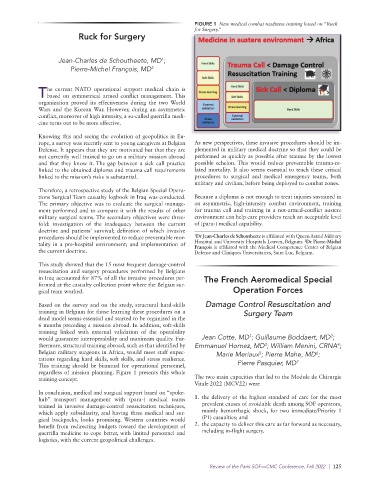
FIGURE 1  New medical combat readiness training based on “Ruck
                                                                 for Surgery.”
                           Ruck for Surgery


                    Jean-Charles de Schoutheete, MD ;
                                                      1
                        Pierre-Michel François, MD 2


                he current NATO operational support medical chain is
              Tbased  on symmetrical  armed  conflict  management.  This
              organization proved its effectiveness during the two  World
              Wars and the Korean War. However, during an asymmetric
              conflict, moreover of high intensity, a so-called guerrilla medi-
              cine turns out to be more effective.

              Knowing this and seeing the evolution of geopolitics in Eu-
              rope, a survey was recently sent to young caregivers at Belgian   As new perspectives, these invasive procedures should be im-
              Defense. It appears that they are motivated but that they are   plemented in military medical doctrine so that they could be
              not currently well trained to go on a military mission abroad   performed as quickly as possible after trauma by the lowest
              and that they know it. The gap between a sick call practice   possible echelon. This would reduce preventable trauma-re-
              linked to the obtained diploma and trauma call requirements   lated mortality. It also seems essential to teach these critical
              linked to the mission’s risks is substantial.      procedures to surgical and medical emergency teams, both
                                                                 military and civilian, before being deployed to combat zones.
              Therefore, a retrospective study of the Belgian Special Opera-
              tions Surgical Team casualty logbook in Iraq was conducted.   Because a diploma is not enough to treat injuries sustained in
              The primary objective was to evaluate the surgical manage-  an asymmetric, high-intensity  combat  environment,  training
              ment performed and to compare it with the results of other   for trauma call and training in a not-armed-conflict austere
              military surgical teams. The secondary objectives were three-  environment can help care providers reach an acceptable level
              fold: investigation of the inadequacy between the current   of (para-) medical capability.
              doctrine and patients’ survival; definition of which invasive
              procedures should be implemented to reduce preventable mor-  1 Dr Jean-Charles de Schoutheete is affiliated with Queen Astrid Military
                                                                                                     2
              tality in a pre-hospital environment; and implementation of   Hospital and University Hospitals Leuven, Belgium.  Dr Pierre-Michel
                                                                 François is affiliated with the Medical Competence Center of Belgian
              the current doctrine.                              Defense and Cliniques Universitaires, Saint Luc, Belgium.
              This study showed that the 15 most frequent damage-control
              resuscitation and surgery procedures performed by Belgians
              in Iraq accounted for 87% of all the invasive procedures per-  The French Aeromedical Special
              formed at the casualty collection point where the Belgian sur-
              gical team worked.                                             Operation Forces

              Based on the survey and on the study, structural hard-skills   Damage Control Resuscitation and
              training in Belgium for those learning these procedures on a       Surgery Team
              dead model seems essential and started to be organized in the
              6 months preceding a mission abroad. In addition, soft-skills
              training linked with external validation of the operability
                                                                                                             2
                                                                                  1
              would guarantee interoperability and maximum quality. Fur-  Jean Cotte, MD ; Guillaume Boddaert, MD ;
              thermore, structural training abroad, such as that identified by   Emmanuel Hornez, MD ; William Menini, CRNA ;
                                                                                       3
                                                                                                               4
              Belgian military surgeons in Africa, would meet staff expec-  Marie Meriaux ; Pierre Mahe, MD ;
                                                                                      5
                                                                                                        6
              tations regarding hard skills, soft skills, and stress resilience.                  7
              This  training should  be  biannual for  operational  personnel,   Pierre Pasquier, MD
              regardless of mission planning. Figure 1 presents this whole
              training concept.                                  The two main capacities that led to the Module de Chirurgie
                                                                 Vitale 2022 (MCV22) were
              In conclusion, medical and surgical support based on “spoke-
              hub” transport management with (para-) medical teams   1.  the delivery of the highest standard of care for the most
              trained  in invasive damage-control  resuscitation  techniques,   prevalent causes of avoidable death among SOF operators,
              which apply subsidiarity, and having three medical and sur-  mainly hemorrhagic shock, for two immediate/Priority 1
              gical backpacks, looks promising.  Western countries would   (P1) casualties; and
              benefit from redirecting budgets toward the development of   2.  the capacity to deliver this care as far forward as necessary,
              guerrilla medicine to cope better, with limited personnel and   including in-flight surgery.
              logistics, with the current geopolitical challenges.


                                                                     Review of the Paris SOF—CMC Conference, Fall 2022  |  125

