


Page 133 - JSOM Spring 2023
P. 133
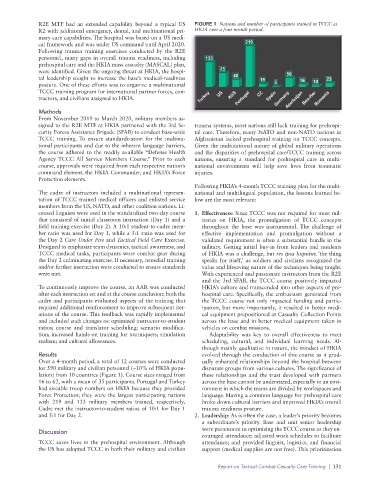
Figure 1:  Nations and number of participants trained in TCCC at HKIA
                                                                           over a four month period.
              R2E MTF had an extended capability beyond a typical US   FIGURE 1  Nations and number of participants trained in TCCC at
              R2 with additional emergency, dental, and multinational pri-    HKIA over a four month period.
              mary care capabilities. The hospital was based on a US medi-
              cal framework and was under US command until April 2020.
              Following trauma training exercises conducted by the R2E
              personnel, many gaps in overall trauma readiness, including
              prehospital care and the HKIA mass casualty (MASCAL) plan,
              were identified. Given the ongoing threat at HKIA, the hospi-
              tal leadership sought to increase the base’s medical-readiness
              posture. One of these efforts was to organize a multinational
              TCCC training program for international partner forces, con-
              tractors, and civilians assigned to HKIA.

              Methods
              From November 2019 to March 2020, military members as-
              signed to the R2E MTF at HKIA partnered with the 3rd Se-    trauma systems, most nations still lack training for prehospi-
              curity Forces Assistance Brigade (SFAB) to conduct base-wide   tal care. Therefore, many NATO and non-NATO nations in
              TCCC training.  To ensure standardization for the multina-  Afghanistan lacked prehospital training on TCCC concepts.
              tional participants and due to the inherent language barriers,   Given the multinational nature of global military operations
              the course adhered to the readily available “Defense Health   and the disparities of prehospital care/TCCC training across
              Agency TCCC All  Service  Members  Course.”  Prior  to  each   nations, ensuring a standard for prehospital care in multi-
              course, approvals were required from each respective nation’s   national environments will help save lives from traumatic
              command element, the HKIA Commander, and HKIA’s Force   injuries.
              Protection elements.
                                                                 Following HKIA’s 4-month TCCC training plan for the multi-
              The cadre of instructors included a multinational represen-  national and multilingual population, the lessons learned be-
              tation of TCCC trained medical officers and enlisted service   low are the most relevant:
              members from the US, NATO, and other coalition nations. Li-
              censed linguists were used in the standardized two-day course   1.  Effectiveness: Since TCCC was not required for most mil-
              that consisted of initial classroom instruction (Day 1) and a   itaries on HKIA, the promulgation of  TCCC concepts
              field training exercise (Day 2). A 10:1 student-to-cadre mem-  throughout the base was instrumental.  The challenge of
              ber ratio was used for Day 1, while a 5:1 ratio was used for   effective  implementation  and  promulgation  without  a
              the Day 2 Care Under Fire and Tactical Field Care Exercise.   validated requirement is often a substantial hurdle in the
              Designed to emphasize team dynamics, tactical awareness, and   military. Getting initial buy-in from leaders and residents
              TCCC medical tasks, participants wore combat gear during   of HKIA was a challenge, but res ipsa loquitur, ‘the thing
              the Day 2 culminating exercise. If necessary, remedial training   speaks for itself,’ as soldiers and civilians recognized the
              and/or further instruction were conducted to ensure standards   value and lifesaving nature of the techniques being taught.
              were met.                                            With experienced and passionate instructors from the R2E
                                                                   and the 3rd SFAB, the TCCC course positively impacted
              To continuously improve the course, an AAR was conducted   HKIA’s culture and transcended into other aspects of pre-
              after each instruction set and at the course conclusion; both the   hospital care. Specifically, the enthusiasm generated from
              cadre and participants evaluated aspects of the training that   the TCCC course not only impacted funding and partic-
              required additional reinforcement to improve subsequent iter-  ipation, but more importantly, it resulted in better medi-
              ations of the course. This feedback was rapidly implemented   cal equipment prepositioned at Casualty Collection Points
              and included such changes as: optimized instructor-to-student   across the base and in better medical equipment taken in
              ratios; course and translator scheduling; scenario modifica-  vehicles on combat missions.
              tion; increased hands-on training for tourniquets; simulation   Adaptability was key to overall effectiveness to meet
              realism; and cultural allowances.                    scheduling, cultural, and individual learning needs.  Al-
                                                                   though mainly qualitative in nature, the mindset of HKIA
              Results                                              evolved through the conduction of this course as it grad-
              Over a 4-month period, a total of 12 courses were conducted   ually enhanced relationships beyond the hospital between
              for 590 military and civilian personnel (~10% of HKIA popu-  disparate groups from various cultures. The significance of
              lation) from 10 countries (Figure 1). Course sizes ranged from   these relationships and the trust developed with partners
              16 to 62, with a mean of 35 participants. Portugal and Turkey   across the base cannot be understated, especially in an envi-
              had sizeable troop numbers on HKIA because they provided   ronment in which the teams are divided by workspaces and
              Force Protection; they were the largest participating nations   language. Having a common language for prehospital care
              with 219 and 133 military members trained, respectively.   broke down cultural barriers and improved HKIA’s overall
              Cadre met the instructor-to-student ratios of 10:1 for Day 1   trauma readiness posture.
              and 5:1 for Day 2.                                 2.  Leadership: As is often the case, a leader’s priority becomes
                                                                   a subordinate’s priority. Base and unit senior leadership
                                                                   were paramount in optimizing the TCCC course as they en-
              Discussion
                                                                   couraged attendance; adjusted work schedules to facilitate
              TCCC saves lives in the prehospital environment. Although   attendance; and provided linguist, logistics, and financial
              the US has adopted TCCC in both their military and civilian   support (medical supplies are not free). This prioritization

                                                                        Report on Tactical Combat Casualty Care Training  |  131

