


Page 99 - JSOM Fall 2022
P. 99
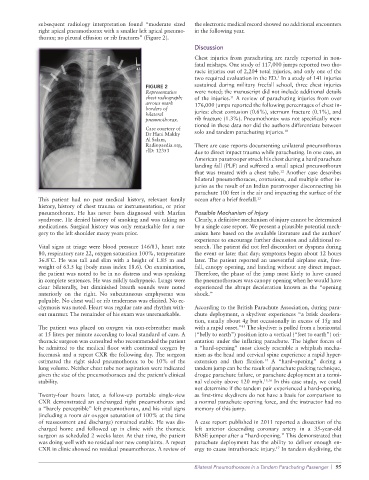
subsequent radiology interpretation found “moderate sized the electronic medical record showed no additional encounters
right apical pneumothorax with a smaller left apical pneumo in the following year.
thorax; no pleural effusion or rib fractures” (Figure 2).
Discussion
Chest injuries from parachuting are rarely reported in non
fatal mishaps. One study of 117,000 jumps reported two tho
racic injuries out of 2,204 total injuries, and only one of the
1
two required evaluation in the ED. In a study of 141 injuries
sustained during military freefall school, three chest injuries
FIGURE 2
Representative were noted; the manuscript did not include additional details
chest radiograph; of the injuries. A review of parachuting injuries from over
11
arrows mark 176,000 jumps reported the following percentages of chest in
borders of
bilateral juries: chest contusion (0.6%), sternum fracture (0.1%), and
pneumothorax. rib fracture (1.3%). Pneumothorax was not specifically men
tioned in these data nor did the authors differentiate between
Case courtesy of 10
Dr Hani Makky solo and tandem parachuting injuries.
Al Salam,
Radiopaedia.org, There are case reports documenting unilateral pneumothorax
rID: 12353 due to direct impact trauma while parachuting. In one case, an
American paratrooper struck his chest during a hard parachute
landing fall (PLF) and suffered a small apical pneumothorax
12
that was treated with a chest tube. Another case describes
bilateral pneumothoraces, contusions, and multiple other in
juries as the result of an Indian paratrooper disconnecting his
parachute 100 feet in the air and impacting the surface of the
This patient had no past medical history, relevant family ocean after a brief freefall. 13
history, history of chest trauma or instrumentation, or prior
pneumothorax. He has never been diagnosed with Marfan Possible Mechanism of Injury
syndrome. He denied history of smoking and was taking no Clearly, a definitive mechanism of injury cannot be determined
medications. Surgical history was only remarkable for a sur by a single case report. We present a plausible potential mech
gery to the left shoulder many years prior. anism here based on the available literature and the authors’
experience to encourage further discussion and additional re
Vital signs at triage were blood pressure 146/83, heart rate search. The patient did not feel discomfort or dyspnea during
80, respiratory rate 22, oxygen saturation 100%, temperature the event or later that day; symptoms began about 12 hours
36.8˚C. He was tall and slim with a height of 1.85 m and later. The patient reported an uneventful airplane exit, free
weight of 63.5 kg (body mass index 18.6). On examination, fall, canopy opening, and landing without any direct impact.
the patient was noted to be in no distress and was speaking Therefore, the phase of the jump most likely to have caused
in complete sentences. He was mildly tachypneic. Lungs were the pneumothoraces was canopy opening when he would have
clear bilaterally, but diminished breath sounds were noted experienced the abrupt deceleration known as the “opening
anteriorly on the right. No subcutaneous emphysema was shock.”
palpable. No chest wall or rib tenderness was elicited. No ec
chymosis was noted. Heart was regular rate and rhythm with According to the British Parachute Association, during para
out murmur. The remainder of his exam was unremarkable. chute deployment, a skydiver experiences “a brisk decelera
tion, usually about 4g but occasionally in excess of 15g and
The patient was placed on oxygen via nonrebreather mask with a rapid onset.” The skydiver is pulled from a horizontal
14
at 15 liters per minute according to local standard of care. A (“belly to earth”) position into a vertical (“feet to earth”) ori
thoracic surgeon was consulted who recommended the patient entation under the inflating parachute. The higher forces of
be admitted to the medical floor with continued oxygen by a “hardopening” most closely resemble a whiplash mecha
facemask and a repeat CXR the following day. The surgeon nism as the head and cervical spine experience a rapid hyper
estimated the right sided pneumothorax to be 10% of the extension and then flexion. A “hardopening” during a
14
lung volume. Neither chest tube nor aspiration were indicated tandem jump can be the result of parachute packing technique,
given the size of the pneumothoraces and the patient’s clinical drogue parachute failure, or parachute deployment at a termi
stability. nal velocity above 120 mph. 15,16 In this case study, we could
not determine if the tandem pair experienced a hardopening,
Twentyfour hours later, a followup portable singleview as firsttime skydivers do not have a basis for comparison to
CXR demonstrated an unchanged right pneumothorax and a normal parachute opening force, and the instructor had no
a “barely perceptible” left pneumothorax, and his vital signs memory of this jump.
(including a room air oxygen saturation of 100% at the time
of reassessment and discharge) remained stable. He was dis A case report published in 2011 reported a dissection of the
charged home and followed up in clinic with the thoracic left anterior descending coronary artery in a 35yearold
surgeon as scheduled 2 weeks later. At that time, the patient BASE jumper after a “hardopening.” This demonstrated that
was doing well with no residual nor new complaints. A repeat parachute deployment has the ability to deliver enough en
CXR in clinic showed no residual pneumothorax. A review of ergy to cause intrathoracic injury. In tandem skydiving, the
17
Bilateral Pneumothoraces in a Tandem Parachuting Passenger | 95

