


Page 98 - JSOM Fall 2022
P. 98
Bilateral Pneumothoraces in a
Tandem Parachuting Passenger Without Traumatic Impact
A Case Report
2
3
1
Preston J. Fedor, MD *; Brian Riley, MA ; Daniel A. Fowl, NRP ; Anthony Donahue, NRP 4
ABSTRACT
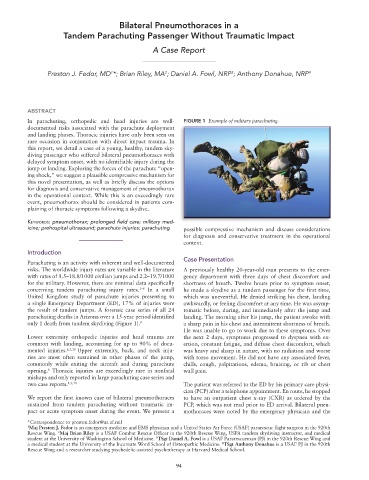
In parachuting, orthopedic and head injuries are well FIGURE 1 Example of military parachuting.
documented risks associated with the parachute deployment
and landing phases. Thoracic injuries have only been seen on
rare occasion in conjunction with direct impact trauma. In
this report, we detail a case of a young, healthy, tandem sky
diving passenger who suffered bilateral pneumothoraces with
delayed symptom onset, with no identifiable injury during the
jump or landing. Exploring the forces of the parachute “open
ing shock,” we suggest a plausible compressive mechanism for
this novel presentation, as well as briefly discuss the options
for diagnosis and conservative management of pneumothorax
in the operational context. While this is an exceedingly rare
event, pneumothorax should be considered in patients com
plaining of thoracic symptoms following a skydive.
Keywords: pneumothorax; prolonged field care; military med-
icine; prehospital ultrasound; parachute injuries; parachuting possible compressive mechanism and discuss considerations
for diagnosis and conservative treatment in the operational
context.
Introduction
Case Presentation
Parachuting is an activity with inherent and welldocumented
risks. The worldwide injury rates are variable in the literature A previously healthy 20yearold man presents to the emer
with rates of 1.5–18.8/1000 civilian jumps and 2.2–19.7/1000 gency department with three days of chest discomfort and
for the military. However, there are minimal data specifically shortness of breath. Twelve hours prior to symptom onset,
concerning tandem parachuting injury rates. In a small he made a skydive as a tandem passenger for the first time,
1–8
United Kingdom study of parachute injuries presenting to which was uneventful. He denied striking his chest, landing
a single Emergency Department (ED), 17% of injuries were awkwardly, or feeling discomfort at any time. He was asymp
the result of tandem jumps. A forensic case series of all 24 tomatic before, during, and immediately after the jump and
parachuting deaths in Arizona over a 15year period identified landing. The morning after his jump, the patient awoke with
only 1 death from tandem skydiving (Figure 1). 9 a sharp pain in his chest and intermittent shortness of breath.
He was unable to go to work due to these symptoms. Over
Lower extremity orthopedic injuries and head trauma are the next 2 days, symptoms progressed to dyspnea with ex
common with landing, accounting for up to 90% of docu ertion, constant fatigue, and diffuse chest discomfort, which
mented injuries. 6,7,10 Upper extremity, back, and neck inju was heavy and sharp in nature, with no radiation and worse
ries are most often sustained in other phases of the jump, with torso movement. He did not have any associated fever,
commonly while exiting the aircraft and during parachute chills, cough, palpitations, edema, bruising, or rib or chest
opening. Thoracic injuries are exceedingly rare in nonfatal wall pain.
6
mishaps and only reported in large parachuting case series and
two case reports. 1,3,10 The patient was referred to the ED by his primary care physi
cian (PCP) after a telephone appointment. En route, he stopped
We report the first known case of bilateral pneumothoraces to have an outpatient chest xray (CXR) as ordered by the
sustained from tandem parachuting without traumatic im PCP, which was not read prior to ED arrival. Bilateral pneu
pact or acute symptom onset during the event. We present a mothoraces were noted by the emergency physician and the
*Correspondence to preston.fedor@us.af.mil
1 Maj Preston J. Fedor is an emergency medicine and EMS physician and a United States Air Force (USAF) pararescue flight surgeon in the 920th
2
Rescue Wing. Maj Brian Riley is a USAF Combat Rescue Officer in the 920th Rescue Wing, USPA tandem skydiving instructor, and medical
3
student at the University of Washington School of Medicine. TSgt Daniel A. Fowl is a USAF Pararescueman (PJ) in the 920th Rescue Wing and
4
a medical student at the University of the Incarnate Word School of Osteopathic Medicine. TSgt Anthony Donahue is a USAF PJ in the 920th
Rescue Wing and a researcher studying psychedelicassisted psychotherapy at Harvard Medical School.
94
94

