


Page 52 - JSOM Fall 2022
P. 52
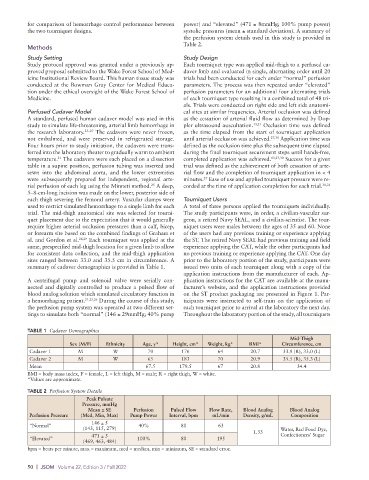
for comparison of hemorrhage control performance between power) and “elevated” (471 ± 8mmHg; 100% pump power)
the two tourniquet designs. systolic pressures (mean ± standard deviation). A summary of
the perfusion system details used in this study is provided in
Table 2.
Methods
Study Setting Study Design
Study protocol approval was granted under a previously ap Each tourniquet type was applied midthigh to a perfused ca
proved proposal submitted to the Wake Forest School of Med daver limb and evaluated in single, alternating order until 20
icine Institutional Review Board. This human tissue study was trials had been conducted for each under “normal” perfusion
conducted at the Bowman Gray Center for Medical Educa parameters. The process was then repeated under “elevated”
tion under the ethical oversight of the Wake Forest School of perfusion parameters for an additional four alternating trials
Medicine. of each tourniquet type resulting in a combined total of 48 tri
als. Trials were conducted on right side and left side anatomi
Perfused Cadaver Model cal sites at similar frequencies. Arterial occlusion was defined
A standard, perfused human cadaver model was used in this as the cessation of arterial fluid flow as determined by Dop
study to simulate lifethreatening, arterial limb hemorrhage in pler ultrasound auscultation. 13,21 Occlusion time was defined
the research laboratory. 25–27 The cadavers were never frozen, as the time elapsed from the start of tourniquet application
not embalmed, and were preserved in refrigerated storage. until arterial occlusion was achieved. 27,30 Application time was
Four hours prior to study initiation, the cadavers were trans defined as the occlusion time plus the subsequent time elapsed
ferred into the laboratory theater to gradually warm to ambient during the final tourniquet securement steps until handsfree,
temperature. The cadavers were each placed on a dissection completed application was achieved. 13,27,30 Success for a given
21
table in a supine position, perfusion tubing was inserted and trial was defined as the achievement of both cessation of arte
sewn into the abdominal aorta, and the lower extremities rial flow and the completion of tourniquet application in < 4
27
were subsequently prepared for independent, regional arte minutes. Ease of use and applied tourniquet pressure were re
rial perfusion of each leg using the Minneti method. A deep, corded at the time of application completion for each trial. 30,31
25
5–8cmlong incision was made on the lower, posterior side of
each thigh severing the femoral artery. Vascular clamps were Tourniquet Users
used to restrict simulated hemorrhage to a single limb for each A total of three persons applied the tourniquets individually.
trial. The midthigh anatomical site was selected for tourni The study participants were, in order, a civilianvascular sur
quet placement due to the expectation that it would generally geon, a retired Navy SEAL, and a civilianscientist. The tour
require higher arterial occlusion pressures than a calf, bicep, niquet users were males between the ages of 35 and 60. None
or forearm site based on the combined findings of Graham et of the users had any previous training or experience applying
al. and Gordon et al. 28,29 Each tourniquet was applied at the the ST. The retired Navy SEAL had previous training and field
same, prespecified midthigh location for a given limb to allow experience applying the CAT, while the other participants had
for consistent data collection, and the midthigh application no previous training or experience applying the CAT. One day
sites ranged between 33.0 and 35.5 cm in circumference. A prior to the laboratory portion of the study, participants were
summary of cadaver demographics is provided in Table 1. issued two units of each tourniquet along with a copy of the
application instructions from the manufacturer of each. Ap
A centrifugal pump and solenoid valve were serially con plication instructions for the CAT are available at the manu
nected and digitally controlled to produce a pulsed flow of facturer’s website, and the application instructions provided
blood analog solution which simulated circulatory function in on the ST product packaging are presented in Figure 1. Par
a hemorrhaging patient. 21,25,26 During the course of this study, ticipants were instructed to selftrain on the application of
the perfusion pump system was operated at two different set each tourniquet prior to arrival at the laboratory the next day.
tings to simulate both “normal” (146 ± 29mmHg; 40% pump Throughout the laboratory portion of the study, all tourniquets
TABLE 1 Cadaver Demographics
Mid-Thigh
Sex (M/F) Ethnicity Age, y* Height, cm* Weight, kg* BMI* Circumference, cm
Cadaver 1 M W 70 176 64 20.7 33.9 (R), 33.0 (L)
Cadaver 2 M W 65 183 70 20.9 35.5 (R), 35.3 (L)
Mean 67.5 179.5 67 20.8 34.4
BMI = body mass index, F = female, L = left thigh, M = male; R = right thigh, W = white.
*Values are approximate.
TABLE 2 Perfusion System Details
Peak Pulsate
Pressure, mmHg
Mean ± SE Perfusion Pulsed Flow Flow Rate, Blood Analog Blood Analog
Perfusion Pressure (Med, Min, Max) Pump Power Interval, bpm mL/min Density, g/mL Composition
146 ± 5
“Normal” 40% 80 63
(143, 115, 279) Water, Red Food Dye,
1.33
471 ± 3 Confectioners’ Sugar
“Elevated” 100% 80 195
(469, 463, 484)
bpm = beats per minute, max = maximum, med = median, min = minimum, SE = standard error.
50 | JSOM Volume 22, Edition 3 / Fall 2022

