


Page 68 - JSOM Summer 2022
P. 68
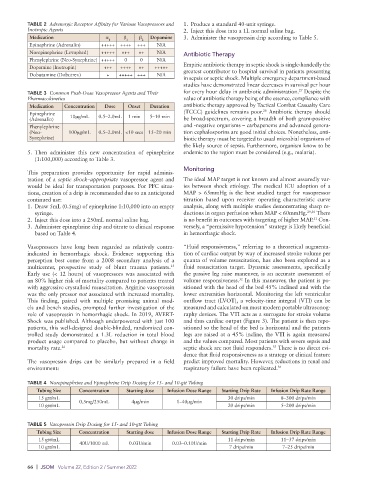
TABLE 2  Adrenergic Receptor Affinity for Various Vasopressors and   1.  Produce a standard 40-unit syringe.
          Inotropic Agents                                   2.  Inject this dose into a 1L normal saline bag.
           Medication               α 1  β 1   β 2  Dopamine  3.  Administer the vasopressin drip according to Table 5.
           Epinephrine (Adrenalin)  +++++  ++++  +++  N/A
           Norepinephrine (Levophed)  +++++  +++  ++  N/A    Antibiotic Therapy
           Phenylephrine (Neo-Synephrine) +++++  0  0  N/A
           Dopamine (Inotropin)    +++  ++++  ++    +++++    Empiric antibiotic therapy in septic shock is single-handedly the
                                                             greatest contributor to hospital survival in patients presenting
           Dobutamine (Dobutrex)    +   +++++ +++   N/A
                                                             in sepsis or septic shock. Multiple emergency department-based
                                                             studies have demonstrated linear decreases in survival per hour
                                                                                                   27
          TABLE 3  Common Push-Dose Vasopressor Agents and Their   for every hour delay in antibiotic administration.  Despite the
          Pharmacokinetics                                   value of antibiotic therapy being of the essence, compliance with
           Medication  Concentration  Dose  Onset  Duration  antibiotic therapy approved by Tactical Combat Casualty Care
                                                                                       28
           Epinephrine   10mg/mL  0.5–2.0mL  1 min  5–10 min  (TCCC) guidelines remains poor.  Antibiotic therapy should
           (Adrenalin)                                       be broad-spectrum, covering a breadth of both gram- positive
           Phenylephrine                                     and -negative organisms – carbapenems and advanced genera-
           (Neo-       100mg/mL  0.5–2.0mL <10 secs  15–20 min  tion cephalosporins are good initial choices. Nonetheless, anti-
           Synephrine)                                       biotic therapy must be targeted to usual microbial organisms of
                                                             the likely source of sepsis. Furthermore, organism know to be
          5.  Then administer this new concentration of epinephrine   endemic to the region must be considered (e.g., malaria).
            (1:100,000) according to Table 3.
                                                             Monitoring
          This preparation provides opportunity for rapid adminis-
          tration of a septic shock–appropriate vasopressor agent and   The ideal MAP target is not known and almost assuredly var-
          would be ideal for transportation purposes. For PFC situa-  ies between shock etiology. The medical ICU adoption of a
          tions, creation of a drip is recommended due to an anticipated   MAP > 65mmHg is the best studied target for vasopressor
          continued use:                                     titration based upon receiver operating characteristic curve
          1.  Draw 5mL (0.5mg) of epinephrine 1:10,000 into an empty   analysis, along with multiple studies demonstrating sharp re-
            syringe.                                         ductions in organ perfusion when MAP < 60mmHg. 29,30  There
          2.  Inject this dose into a 250mL normal saline bag.  is no benefit in outcomes with targeting of higher MAP.  Con-
                                                                                                        31
          3.  Administer epinephrine drip and titrate to clinical response   versely, a “permissive hypotension” strategy is likely beneficial
            based on Table 4.                                in hemorrhagic shock.

          Vasopressors have long been regarded as relatively contra-  “Fluid responsiveness,” referring to a theoretical augmenta-
          indicated in hemorrhagic shock. Evidence supporting this   tion of cardiac output by way of increased stroke volume per
          perception best come from a 2008 secondary analysis of a   quanta of volume resuscitation, has also been explored as a
          multicenter, prospective study of blunt trauma patients.    fluid resuscitation target. Dynamic assessments, specifically
                                                         25
          Early  use  (< 12  hours)  of  vasopressors  was  associated  with   the passive leg raise maneuver, is an accurate assessment of
          an 80% higher risk of mortality compared to patients treated   volume responsiveness.  In this maneuver, the patient is po-
                                                                               32
          with aggressive crystalloid resuscitation. Arginine vasopressin   sitioned with the head of the bed 45% inclined and with the
          was the only pressor not associated with increased mortality.   lower extremities horizontal. Monitoring the left ventricular
          This  finding, paired  with  multiple  promising animal  mod-  outflow tract (LVOT), a velocity-time integral (VTI) can be
          els and bench studies, prompted further investigation of the   measured and calculated on most modern portable ultrasonog-
          role of vasopressin in hemorrhagic shock. In 2019, AVERT-  raphy devices. The VTI acts as a surrogate for stroke volume
          Shock was published. Although underpowered with just 100   and thus cardiac output (Figure 3). The patient is then repo-
          patients, this well-designed double-blinded, randomized con-  sitioned so the head of the bed is horizontal and the patients
          trolled study demonstrated a 1.3L reduction in total blood   legs are raised at a 45% incline, the VTI is again measured
          product usage compared to placebo, but without change in   and the values compared. Most patients with severe sepsis and
          mortality rate. 26                                 septic shock are not fluid responders.  There is no direct evi-
                                                                                          33
                                                             dence that fluid responsiveness as a strategy or clinical feature
          The vasopressin drips can be similarly prepared in a field   predict improved mortality. However, reductions in renal and
          environment:                                       respiratory failure have been replicated. 34

          TABLE 4  Norepinephrine and Epinephrine Drip Dosing for 15- and 10-gtt Tubing
             Tubing Size   Concentration  Starting dose  Infusion Dose Range  Starting Drip Rate  Infusion Drip Rate Range
              15 gtt/mL    0.5mg/250mL      4mg/min        1–40mg/min      30 drips/min      8–300 drips/min
              10 gtt/mL                                                    20 drips/min      5–200 drips/min


          TABLE 5  Vasopressin Drip Dosing for 15- and 10-gtt Tubing
             Tubing Size   Concentration  Starting dose  Infusion Dose Range  Starting Drip Rate  Infusion Drip Rate Range
              15 gtt/mL    40U/1000 mL     0.03U/min     0.03–0.10U/min    11 drips/min      11–37 drips/min
              10 gtt/mL                                                     7 drips/min      7–25 drips/min


          66  |  JSOM   Volume 22, Edition 2 / Summer 2022

