


Page 73 - JSOM Summer 2022
P. 73
40
              Acute or chronically anemic patients can present with a spec-  limiting laboratory evaluation.  Furthermore, in the setting
              trum of symptoms, including dyspnea, weakness, fatigue, ir-  of acute hemorrhage, initial testing may not demonstrate ane-
              ritability, and headache, and most will not demonstrate any   mia; therefore, repeat testing should be performed as indicated
                                                                                                              1
              visible evidence of active bleeding. 1–3,9,22  Many symptoms may   with vital sign changes or following resuscitation measures.  If
              not manifest until hemoglobin levels fall below 7g/dL, given   finger prick samples are used for point-of-care testing, medics
              potential compensatory mechanisms, although there is sparse   must remember that inaccuracies may occur because of de-
              literature to directly correlate laboratory values and symptom   creased capillary flow in cold or shock patients, or simple di-
              onset. 1–3,20  Patients with chronic anemia may have significantly   lution from interstitial fluid shifts. 41
              lower hemoglobin levels with only mild symptoms, given grad-
              ual rates of decline and ongoing adaptations.      Other indices found on traditional laboratory evaluation, such
                                                                 as hematocrit and RBC values, are derived from the hemo-
              Initial findings of the acutely anemic patient may reveal he-  globin  concentration. 1,3,42   If  available,  this  information  can
              modynamic instability, including hypotension, tachycardia,   further characterize the anemia and help narrow its etiology,
              tachypnea, and even hypoxemia. 1,20,26,27  The presence of fever   primarily through the use of RDW and MCV. The MCV can
              and considerations of anemia should prompt concerns for ma-  help  delineate  anemia  between  microcytic,  normocytic,  and
              laria in endemic regions, other infections, or such acute he-  macrocytic classifications, thus narrowing etiologies (Table 2).
                                            39
              molytic anemias as DIC, HUS, or TTP.  Additional signs and   Overlap can occur between these groups, especially with
              symptoms include decreased urine output, increased thirst, and   iron-deficiency anemia (IDA). Although MCV values may not
              altered mental status. Vital sign changes in anemia are incon-  be available in an austere setting, differential diagnoses based
              sistent and can change with patient demographics (primarily   on these levels are discussed here for further consideration in
              age), as well as possible comorbidities and medication usage.   the setting of the atraumatic anemia patient in an austere set-
              Pediatric patients may have delayed vital sign changes. 1,20    ting. Despite these expected limitations, the traditional differ-
              Older patients do not consistently demonstrate compensatory   ential for causes of anemia will be briefly discussed.
              responses, and the use of such medications as beta-blockers
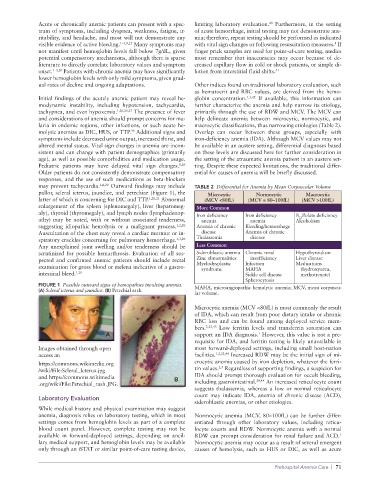
              may prevent tachycardia. 1,6,20  Outward findings may include   TABLE 2  Differential for Anemia by Mean Corpuscular Volume
              pallor, scleral icterus, jaundice, and petechiae (Figure 1), the   Microcytic    Normocytic    Macrocytic
              latter of which is concerning for DIC and TTP. 1,20,21  Abnormal   (MCV <80fL)  (MCV = 80–100fL)  (MCV >100fL)
              enlargement of the spleen (splenomegaly), liver (hepatomeg-  More Common
              aly), thyroid (thyromegaly), and lymph nodes (lymphadenop-  Iron deficiency   Iron deficiency   B /folate deficiency
                                                                                                   12
              athy) may be noted, with or without associated tenderness,   anemia  anemia         Alcoholism
              suggesting idiopathic hemolysis or a malignant process. 1,2,20    Anemia of chronic   Bleeding/hemorrhage
              Auscultation of the chest may reveal a cardiac murmur or in-  disease  Anemia of chronic
              spiratory crackles concerning for pulmonary hemorrhage. 1,3,20    Thalassemia  disease
              Any unexplained joint swelling and/or tenderness should be   Less Common
              scrutinized for possible hemarthrosis. Evaluation of all sus-  Sideroblastic anemia  Chronic renal   Hypothyroidism
              pected  and confirmed  anemic  patients  should include  rectal   Zinc abnormalities  insufficiency  Liver disease
              examination for gross blood or melena indicative of a gastro-  Myelodysplastic   Infection  Medications
                                                                   syndrome
                                                                                 MAHA
                                                                                                   (hydroxyurea,
              intestinal bleed. 1,20                                             Sickle cell disease  methotrexate)
                                                                                 Spherocytosis
              FIGURE 1  Possible outward signs of hemopathies involving anemia.   MAHA, microangiopathic hemolytic anemia; MCV, mean corpuscu-
              (A) Scleral icterus and jaundice. (B) Petechial rash.
                                                                 lar volume.
                                                                 Microcytic anemia (MCV <80fL) is most commonly the result
                                                                 of IDA, which can result from poor dietary intake or chronic
                                                                 RBC loss and can be found among deployed service mem-
                                                                 bers. 2,22,43  Low ferritin levels and transferrin saturation can
                                                                                     1
                                    A                            support an IDA diagnosis.  However, this value is not a pre-
                                                                 requisite for IDA, and ferritin testing is likely unavailable in
              Images obtained through open                       most forward-deployed settings, including small host-nation
              access at:                                         facilities. 1,2,22,44  Increased RDW may be the initial sign of mi-
              https://commons.wikimedia.org                      crocytic anemia caused by iron depletion, whatever the ferri-
                                                                        2,3
              /wiki/File:Scleral_Icterus.jpg                     tin values.  Regardless of supporting findings, a suspicion for
              and https://commons.wikimedia               B      IDA should prompt thorough evaluation for occult bleeding,
              .org/wiki/File:Petechial_rash.JPG.                 including gastrointestinal. 20,44  An increased reticulocyte count
                                                                 suggests thalassemia, whereas a low or normal reticulocyte
                                                                 count may indicate IDA, anemia of chronic disease (ACD),
              Laboratory Evaluation
                                                                 sideroblastic anemias, or other etiologies.
              While medical history and physical examination may suggest
              anemia, diagnosis relies on laboratory testing, which in most   Normocytic anemia (MCV, 80–100fL) can be further differ-
              settings comes from hemoglobin levels as part of a complete   entiated through other laboratory values, including reticu-
              blood count panel. However, complete testing may not be   locyte counts and RDW. Normocytic anemia with a normal
              available in forward-deployed settings, depending on ancil-  RDW can prompt consideration for renal failure and ACD.
                                                                                                                1
              lary medical support, and hemoglobin levels may be available   Normocytic anemia may occur as a result of several emergent
              only through an iSTAT or similar point-of-care testing device,   causes of hemolysis, such as HUS or DIC, as well as acute

                                                                                           Prehospital Anemia Care  |  71

