


Page 75 - JSOM Summer 2022
P. 75
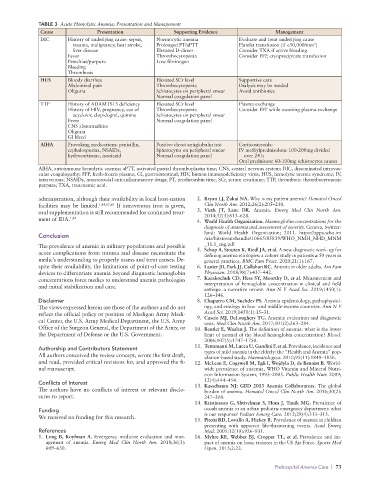
TABLE 3  Acute Hemolytic Anemia: Presentation and Management
              Cause              Presentation             Supporting Evidence              Management
              DIC      History of underlying cause: sepsis,   Normocytic anemia  Evaluate and treat underlying cause
                         trauma, malignancy, heat stroke,    Prolonged PT/aPTT  Platelet transfusion (if <50,000/mm )
                                                                                                        3
                         liver disease              Elevated D-dimer           Consider TXA if active bleeding
                       Fever                        Thrombocytopenia           Consider FFP, cryoprecipitate transfusion
                       Petechiae/purpura            Low fibrinogen
                       Bleeding
                       Thrombosis
              HUS      Bloody diarrhea              Elevated SCr level         Supportive care
                       Abdominal pain               Thrombocytopenia           Dialysis may be needed
                       Oliguria                     Schistocytes on peripheral smear  Avoid antibiotics
                                                    Normal coagulation panel
              TTP      History of ADAMTS13 deficiency  Elevated SCr level      Plasma exchange
                       History of HIV, pregnancy, use of   Thrombocytopenia    Consider FFP while awaiting plasma exchange
                         acyclovir, clopidogrel, quinine  Schistocytes on peripheral smear
                       Fever                        Normal coagulation panel
                       CNS abnormalities
                       Oliguria
                       GI bleed
              AIHA     Provoking medications: penicillin,   Positive direct antiglobulin test  Corticosteroids:
                       cephalosporins, NSAIDs,      Spherocytes on peripheral smear  IV methylprednisolone 100-200mg divided
                       hydrocortisone, isoniazid    Normal coagulation panel     over 24 h
                                                                               Oral prednisone 60-100mg schistocytes causes
              AIHA, autoimmune hemolytic anemia; aPTT, activated partial thromboplastin time; CNS, central nervous system; DIC, disseminated intravas-
              cular coagulopathy; FFP, fresh-frozen plasma; GI, gastrointestinal; HIV, human immunodeficiency virus; HUS, hemolytic uremic syndrome; IV,
              intravenous; NSAIDs, nonsteroidal anti-inflammatory drugs; PT, prothrombin time; SCr, serum creatinine; TTP, thrombotic thrombocytopenic
              purpura; TXA, tranexamic acid.

              administration, although their availability in local host-nation   2.  Bryan LJ, Zakai NA. Why is my patient anemic? Hematol Oncol
              facilities  may  be  limited. 1,44,67,68   If  intravenous  iron  is  given,   Clin North Am. 2012;26(2):205–230.
              oral supplementation is still recommended for continued treat-  3.  Vieth JT, Lane DR. Anemia.  Emerg Med Clin North Am.
                                                                    2014;32(3):613–628.
              ment of IDA. 1,44                                  4.  World Health Organization. Haemoglobin concentrations for the
                                                                    diagnosis of anaemia and assessment of severity. Geneva, Switzer-
                                                                    land: World Health Organization; 2011.  https://apps.who.int
              Conclusion                                            /iris/bitstream/handle/10665/85839/WHO_NMH_NHD_MNM
              The prevalence of anemia in military populations and possible   _11.1_eng.pdf
              acute complications from trauma and disease necessitate the   5.  Schop A, Stouten K, Riedl JA, et al. A new diagnostic work-up for
                                                                    defining anemia etiologies: a cohort study in patients ≥ 50 years in
              medic’s understanding to properly assess and treat causes. De-  general practices. BMC Fam Pract. 2020;21(1):167.
              spite their availability, the limitations of point-of-care testing   6.  Lanier JB, Park JJ, Callahan RC. Anemia in older adults. Am Fam
              devices to differentiate anemia beyond diagnostic hemoglobin   Physician. 2018;98(7):437–442.
              concentrations force medics to understand anemia pathologies   7.  Karakochuk CD, Hess SY, Moorthy D, et al. Measurement and
              and initial stabilization and care.                   interpretation of hemoglobin concentration in clinical and field
                                                                    settings: a narrative review. Ann N Y Acad Sci. 2019;1450(1):
                                                                    126–146.
              Disclaimer                                         8.  Chaparro CM, Suchdev PS. Anemia epidemiology, pathophysiol-
              The views expressed herein are those of the authors and do not   ogy, and etiology in low- and middle-income countries. Ann N Y
              reflect the official policy or position of Madigan Army Medi-  Acad Sci. 2019;1450(1):15–31.
              cal Center, the U.S. Army Medical Department, the U.S. Army   9.  Cascio MJ, DeLoughery TG. Anemia: evaluation and diagnostic
                                                                    tests. Med Clin North Am. 2017;101(2):263–284.
              Office of the Surgeon General, the Department of the Army, or   10.  Beutler E, Waalen J. The definition of anemia: what is the lower
              the Department of Defense or the U.S. Government.     limit of normal of the blood hemoglobin concentration? Blood.
                                                                    2006;107(5):1747–1750.
                                                                 11.  Tettamanti M, Lucca U, Gandini F, et al. Prevalence, incidence and
              Authorship and Contributors Statement                 types of mild anemia in the elderly: the “Health and Anemia” pop-
              All authors conceived the review concept, wrote the first draft,   ulation-based study. Haematologica. 2010;95(11):1849–1856.
              and read, provided critical revisions for, and approved the fi-  12.  McLean E, Cogswell M, Egli I, Wojdyla D, de Benoist B. World-
              nal manuscript.                                       wide prevalence of anaemia, WHO Vitamin and Mineral Nutri-
                                                                    tion Information System, 1993–2005. Public Health Nutr. 2009;
                                                                    12(4):444–454.
              Conflicts of Interest                              13.  Kassebaum  NJ; GBD 2013 Anemia  Collaborators. The global
              The authors have no conflicts of interest or relevant disclo-  burden of anemia. Hematol Oncol Clin North Am. 2016;30(2):
              sures to report.                                      247–308.
                                                                 14.  Kristinsson G, Shtivelman S, Hom J, Tunik MG. Prevalence of
                                                                    occult anemia in an urban pediatric emergency department: what
              Funding
              We received no funding for this research.             is our response? Pediatr Emerg Care. 2012;28(4):313–315.
                                                                 15.  Pitetti RD, Lovallo A, Hickey R. Prevalence of anemia in children
                                                                    presenting with apparent life-threatening events.  Acad Emerg
              References                                            Med. 2005;12(10):926–931.
              1.  Long B, Koyfman A. Emergency medicine evaluation and man-  16.  Myhre KE, Webber BJ, Cropper TL, et al. Prevalence and im-
                agement of anemia.  Emerg Med Clin North Am.  2018;36(3):     pact of anemia on basic trainees in the US Air Force. Sports Med
                609–630.                                            Open. 2015;2:23.

                                                                                           Prehospital Anemia Care  |  73

