


Page 72 - JSOM Summer 2022
P. 72
overall oxygen-carrying capacity of RBCs. Hereditary factors   some settings the diagnosis may be found incidentally. An ef-
          include  methemoglobinemia  and  the  hemoglobin  S  variant,   fort should be made to correlate low hemoglobin values with
          the latter of which is present in sickle cell disease. Hemoglobin   patient history, physical examination, and other laboratory
          structural alterations underlie these pathologies, referred to as   findings, when available, to identify an underlying cause. Al-
          hemoglobinopathies, and affect not only the oxygen-carrying   though laboratory values such as mean corpuscular volume
          capacity but also RBC lifespan and tendency toward destruc-  (MCV) and RBC distribution width (RDW) can narrow pos-
          tion (i.e., hemolysis). Environmental factors may likewise   sible causes of anemia, these may be difficult to obtain in the
          worsen hereditary disease or alone cause hemoglobinopathy.   austere setting. 1–3,9,20
          Examples include sulfhemoglobinemia (i.e., exposure to sulfa),
          cyanohemoglobinemia (i.e., exposure to cyanide), and carbon
          monoxide toxicity. 1–3,20,23  Hemoglobinopathy can compromise   Patient Presentation and Assessment
          tissue oxygenation and trigger compensatory responses, such   Initial assessment in suspected or confirmed cases of anemia
                                                 1,9
          as increased cardiac output and vasoconstriction.  A right-  immediately focuses on hemodynamic stability and the search
          ward shift in the oxyhemoglobin dissociation curve increases   for possible sources of gross hemorrhage. Priority should be
          oxygen release from circulating hemoglobin to supplement   made for stabilization in all patients, with or without signifi-
          tissue oxygenation. 9,22  If anemia continues over several weeks   cant hemorrhage. 1–3,26,27  It is important to note, however, that
          or longer, hematologic adaptations occur, such as increasing   RBCs can carry up to four times the oxygen required for the
          plasma  volume  to  offset  lost  intravascular  mass  and  eryth-  body at rest and therefore can compensate for hypoxemia,
          ropoietin surges to promote RBC production. 1,9,22  Increased   precluding tachypnea or tachycardia. 1,22,26  Stable vital signs
          RBC turnover and a hastened production cycle increase the   should not necessarily reassure medics. 1,22,26  When vital signs
          proportion of circulating immature reticulocytes. 1,18,22,24  These   are unstable in suspected anemia, medics should refrain from
          physiologic adaptations are important to remember during   reflexive fluid resuscitation with crystalloids or other non-
          the initial evaluation because they can prevent compensatory   blood products because military and civilian trauma literature
          physiologic responses, concealing outward signs and symp-  continues to illustrate the harmful effect of dilution. 28–30
          toms classically associated with anemia. 2,3,6,22
                                                             In the anemic patient, medics should consider all possible
                                                             sources of recent or ongoing hemorrhage, including the nose
          Classification
                                                             (epistaxis), lungs (hemoptysis), gastrointestinal tract (hemate-
          Evaluation of anemia in the forward-deployed setting neces-  mesis, hematochezia, melena), and genitourinary (hematuria)
          sitates a foundational understanding of acute and chronic   systems, whereas others may be based on patient demograph-
          causes in relation to overall patient stability. 1–3,24  Ranges for   ics, such as ectopic pregnancy in women of childbearing
          acute and chronic, often used to describe medical conditions,   age. 1,3,31  A thorough surgical and medical history may suggest
          are not equally well-defined in anemia but rather are broadly   other conditions indicating proneness to bleeding, including
          used in patient evaluations.                       peptic ulcer disease, Crohn’s disease, and ulcerative colitis.
                                                                                                            32
                                                             Similarly, acute hemolytic anemia may be triggered by recent
          Acute anemia may be most obviously caused by hemorrhage   illness, often with strongly suggestive symptoms (Table 1).
          in settings of severe battlefield injury, but occult hemorrhage
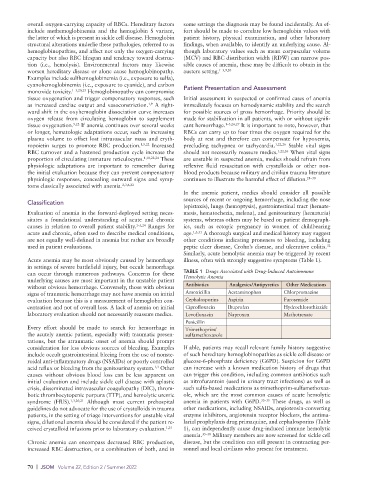
          can occur through numerous pathways. Concerns for these   TABLE 1  Drugs Associated with Drug-Induced Autoimmune
          underlying causes are most important in the unstable patient   Hemolytic Anemia
          without obvious hemorrhage. Conversely, those with obvious   Antibiotics  Analgesics/Antipyretics  Other Medications
          signs of traumatic hemorrhage may not have anemia on initial   Amoxicillin  Acetaminophen  Chlorpromazine
          evaluation because this is a measurement of hemoglobin con-  Cephalosporins  Aspirin  Furosemide
          centration and not of overall loss. A lack of anemia on initial   Ciprofloxacin  Ibuprofen  Hydrochlorothiazide
          laboratory evaluation should not necessarily reassure medics.  Levofloxacin  Naproxen  Methotrexate
                                                              Penicillin
          Every effort should be made to search for hemorrhage in   Trimethoprim/
          the acutely anemic patient, especially with traumatic presen-  sulfamethoxazole
          tations, but the atraumatic onset of anemia should prompt
          consideration for less obvious sources of bleeding. Examples   If able, patients may recall relevant family history suggestive
          include occult gastrointestinal bleeing from the use of nonste-  of such hereditary hemoglobinopathies as sickle cell disease or
          roidal anti-inflammatory drugs (NSAIDs) or poorly controlled   glucose-6-phosphate deficiency (G6PD). Suspicion for G6PD
          acid reflux or bleeding from the genitourinary system.  Other   can increase with a known medication history of drugs that
                                                   1,3
          causes without obvious blood loss can be less apparent on   can trigger this condition, including common antibiotics such
          initial evaluation and include sickle cell disease with aplastic   as nitrofurantoin (used in urinary tract infections) as well as
          crisis, disseminated intravascular coagulopathy (DIC), throm-  such sulfa-based medications as trimethoprim-sulfamethoxaz-
          botic thrombocytopenic purpura (TTP), and hemolytic uremic   ole, which are the most common causes of acute hemolytic
          syndrome (HUS). 1,3,20,21  Although most current prehospital   anemia in patients with G6PD. 33–35  These drugs, as well as
          guidelines do not advocate for the use of crystalloids in trauma   other medications, including NSAIDs, angiotensin-converting
          patients, in the setting of triage interventions for unstable vital   enzyme inhibitors, angiotensin receptor blockers, the antima-
          signs, dilutional anemia should be considered if the patient re-  larial prophylaxis drug primaquine, and cephalosporins (Table
          ceived crystalloid infusions prior to laboratory evaluation. 1,25  1), can independently cause drug-induced immune hemolytic
                                                             anemia. 35–38  Military members are now screened for sickle cell
          Chronic anemia can encompass decreased RBC production,   disease, but the condition can still present in contracting per-
          increased RBC destruction, or a combination of both, and in   sonnel and local civilians who present for treatment.


          70  |  JSOM   Volume 22, Edition 2 / Summer 2022

