


Page 65 - JSOM Summer 2022
P. 65
Shock and Vasopressors


                                                                      2
                                                   1
                                   Peter Lampman *; Kyle Kennington ; Seth M. Assar, MD   3


              ABSTRACT
              Shock is a life-threatening condition carrying a high mortality   Presentation
              rate when untreated. The consequences of shock are cellular
              and meta bolic derangements, which are initially reversible. The   The diagnosis of shock considers clinical, hemodynamic, and
              authors present the case of a Servicemember who sustained   biochemical features and cannot be established by a specific
                mortar shrapnel wounds that resulted in shock.   parameter. Clinical features common to shock include tachy-
                                                                 cardia, hypotension, tachypnea, altered mental status, oliguria,
              Keywords: shock; homeostasis; critical care        and a spectrum of skin changes (cold to warm, pale to flushed)
                                                                 dependent on etiology. Tachycardia is typically an early com-
                                                                 pensatory mechanism to provide perfusion in shock states. It
                                                                 is the common precursor to frank hypotension, which occurs
              Introduction                                       in most shock patients. The inverse and converse statements
                                                                 are not true: an absence of hypotension does not exclude ac-
                “. . . shock is a lack of homeostasis and without homeo-  tive shock and the presence of hypotension does not indicate
                stasis the patient does not survive.”            shock. Tachypnea is another compensatory mechanism indic-
                                   Walter B. Cannon, United States    ative of the presence of an insidious acute metabolic acidosis.
                                       Army Medical Corps (1918)
                                                                 Often referred to as one of the “windows to the body,” the skin
                                                                 and mucosal surfaces often reveal histologic derangements of
              Shock is a life-threatening condition characterized by cellular
              and tissue hypoxia resulting from circulatory failure-associ-  shock. The severe peripheral vasoconstriction characteristic of
              ated hypoperfusion. The consequences of shock are cellular   cardiogenic shock may result in cold and pale skin. Alterna-
              and metabolic derangements, which are initially reversible.   tively, peripheral shunting in septic shock may leave the skin
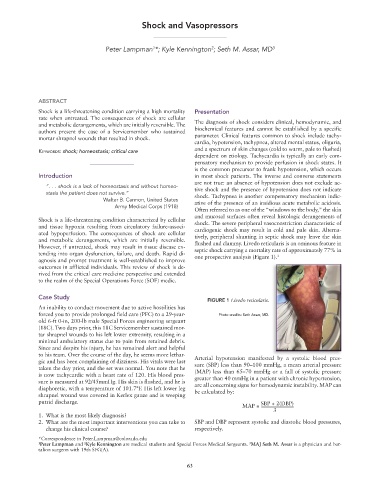
              However, if untreated, shock may result in tissue disease ex-  flushed and clammy. Livedo reticularis is an ominous feature in
              tending into organ dysfunction, failure, and death. Rapid di-  septic shock carrying a mortality rate of approximately 77% in
                                                                                            1
              agnosis and prompt treatment is well-established to improve   one prospective analysis (Figure 1).
              outcomes in afflicted individuals. This review of shock is de-
              rived from the critical care medicine perspective and extended
              to the realm of the Special Operations Force (SOF) medic.


              Case Study
                                                                     FIGURE 1 Livedo reticularis.
              An inability to conduct movement due to active hostilities has
              forced you to provide prolonged field care (PFC) to a 29-year-  Photo credits: Seth Assar, MD.
              old 6-ft 0-in, 200-lb male Special Forces engineering sergeant
              (18C). Two days prior, this 18C Servicemember sustained mor-
              tar shrapnel wounds to his left lower extremity, resulting in a
              minimal ambulatory status due to pain from retained debris.
              Since and despite his injury, he has remained alert and helpful
              to his team. Over the course of the day, he seems more lethar-
              gic and has been complaining of dizziness. His vitals were last   Arterial hypotension manifested by a systolic blood pres-
              taken the day prior, and the set was normal. You note that he   sure (SBP) less than 90–100 mmHg, a mean arterial pressure
              is now tachycardic with a heart rate of 120. His blood pres-  (MAP) less than 65–70 mmHg or a fall of systolic pressure
              sure is measured at 92/45mmHg. His skin is flushed, and he is   greater than 40 mmHg in a patient with chronic hypertension,
              diaphoretic, with a temperature of 101.7°F. His left lower leg   are all concerning signs for hemodynamic instability. MAP can
              shrapnel wound was covered in Kerlex gauze and is weeping   be calculated by:
              putrid discharge.                                                        SBP + 2(DBP)
                                                                                MAP =
                                                                                               3
              1.  What is the most likely diagnosis?
              2.  What are the most important interventions you can take to   SBP and DBP represent systolic and diastolic blood pressures,
                change his clinical course?                      respectively.
              *Correspondence to Peter.Lampman@colorado.edu
                                                                                  3
              1 Peter Lampman and  Kyle Kennington are medical students and Special Forces Medical Sergeants.  MAJ Seth M. Assar is a physician and bat-
                             2
              talion surgeon with 19th SFG(A).
                                                              63

