


Page 41 - JSOM Summer 2022
P. 41
Special Operator’s body fat percentage has little significance   Case Presentation 2
              until it is associated with desired physical performance out-  Full ISAK profile was completed by a level 3 anthropometrist
              comes, low incidence  of injury and illness, and sustainable   on a male Air Force Explosive Ordnance Disposal (EOD): aged
                           1
              lifestyle factors.”  In the next section, we present a case series   31 years, body mass 69 kg, height 175 cm, and BMI 22.6kg/
              demonstrating application of the ISAK profile in a SOF Hu-  m . The Operator competed as a Wounded Warrior following
                                                                  2
              man Performance facility.                          multiple surgeries on both knees due to combat injuries. He has
                                                                 medaled in sprint track and field events and earned an invita-
                                                                 tion to the Invictus Games. Sum of six skinfolds totaled 47.6
              Case Series
                                                                 mm, body fat was calculated as 11.0% using the Yuhasz for-
              Case Presentation 1                                mula, and muscle:bone ratio was 4.6.  A lower muscle:bone
                                                                                              13
              Full ISAK profile was completed by a level 3 anthropometrist   ratio with lean physique is better suited for sprinting events
              on a male Air Force Joint Terminal Attack Controller: aged 33   than the high (>5) muscle:bone ratio found in many Operators,
                                                             2
              years, body mass 110 kg, height 176 cm, and BMI 35.6kg/m .   because carrying excess mass would slow his speed. In another
              BMI would suggest obesity; but the ISAK profile shows that   sport characterized by shorts bursts speed, elite rugby players
              adipose mass was below average, and the Operator carries high   have similar average muscle:bone ratios ranging from 4.5 to
              muscle mass not evident from the standard waist:neck ratio cal-  4.7.  Although little data have been published on muscle:bone
                                                                    15
              culated by military body fat standards. His muscle:bone ratio   ratios in sprinters, the mean somatotype found in internation-
              of 6.1 was well above average, showing he carries maximum   ally competitive 100-m sprinters is ectomorphic mesomorph
              muscle for his frame. His sum of six skinfolds totaled 91.2 mm,   category. The Operator presented in the case study has a sim-
                                                                       23
              and his body fat was calculated as 17.7% using the Yuhasz   ilar somatotype, indicating a lean muscular physique is advan-
              formula.  The Operator complained of loss of mobility and   tageous for short sprints (Figure 2).
                    13
              agility, likely related to a muscular imbalance at the hips. His
              high muscularity around the hips (wide gluteal girth, low skin-
              fold thickness) compared to average bone length and breadths   FIGURE 2  Somatotype of an Air
                                                                  Force EOD Wounded Warrior
              at the hip joint stress the bones and joints beyond their func-  athlete who has medaled track
              tional capacity and contributes to loss of agility (Figure 1). The   and field events.
              Operator had begun yoga training to improve flexibility, but
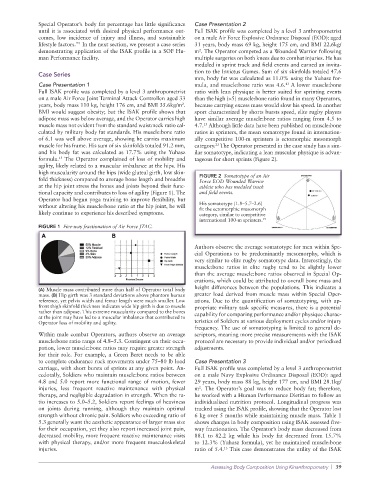
              without altering his muscle:bone ratio at the hip joint, he will   His somatotype (1.8–5.7–2.6)
                                                                  fit the ectomorphic mesomorph
              likely continue to experience his described symptoms.  category, similar to competitive
                                                                  international 100-m sprinters. 19
              FIGURE 1  Five-way fractionation of Air Force JTAC.


                                                                 Authors observe the average somatotype for men within Spe-
                                                                 cial  Operations  to  be  predominantly  mesomorphy,  which  is
                                                                 very similar to elite rugby somatotype data. Interestingly, the
                                                                 muscle:bone  ratios  in  elite  rugby tend  to  be  slightly lower
                                                                 than the average muscle:bone ratios observed in Special Op-
                                                                 erations, which could be attributed to overall bone mass and
              (A) Muscle mass contributed more than half of Operator total body   height differences between the populations. This indicates a
              mass. (B) Hip girth was 3 standard deviations above phantom human   greater load derived from muscle mass within Special Oper-
              reference, yet pelvis width and femur length were much smaller. Low   ations. Due to the quantification of somatotyping, with ap-
              front thigh skinfold thickness indicates wide hip girth is due to muscle   propriate military task specific measures, there is a potential
              rather than adipose. This extreme muscularity compared to the bones   capability for comparing performance and/or physique charac-
              at the joint may have led to a muscular imbalance that contributed to
              Operator loss of mobility and agility.             teristics of Soldiers at various deployment cycles and/or injury
                                                                 frequency. The use of somatotyping is limited to general de-
              Within male combat Operators, authors observe an average   scriptors, meaning more precise measurements with the ISAK
              muscle:bone ratio range of 4.8–5.3. Contingent on their occu-  protocol are necessary to provide individual and/or periodized
              pation, lower muscle:bone ratios may require greater strength   adjustments.
              for their role. For example, a Green Beret needs to be able
              to complete endurance ruck movements under 75–80 lb load   Case Presentation 3
              carriage, with short bursts of sprints at any given point. An-  Full ISAK profile was completed by a level 3 anthropometrist
              ecdotally, Soldiers who maintain muscle:bone ratios between   on a male Navy Explosive Ordinance Disposal (EOD): aged
              4.8 and 5.0 report more functional range of motion, fewer   29 years, body mass 88 kg, height 177 cm, and BMI 28.1kg/
              injuries, less frequent reactive maintenance with physical   m . The Operator’s goal was to reduce body fat; therefore,
                                                                  2
              therapy, and negligible degradation in strength. When the ra-  he worked with a Human Performance Dietitian to follow an
              tio increases to 5.0–5.2, Soldiers report feelings of heaviness   individualized nutrition protocol. Longitudinal progress was
              on joints during running, although they maintain optimal   tracked using the ISAK profile, showing that the Operator lost
              strength without chronic pain. Soldiers who exceeding ratio of   6 kg over 5 months while maintaining muscle mass.  Table 1
              5.3 generally want the aesthetic appearance of larger mass size   shows changes in body composition using ISAK assessed five-
              for their occupation, yet they also report increased joint pain,   way fractionation. The Operator’s body mass decreased from
              decreased mobility, more frequent reactive maintenance visits   88.1 to 82.2 kg while his body fat decreased from 15.7%
              with physical therapy, and/or more frequent musculoskeletal   to 12.3% (Yuhasz formula), yet he maintained muscle:bone
              injuries.                                          ratio of 5.4.  This case demonstrates the utility of the ISAK
                                                                          13
                                                                      Assessing Body Composition Using Kinanthropometry  |  39

