


Page 45 - JSOM Summer 2022
P. 45
Management of Severe Crush Injuries in Austere Environments

                                           A Special Operations Perspective


                                                                                                     2
                        Justin L. Anderson, BHS, SO-ATP, NREMT-P ; Meredith Cole, SO-ATP, NREMT-P ;
                                                                  1
                                         Dylan Pannell, CD, MD, PhD, CCFP, FRCS(C)   3


              ABSTRACT
              Crush injuries present a challenging case for medical provid-  Pathophysiology
              ers and require knowledge and skill to manage the subsequent
              damage to multiple organ systems. In an austere environment,   As prehospital providers, medics are in the mindset of treating
              in which resources are limited and evacuation time is exten-  the injury that they come across at point of injury (POI). How-
              sive, a medic must be prepared to identify trends and predict   ever, crush syndrome does not occur at the time of insult—
              outcomes based on the mechanism of injury and patient pre-  it occurs during reperfusion. As the ischemic limb is being
              sentation. These injuries occur in a variety of environments   re-perfused, the cellular contents that are released from dy-
              from motor vehicle accidents (at home or abroad) to natural   ing cells act as systemic toxins, disrupting cardiac, renal, and
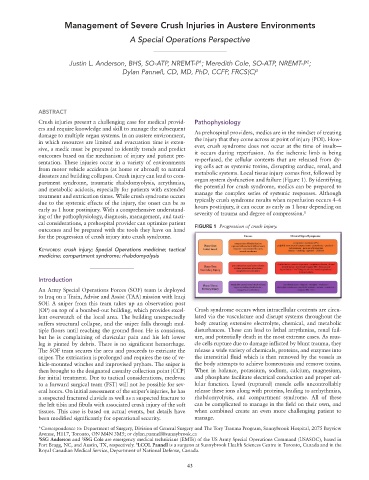
              disasters and building collapses. Crush injury can lead to com-  metabolic systems. Local tissue injury comes first, followed by
              partment  syndrome,  traumatic  rhabdomyolysis,  arrythmias,   organ system dysfunction and failure (Figure 1). By identifying
              and metabolic acidosis, especially for patients with extended   the potential for crush syndrome, medics can be prepared to
              treatment and extrication times. While crush syndrome occurs   manage the complex series of systemic responses. Although
              due to the systemic effects of the injury, the onset can be as   typically crush syndrome results when reperfusion occurs 4–6
              early as 1 hour postinjury. With a comprehensive understand-  hours postinjury, it can occur as early as 1 hour depending on
                                                                                                    1
              ing of the pathophysiology, diagnosis, management, and tacti-  severity of trauma and degree of compression.
              cal considerations, a prehospital provider can optimize patient
              outcomes and be prepared with the tools they have on hand   FIGURE 1  Progression of crush injury.
              for the progression of crush injury into crush syndrome.
              Keywords: crush injury; Special Operations medicine; tactical
              medicine; compartment syndrome; rhabdomyolysis


              Introduction
              An Army Special Operations Forces (SOF) team is deployed
              to Iraq on a Train, Advise and Assist (TAA) mission with Iraqi
              SOF. A sniper from this team takes up an observation post
              (OP) on top of a bombed-out building, which provides excel-  Crush syndrome occurs when intracellular contents are circu-
              lent overwatch of the local area. The building unexpectedly   lated via the vasculature and disrupt systems throughout the
              suffers structural collapse, and the sniper falls through mul-  body creating extensive electrolyte, chemical, and metabolic
              tiple floors until reaching the ground floor. He is conscious,   disturbances. These can lead to lethal arrythmias, renal fail-
              but he is complaining of clavicular pain and his left lower   ure, and potentially death in the most extreme cases. As mus-
              leg is pinned by debris. There is no significant hemorrhage.   cle cells rupture due to damage inflicted by blunt trauma, they
              The SOF team secures the area and proceeds to extricate the   release a wide variety of chemicals, proteins, and enzymes into
              sniper. The extrication is prolonged and requires the use of ve-  the interstitial fluid which is then removed by the vessels as
              hicle-mounted winches and improvised prybars. The sniper is   the body attempts to achieve homeostasis and remove toxins.
              then brought to the designated casualty collection point (CCP)   When in balance, potassium, sodium, calcium, magnesium,
              for initial treatment. Due to tactical considerations, medevac   and phosphate facilitate electrical conduction and proper cel-
              to a forward surgical team (FST) will not be possible for sev-  lular function. Lysed (ruptured) muscle cells uncontrollably
              eral hours. On initial assessment of the sniper’s injuries, he has   release these ions along with proteins, leading to arrhythmias,
              a suspected fractured clavicle as well as a suspected fracture to   rhabdomyolysis, and compartment syndrome. All of these
              the left tibia and fibula with associated crush injury of the soft   can be complicated to manage in the field on their own, and
              tissues. This case is based on actual events, but details have   when combined create  an even more challenging  patient to
              been modified significantly for operational security.  manage.

              *Correspondence to: Department of Surgery, Division of General Surgery and The Tory Trauma Program, Sunnybrook Hospital, 2075 Bayview
              Avenue, H117, Toronto, ON M4N 3M5; or dylan.pannell@sunnybrook.ca
              1 SSG Anderson and  SSG Cole are emergency medical technicians (EMTs) of the US Army Special Operations Command (USASOC), based in
                            2
              Fort Bragg, NC, and Austin, TX, respectively.  LCOL Pannell is a surgeon at Sunnybrook Health Sciences Centre in Toronto, Canada and in the
                                             3
              Royal Canadian Medical Service, Department of National Defense, Canada.
                                                              43

