


Page 46 - JSOM Summer 2022
P. 46
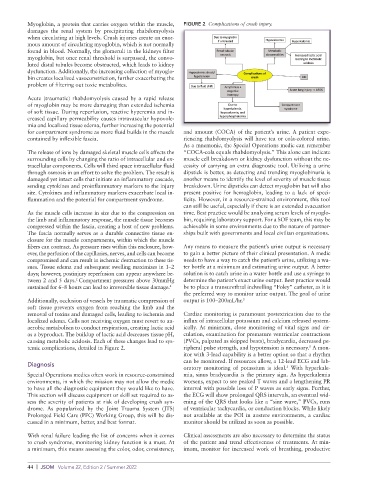
Myoglobin, a protein that carries oxygen within the muscle,   FIGURE 2  Complications of crush injury.
          damages the renal system by precipitating rhabdomyolysis
          when circulating at high levels. Crush injuries create an enor-
          mous amount of circulating myoglobin, which is not normally
          found in blood. Normally, the glomeruli in the kidneys filter
          myoglobin, but once renal threshold is surpassed, the convo-
          luted distal tubules become obstructed, which leads to kidney
          dysfunction. Additionally, the increasing collection of myoglo-
          bin creates localized vasoconstriction, further exacerbating the
          problem of filtering out toxic metabolites.
          Acute (traumatic) rhabdomyolysis caused by a rapid release
          of myoglobin may be more damaging than extended ischemia
          of soft tissue. During reperfusion, reactive hyperemia and in-
          creased capillary permeability causes intravascular hypovole-
          mia and localized tissue edema, further increasing the potential
          for compartment syndrome as more fluid builds in the muscle   and amount (COCA) of the patient’s urine. A patient expe-
          contained by inflexible fascia.                    riencing rhabdomyolysis will have tea or cola-colored urine.
                                                             As a mnemonic, the Special Operations medic can remember
          The release of ions by damaged skeletal muscle cells affects the   “COCA-cola equals rhabdomyolysis.” This alone can indicate
          surrounding cells by changing the ratio of intracellular and ex-  muscle cell breakdown or kidney dysfunction without the ne-
          tracellular components. Cells will third space intracellular fluid   cessity of carrying an extra diagnostic tool. Utilizing a urine
          through osmosis in an effort to solve the problem. The result is   dipstick is better, as detecting and trending myoglobinuria is
          damaged yet intact cells that initiate an inflammatory cascade,   another means to identify the level of severity of muscle tissue
          sending cytokines and proinflammatory markers to the injury   breakdown. Urine dipsticks can detect myoglobin but will also
          site. Cytokines and inflammatory markers exacerbate local in-  present positive for hemoglobin, leading to a lack of speci-
          flammation and the potential for compartment syndrome.  ficity. However, in a resource-strained environment, this tool
                                                             can still be useful, especially if there is an extended evacuation
          As the muscle cells increase in size due to the compression on   time. Best practice would be analyzing serum levels of myoglo-
          the limb and inflammatory response, the muscle tissue becomes   bin, requiring laboratory support. For a SOF team, this may be
          compressed within the fascia, creating a host of new problems.   achievable in some environments due to the nature of partner-
          The fascia normally serves as a durable connective tissue en-  ships built with governments and local civilian organizations.
          closure for the muscle compartments, within which the muscle
          fibers can contract. As pressure rises within this enclosure, how-  Any means to measure the patient’s urine output is necessary
          ever, the perfusion of the capillaries, nerves, and cells can become   to gain a better picture of their clinical presentation. A medic
          compromised and can result in ischemic destruction to these tis-  needs to have a way to catch the patient’s urine, utilizing a wa-
          sues. Tissue edema and subsequent swelling maximizes in 1–2   ter bottle at a minimum and estimating urine output. A better
          days; however, postinjury reperfusion can appear anywhere be-  solution is to catch urine in a water bottle and use a syringe to
                          2
          tween 2 and 5 days. Compartment pressures above 30mmHg   determine the patient’s exact urine output. Best practice would
          sustained for 6–8 hours can lead to irreversible tissue damage. 4  be to place a transurethral indwelling “Foley” catheter, as it is
                                                             the preferred way to monitor urine output. The goal of urine
          Additionally, occlusion of vessels by traumatic compression of   output is 100–200mL/hr. 5
          soft tissue prevents oxygen from reaching the limb and the
          removal of toxins and damaged cells, leading to ischemia and   Cardiac monitoring is paramount postextrication due to the
          localized edema. Cells not receiving oxygen must revert to an-  influx of intracellular potassium and calcium released system-
          aerobic metabolism to conduct respiration, creating lactic acid   ically. At minimum, close monitoring of vital signs and cir-
          as a byproduct. The buildup of lactic acid decreases tissue pH,   culation, examination for premature ventricular contractions
          causing metabolic acidosis. Each of these changes lead to sys-  (PVCs, palpated as skipped beats), bradycardia, decreased pe-
                                                                                                      5
          temic complications, detailed in Figure 2.         ripheral pulse strength, and hypotension is necessary.  A mon-
                                                             itor with 3-lead capability is a better option so that a rhythm
                                                             can be monitored. If resources allow, a 12-lead ECG and lab-
          Diagnosis
                                                             oratory monitoring of potassium is ideal.  With hyperkale-
                                                                                               5
          Special Operations medics often work in resource-constrained   mia, sinus bradycardia is the primary sign. As hyperkalemia
          environments, in which the mission may not allow the medic   worsens, expect to see peaked T waves and a lengthening PR
          to have all the diagnostic equipment they would like to have.   interval with possible loss of P waves as early signs. Further,
          This section will discuss equipment or skill set required to as-  the ECG will show prolonged QRS intervals, an eventual wid-
          sess the severity of patients at risk of developing crush syn-  ening of the QRS that looks like a “sine wave,” PVCs, runs
          drome. As  popularized by the Joint Trauma  System (JTS)   of ventricular tachycardia, or conduction blocks. While likely
          Prolonged Field Care (PFC) Working Group, this will be dis-  not available at the POI in austere environments, a cardiac
          cussed in a minimum, better, and best format.      monitor should be utilized as soon as possible.

          With renal failure leading the list of concerns when it comes   Clinical assessments are also necessary to determine the status
          to crush syndrome, monitoring kidney function is a must. At   of the patient and trend effectiveness of treatments. At min-
          a minimum, this means assessing the color, odor, consistency,   imum, monitor for increased work of breathing, productive


          44  |  JSOM   Volume 22, Edition 2 / Summer 2022

