


Page 38 - JSOM Summer 2022
P. 38
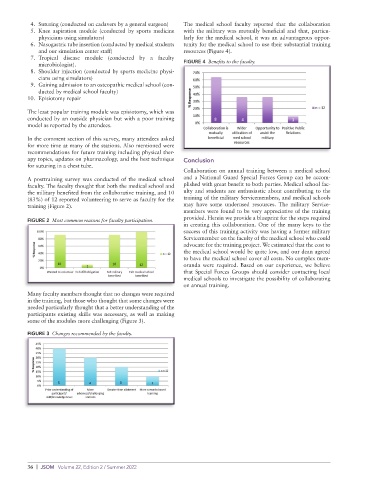
4.  Suturing (conducted on cadavers by a general surgeon)  The medical school faculty reported that the collaboration
           5.  Knee aspiration module (conducted by sports medicine   with the military was mutually beneficial and that, particu-
              physicians using simulators)                   larly for the medical school, it was an advantageous oppor-
           6.  Nasogastric tube insertion (conducted by medical students   tunity for the medical school to use their substantial training
              and our simulation center staff)               resources (Figure 4).
           7.  Tropical disease module (conducted by a faculty
              micro biologist).                              FIGURE 4  Benefits to the faculty.
           8.  Shoulder injection (conducted by sports medicine physi-
              cians using simulators)
           9.  Gaining admission to an osteopathic medical school (con-
              ducted by medical school faculty)
          10.  Episiotomy repair

          The least popular training module was episiotomy, which was
          conducted by an outside physician but with a poor training
          model as reported by the attendees.

          In the comment section of this survey, many attendees asked
          for more time at many of the stations. Also mentioned were
          recommendations for future training including physical ther-
          apy topics, updates on pharmacology, and the best technique   Conclusion
          for suturing in a chest tube.
                                                             Collaboration on annual training between a medical school
          A posttraining survey was conducted of the medical school   and a National Guard Special Forces Group can be accom-
          faculty. The faculty thought that both the medical school and   plished with great benefit to both parties. Medical school fac-
          the military benefited from the collaborative training, and 10   ulty and students are enthusiastic about contributing to the
          (83%) of 12 reported volunteering to serve as faculty for the   training of the military Servicemembers, and medical schools
          training (Figure 2).                               may  have some  underused  resources.  The military  Service-
                                                             members were found to be very appreciative of the training
                                                             provided. Herein we provide a blueprint for the steps required
          FIGURE 2  Most common reasons for faculty participation.
                                                             in creating this collaboration. One of the many keys to the
                                                             success of this training activity was having a former military
                                                             Servicemember on the faculty of the medical school who could
                                                             advocate for the training project. We estimated that the cost to
                                                             the medical school would be quite low, and our dean agreed
                                                             to have the medical school cover all costs. No complex mem-
                                                             oranda were required. Based on our experience, we believe
                                                             that Special Forces Groups should consider contacting local
                                                             medical schools to investigate the possibility of collaborating
                                                             on annual training.
          Many faculty members thought that no changes were required
          in the training, but those who thought that some changes were
          needed particularly thought that a better understanding of the
          participants existing skills was necessary, as well as making
          some of the modules more challenging (Figure 3).
          FIGURE 3  Changes recommended by the faculty.


          36  |  JSOM   Volume 22, Edition 2 / Summer 2022

