


Page 37 - JSOM Summer 2022
P. 37
Collaboration of a Medical School

                                With a Special Forces Group on Annual Training
                                                        A Blueprint


                                                      1
                                                                                  2
                    Paul Brisson, MD, MS, FACP, FAAP ; David W. McGregor Jr, DO *; Zachary Murphy, DO    3


              ABSTRACT
              Collaboration on annual training between a medical school and   modules, so we wanted to include them as assistant faculty.
              a National Guard Special Forces Group can be accomplished   We recruited students primarily from our Military Club
              with great benefit to both parties. The authors describe the in-  (Student Association of Osteopathic Military Physicians
              volvement by the Edward Via College of Osteopathic Medicine   and Surgeons) since they were interested in associating with
              in providing training for the 20th Special Forces Group Medi-  the medical National Guard members.
              cal Sergeants of the Alabama Army National Guard.  5.  Request permission of the medical school dean to conduct
                                                                   the training activity. We presented a detailed proposal, in-
              Keywords: training; collaboration; volunteers; military training;   cluding the budget, to our medical school dean. The dean
              medical school                                       was incredibly supportive and enthusiastic about the activ-
                                                                   ity and provided rapid approval. Our dean agreed to have
                                                                   the medical school cover the expenses related to the budget
                                                                   items.
              Introduction
              The Edward Via College of Osteopathic Medicine (VCOM)   Once the dean’s approval was obtained and a date was chosen,
              involvement in providing training for the 20th Special Forces   a training agenda was published.
              Group Medical Sergeants of the Alabama Army National
              Guard (Z.M.) was initiated by a request submitted to us by   No memoranda were required.
              a representative of the AL-ARNG who brought a proposal to
              the VCOM chair of surgery (P.B.) for consideration. The chair   Results
              of surgery worked with the associate dean for research and
              other faculty to develop a plan of training. VCOM Auburn   Twenty-two members of the 20th Special Forces Group Med-
              campus was established 4 years earlier and had not provided   ical Sergeants of the Alabama Army National Guard attended
              such training for any military entity.             the training. All the members participated in all 10 training
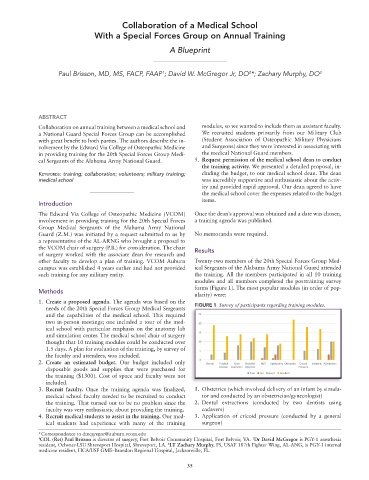
                                                                 modules and all members completed the posttraining survey
                                                                 forms (Figure 1). The most popular modules (in order of pop-
              Methods
                                                                 ularity) were:
              1.  Create a proposed agenda. The agenda was based on the
                needs of the 20th Special Forces Group Medical Sergeants   FIGURE 1  Survey of participants regarding training modules.
                and the capabilities of the medical school. This required
                two in-person meetings; one included a tour of the med-
                ical school with particular emphasis on the anatomy lab
                and simulation center. The medical school chair of surgery
                thought that 10 training modules could be conducted over
                1.5 days. A plan for evaluation of the training, by survey of
                the faculty and attendees, was included.
              2.  Create an estimated budget.  Our budget included only
                disposable goods and supplies that were purchased for
                the training ($1300). Cost of space and faculty were not
                included.
              3.  Recruit faculty. Once the training agenda was finalized,   1.  Obstetrics (which involved delivery of an infant by simula-
                medical school faculty needed to be recruited to conduct   tor and conducted by an obstetrician/gynecologist)
                the training. That turned out to be no problem since the   2.  Dental extractions (conducted by two dentists using
                faculty was very enthusiastic about providing the training.  cadavers)
              4.  Recruit medical students to assist in the training. Our med-  3.  Application of cricoid pressure (conducted by a general
                ical students had experience with many of the training   surgeon)
              *Correspondence to dmcgregor@auburn.vcom.edu
              1 COL (Ret) Paul Brisson is director of surgery, Fort Belvoir Community Hospital, Fort Belvoir, VA.  Dr David McGregor is PGY-1 anesthesia
                                                                                    2
                                                        3
              resident, Ochsner-LSU Shreveport Hospital, Shreveport, LA.  LT Zachary Murphy, FS, USAF 187th Fighter Wing, AL-ANG, is PGY-1 internal
              medicine resident, HCA/USF GME–Brandon Regional Hospital, Jacksonville, FL.
                                                              35

