


Page 32 - JSOM Summer 2022
P. 32
the Edward Via College of Osteopathic Medicine and at Fort   •  Dental restorations. Students are trained to restore
          Bragg. Current efforts are under way to create a permanent   dental lesions (carious and/or traumatic) with the most
          collaboration with Auburn University to gain access to their   available materials on the market (foreign and domes-
          highly trained specialized instructors, state-of-the-art facilities,   tic).  Focus  is  on  eliminating  pain,  restoring  function,
          and convenient proximity to quality surroundings in the City   and esthetics (if mission dictates): permanent dental res-
          of Auburn.                                              torations (if all decay/caries can be removed) – Fuji IX
                                                                  (can be used as a temporary due to its excellent hydro-
          NTM instructors include the battalion surgeons as well as ded-  philic adhesive properties) and provisional dental resto-
          icated SMEs assigned to the Group Support Battalion (GSB)   rations (Intermediate restorative material [IRM], Cavit).
          Medical Company, to include dentists, veterinarians, and
          physical therapists. Outside SMEs, both civilian and military,   Dental Instructors
          are sometimes contracted on an as-needed basis, and 18Ds as-  The 20th SFG(A) has three dentists on staff who support this
          signed to the GSB’s Special Operations Training Detachment   training (Figures 2 and 3):
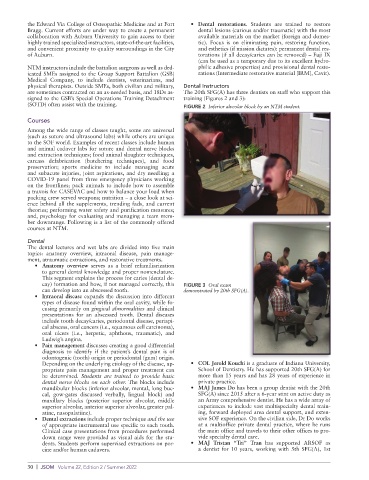
          (SOTD) often assist with the training.             FIGURE 2  Inferior alveolar block by an NTM student.

          Courses
          Among the wide range of classes taught, some are universal
          (such as suture and ultrasound labs) while others are unique
          to the SOF world. Examples of recent classes include human
          and animal cadaver labs for suture and dental nerve blocks
          and extraction techniques; food animal slaughter techniques,
          carcass defabrication (butchering techniques), and food
          preservation; sports medicine to include managing acute
          and subacute injuries, joint aspirations, and dry needling; a
          COVID-19 panel from three emergency physicians working
          on the frontlines; pack animals to include how to assemble
          a travois for CASEVAC and how to balance your load when
          packing crew served weapons; nutrition – a close look at sci-
          ence behind all the supplements, trending fads, and current
          theories; performing water safety and purification measures;
          and, psychology for evaluating and managing a team mem-
          ber downrange. Following is a list of the commonly offered
          courses at NTM.
          Dental
          The dental lectures and wet labs are divided into five main
          topics: anatomy overview, intraoral disease, pain manage-
          ment, atraumatic extractions, and restorative treatments.
            •  Anatomy overview serves as a brief refamiliarization
               to general dental knowledge and proper nomenclature.
               This segment explains the process for caries (dental de-
               cay) formation and how, if not managed correctly, this   FIGURE 3  Oral exam
               can develop into an abscessed tooth.          demonstrated by 20th SFG(A).
            •  Intraoral disease expands the discussion into different
               types of disease found within the oral cavity, while fo-
               cusing primarily on gingival abnormalities and clinical
               presentations for an abscessed tooth. Dental diseases
               include tooth decay/caries, periodontal disease, periapi-
               cal abscess, oral cancers (i.e., squamous cell carcinoma),
               oral ulcers (i.e., herpetic, aphthous, traumatic), and
               Ludwig’s angina.
            •  Pain management discusses creating a good differential
               diagnosis to  identify if  the patient’s  dental pain is  of
               odontogenic (tooth) origin or periodontal (gum) origin.
               Depending on the underlying etiology of the disease, ap-  •  COL Jerold Kouchi is a graduate of Indiana University,
               propriate pain management and proper treatment can   School of Dentistry. He has supported 20th SFG(A) for
               be determined.  Students are trained to provide basic   more than 15 years and has 28 years of experience in
               dental nerve blocks on each other. The blocks include   private practice.
               mandibular blocks (inferior alveolar, mental, long buc-  •  MAJ James Do has been a group dentist with the 20th
               cal, gow-gates discussed verbally, lingual block) and   SFG(A) since 2015 after a 6-year stint on active duty as
               maxillary blocks (posterior superior alveolar, middle   an Army comprehensive dentist. He has a wide array of
               superior alveolar, anterior superior alveolar, greater pal-  experiences to include vast multispecialty dental train-
               atine, nasopalatiine).                             ing, forward deployed area dental support, and exten-
            •  Dental extractions include proper technique and the use   sive SOF experience. On the civilian side, Dr Do works
               of appropriate instrumental use specific to each tooth.   at a multioffice private dental practice, where he runs
               Clinical case presentations from procedures performed   the main office and travels to their other offices to pro-
               down range were provided as visual aids for the stu-  vide specialty dental care.
               dents. Students perform supervised extractions on por-  •  MAJ Tristan “Tri” Tran has supported ARSOF as
               cine and/or human cadavers.                        a dentist for 10 years, working with 5th SFG(A), 1st


          30  |  JSOM   Volume 22, Edition 2 / Summer 2022

