


Page 59 - JSOM Spring 2021
P. 59
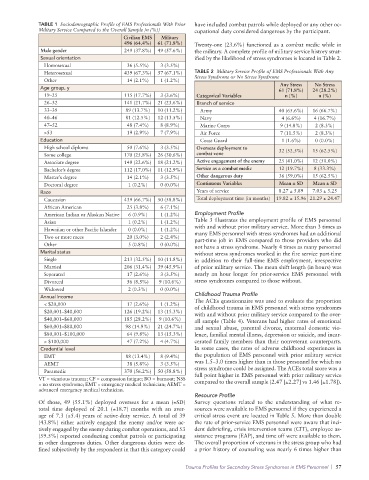
TABLE 1  Sociodemographic Profile of EMS Professionals With Prior   have included combat patrols while deployed or any other oc-
              Military Service Compared to the Overall Sample [n (%)]  cupational duty considered dangerous by the participant.
                                         Civilian EMS   Military
                                          496 (64.4%)  61 (71.8%)  Twenty-one (23.6%) functioned as a combat medic while in
              Male gender                 249 (37.8%)  49 (57.6%)  the military. A complete profile of military service history strat-
              Sexual orientation                                 ified by the likelihood of stress syndromes is located in Table 2.
               Homosexual                 36 (5.5%)  3 (3.5%)
               Heterosexual               439 (67.3%)  57 (67.1%)  TABLE 2  Military Service Profile of EMS Professionals With Any
               Other                      14 (2.1%)  1 (1.2%)    Stress Syndrome or No Stress Syndrome
                                                                                             Any Stress
                                                                                                        No Stress
              Age group, y                                                                  61 (71.8%)  24 (28.2%)
               19–25                      115 (17.7%)  3 (3.6%)  Categorical Variables        n (%)      n (%)
               26–32                      141 (21.7%)  21 (23.6%)  Branch of service
               33–39                      89 (13.7%)  10 (11.2%)  Army                      40 (65.6%)  16 (66.7%)
               40–46                      81 (12.5%)  12 (13.5%)  Navy                       4 (6.6%)   4 (16.7%)
               47–52                      48 (7.4%)  8 (8.9%)     Marine Corps               9 (14.8%)  2 (8.3%)
               >53                        19 (2.9%)  7 (7.9%)     Air Force                  7 (11.5%)  2 (8.3%)
              Education                                           Coast Guard                1 (1.6%)   0 (0.0%)
               High school diploma        50 (7.6%)  3 (3.5%)    Overseas deployment to     32 (52.5%)  15 (62.5%)
               Some college               170 (25.8%)  26 (30.6%)  combat zone
               Associate degree           149 (22.6%)  18 (21.2%)  Active engagement of the enemy  25 (41.0%)  12 (50.0%)
               Bachelor’s degree          112 (17.0%)  11 (12.9%)  Service as a combat medic  12 (19.7%)  8 (33.3%)
               Master’s degree            14 (2.1%)  3 (3.5%)    Other dangerous duty       36 (59.0%)  15 (62.5%)
               Doctoral degree             1 (0.2%)  0 (0.0%)    Continuous Variables       Mean ± SD  Mean ± SD
              Race                                               Years of service           8.27 ± 5.89  7.03 ± 5.25
               Caucasian                  439 (66.7%)  50 (58.8%)  Total deployment time (in months)  19.82 ± 15.96 21.29 ± 24.47
               African American           25 (3.8%)  6 (7.1%)
               American Indian or Alaskan Native  6 (0.9%)  1 (1.2%)  Employment Profile
               Asian                       1 (0.2%)  1 (1.2%)    Table 3 illustrates the employment profile of EMS personnel
               Hawaiian or other Pacific Islander  0 (0.0%)  1 (1.2%)  with and without prior military service. More than 3 times as
                                                                 many EMS personnel with stress syndromes had an additional
               Two or more races          20 (3.0%)  2 (2.4%)    part-time job in EMS compared to those providers who did
               Other                       5 (0.8%)  0 (0.0%)    not have a stress syndrome. Nearly 4 times as many personnel
              Marital status                                     without stress syndromes worked in the fire service part-time
               Single                     213 (32.5%)  10 (11.8%)  in addition to their full-time EMS employment, irrespective
               Married                    206 (31.4%)  39 (45.9%)  of prior military service. The mean shift length (in hours) was
               Separated                  17 (2.6%)  3 (3.5%)    nearly an hour longer for prior-service EMS personnel with
               Divorced                   56 (8.5%)  9 (10.6%)   stress syndromes compared to those without.
               Widowed                     2 (0.3%)  0 (0.0%)
              Annual income                                      Childhood Trauma Profile
                                                                 The ACEs questionnaire was used to evaluate the proportion
               < $20,000                  17 (2.6%)  1 (1.2%)    of childhood trauma in EMS personnel with stress syndromes
               $20,001–$40,000            126 (19.2%)  13 (15.3%)  with and without prior military service compared to the over-
               $40,001–$60,000            185 (28.2%)  9 (10.6%)  all sample (Table 4). Veterans had higher rates of emotional
               $60,001–$80,000            98 (14.9%)  21 (24.7%)  and sexual abuse, parental divorce, maternal domestic vio-
               $80,001–$100,000           64 (9.8%)  13 (15.3%)  lence, familial mental illness, depression or suicide, and incar-
               > $100,000                 47 (7.2%)  4 (4.7%)    cerated family members than their nonveteran counterparts.
              Credential level                                   In some cases, the rates of adverse childhood experiences in
               EMT                        88 (13.4%)  8 (9.4%)   the population of EMS personnel with prior military service
               AEMT                       38 (5.8%)  3 (3.5%)    was 1.5–3.0 times higher than in those personnel for which no
                                                                 stress syndrome could be assigned. The ACEs total score was a
               Paramedic                  370 (56.2%)  50 (58.8%)  full point higher in EMS personnel with prior military service
              VT = vicarious trauma; CF = compassion fatigue; BO = burnout; NSS   compared to the overall sample (2.47 [±2.27] vs 1.46 [±1.78]).
              = no stress syndrome; EMT = emergency medical technician; AEMT =
              advanced emergency medical technician.
                                                                 Resource Profile
              Of those, 49 (55.1%) deployed overseas for a mean (±SD)   Survey  questions  related  to  the  understanding  of  what  re-
              total time deployed of 20.1 (±18.7) months with an aver-  sources were available to EMS personnel if they experienced a
              age of 7.3 (±5.4) years of active-duty service. A total of 39   critical stress event are located in Table 5. More than double
              (43.8%) either actively engaged the enemy and/or were ac-  the rate of prior-service EMS personnel were aware that inci-
              tively engaged by the enemy during combat operations, and 53   dent debriefing, crisis intervention teams (CIT), employee as-
              (59.5%) reported conducting combat patrols or participating   sistance programs (EAP), and time off were available to them.
              in other dangerous duties. Other dangerous duties were de-  The overall proportion of veterans in the stress group who had
              fined subjectively by the respondent in that this category could   a prior history of counseling was nearly 6 times higher than

                                                             Trauma Profiles for Secondary Stress Syndromes in EMS Personnel  |  57

