


Page 61 - JSOM Spring 2021
P. 61
2
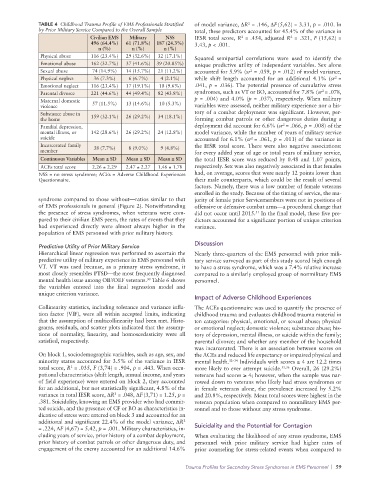
              TABLE 4  Childhood Trauma Profile of EMS Professionals Stratified   of model variance, ∆R  = .146, ∆F (5,62) = 3.31, p = .010. In

              by Prior Military Service Compared to the Overall Sample  total, these predictors accounted for 45.4% of the variance in
                               Civilian EMS    Military   NSS    IESR total score, R  = .454, adjusted R  = .321, F (15,62) =
                                                                                2
                                                                                                2
                               496 (64.4%)  61 (71.8%)  187 (24.3%)  3.43, p < .001.
                                 n (%)      n (%)      n (%)
              Physical abuse   116 (23.4%)  29 (32.6%)  32 (17.1%)  Squared semipartial  correlations  were  used  to identify  the
              Emotional abuse  162 (32.7%)  37 (41.6%)  39 (20.85%)  unique predictive utility of independent variables. Sex alone
              Sexual abuse     74 (14.9%)  14 (15.7%)  21 (11.2%)  accounted for 5.9% (sr  = .059, p = .012) of model variance,
                                                                                   2
              Physical neglect  36 (7.3%)  6 (6.7%)  4 (2.1%)    while shift length accounted for an additional 4.1% (sr =
                                                                                                              2
              Emotional neglect  116 (23.4%)  17 (19.1%)  18 (9.6%)  .041, p = .036). The potential presence of cumulative stress
                                                                                                          2
              Parental divorce  221 (44.6%)  44 (49.4%)  82 (43.8%)  syndromes, such as VT or BO, accounted for 7.8% (sr = .078,
              Maternal domestic   57 (11.5%)  13 (14.6%)  10 (5.3%)  p = .004) and 4.0% (p = .037), respectively. When military
              violence                                           variables were assessed, neither military experience nor a his-
              Substance abuse in   159 (32.1%)  26 (29.2%)  34 (18.1%)  tory of a combat deployment was significant. However, per-
              the home                                           forming combat patrols or other dangerous duties during a
                                                                                             2
              Familial depression,                               deployment did account for 6.6% (sr = .066, p = .008) of the
              mental illness, or   142 (28.6%)  26 (29.2%)  24 (12.8%)  model variance, while the number of years of military service
              suicide                                            accounted for 6.1% (sr = .061, p = .011) of the variance in
                                                                                   2
              Incarcerated family                                the IESR total score. There were also negative associations:
              member            38 (7.7%)  8 (9.0%)  9 (4.8%)    for every added year of age or total years of military service,
              Continuous Variables  Mean ± SD  Mean ± SD  Mean ± SD  the  total  IESR  score  was  reduced  by  0.48 and  1.07  points,
              ACEs total score  2.26 ± 2.29  2.47 ± 2.27  1.46 ± 1.78  respectively. Sex was also negatively associated in that females
              NSS = no stress syndrome; ACEs = Adverse Childhood Experiences   had, on average, scores that were nearly 12 points lower than
              Questionnaire.                                     their male counterparts, which could be the result of several
                                                                 factors. Namely, there was a low number of female veterans
                                                                 enrolled in the study. Because of the timing of service, the ma-
              syndrome compared to those without—ratios similar to that   jority of female prior Servicemembers were not in positions of
              of EMS professionals in general (Figure 2). Notwithstanding   offensive or defensive combat arms—a procedural change that
              the presence of stress syndromes, when veterans were com-  did not occur until 2015.  In the final model, these five pre-
                                                                                     31
              pared to their civilian EMS peers, the rates of events that they   dictors accounted for a significant portion of unique criterion
              had experienced directly were almost always higher in the   variance.
              population of EMS personnel with prior military history.
                                                                 Discussion
              Predictive Utility of Prior Military Service
              Hierarchical linear regression was performed to ascertain the   Nearly three-quarters of the EMS personnel with prior mili-
              predictive utility of military experience in EMS personnel with   tary service surveyed as part of this study scored high enough
              VT. VT was used because, as a primary stress syndrome, it   to have a stress syndrome, which was a 7.4% relative increase
              most closely resembles PTSD—the most frequently diagnosed   compared to a similarly employed group of nonmilitary EMS
              mental health issue among OIF/OEF veterans.  Table 6 shows   personnel.
                                                 30
              the variables entered into the final regression model and
              unique criterion variance.
                                                                 Impact of Adverse Childhood Experiences
              Collinearity statistics, including tolerance and variance infla-  The ACEs questionnaire was used to quantify the presence of
              tion factor (VIF), were all within accepted limits, indicating   childhood trauma and evaluates childhood trauma material in
              that the assumption of multicollinearity had been met. Histo-  ten categories: physical, emotional, or sexual abuse; physical
              grams, residuals, and scatter plots indicated that the assump-  or emotional neglect; domestic violence; substance abuse; his-
              tions of normality, linearity, and homoscedasticity were all   tory of depression, mental illness, or suicide within the family;
              satisfied, respectively.                           parental divorce; and whether any member of the household
                                                                 was incarcerated. There is an association between scores on
              On block 1, sociodemographic variables, such as age, sex, and   the ACEs and reduced life expectancy or impaired physical and
              minority status accounted for 3.5% of the variance in IESR   mental health. 32–34  Individuals with scores ≥ 4 are 12.2 times
              total score, R  = .035, F (3,74) = .904, p = .443. When occu-  more likely to ever attempt suicide. 35,36  Overall, 26 (29.2%)
                        2
              pational characteristics (shift length, annual income, and years   veterans had scores ≥ 4; however, when the sample was nar-
              of field experience) were entered on block 2, they accounted   rowed down to veterans who likely had stress syndromes or
              for an additional, but not statistically significant, 4.8% of the   in female veterans alone, the prevalence increased  by 5.2%
              variance in total IESR score, ∆R  = .048, ∆F (3,71) = 1.25, p =   and 20.8%, respectively. Mean total scores were highest in the
                                      2

              .381. Suicidality, knowing an EMS provider who had commit-  veteran population when compared to nonmilitary EMS per-
              ted suicide, and the presence of CF or BO as characteristics in-  sonnel and to those without any stress syndrome.
              dicative of stress were entered on block 3 and accounted for an
              additional and significant 22.4% of the model variance, ∆R
                                                             2
              = .224, ∆F (4,67) = 5.42, p = .001. Military characteristics, in-  Suicidality and the Potential for Contagion
              cluding years of service, prior history of a combat deployment,   When evaluating the likelihood of any stress syndrome, EMS
              prior history of combat patrols or other dangerous duty, and   personnel with prior military service had higher rates of
              engagement of the enemy accounted for an additional 14.6%   prior counseling for stress-related events when compared to

                                                             Trauma Profiles for Secondary Stress Syndromes in EMS Personnel  |  59

