


Page 24 - JSOM Spring 2021
P. 24
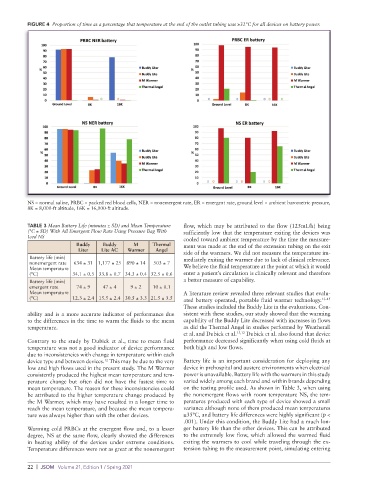
FIGURE 4  Proportion of time as a percentage that temperature at the end of the outlet tubing was ≥32°C for all devices on battery power.


          NS = normal saline, PRBC = packed red blood cells, NER = nonemergent rate, ER = emergent rate, ground level = ambient barometric pressure,
          8K = 8,000-ft altitude, 16K = 16,000-ft altitude.

          TABLE 3 Mean Battery Life (minutes ± SD) and Mean Temperature   flow, which may be attributed to the flow (125mL/h) being
          (°C ± SD) With All Emergent Flow Rate Using Pressure Bag With   sufficiently low that the temperature exiting the devices was
          Iced NS                                            cooled toward ambient temperature by the time the measure-
                          Buddy    Buddy     M     Thermal   ment was made at the end of the extension tubing on the exit
                           Liter  Lite AC  Warmer   Angel    side of the warmers. We did not measure the temperature im-
           Battery life (min)                                mediately exiting the warmer due to lack of clinical relevance.
           nonemergent rate  634 ± 31  1,177 ± 25  890 ± 14  503 ± 7
           Mean temperature                                  We believe the fluid temperature at the point at which it would
           (°C)          34.1 ± 0.5 33.8 ± 0.7 34.3 ± 0.4 32.5 ± 0.6  enter a patient’s circulation is clinically relevant and therefore
           Battery life (min)                                a better measure of capability.
           emergent rate  74 ± 9   47 ± 4   9 ± 2  10 ± 0.1
           Mean temperature                                  A literature review revealed three relevant studies that evalu-
           (°C)          12.3 ± 2.4 15.5 ± 2.4 30.5 ± 3.3 21.5 ± 3.5  ated battery operated, portable fluid warmer technology. 13–15
                                                             These studies included the Buddy Lite in the evaluations. Con-
          ability and is a more accurate indicator of performance due   sistent with these studies, our study showed that the warming
          to the differences in the time to warm the fluids to the mean   capability of the Buddy Lite decreased with increases in flows
          temperature.                                       as did the Thermal Angel in studies performed by Weatherall
                                                             et al. and Dubick et al. 13,12  Dubick et al. also found that device

          Contrary to the study by Dubick et al., time to mean fluid   performance decreased significantly when using cold fluids at
          temperature was not a good indicator of device performance   both high and low flows.
          due to inconsistencies with change in temperature within each
          device type and between devices.  This may be due to the very   Battery life is an important consideration for deploying any
                                   12
          low and high flows used in the present study. The M Warmer   device in prehospital and austere environments when electrical
          consistently produced the highest mean temperature and tem-  power is unavailable. Battery life with the warmers in this study
          perature change but often did not have the fastest time to   varied widely among each brand and within brands depending
          mean temperature. The reason for these inconsistencies could   on the testing profile used. As shown in Table 3, when using
          be attributed to the higher temperature change produced by   the nonemergent flows with room temperature NS, the tem-
          the M Warmer, which may have resulted in a longer time to   peratures produced with each type of device showed a small
          reach the mean temperature, and because the mean tempera-  variance although none of them produced mean temperatures
          ture was always higher than with the other devices.  ≥35°C, and battery life differences were highly significant (p <
                                                             .001). Under this condition, the Buddy Lite had a much lon-
          Warming cold PRBCs at the emergent flow and, to a lesser   ger battery life than the other devices. This can be attributed
          degree, NS at the same flow, clearly showed the differences   to the extremely low flow, which allowed the warmed fluid
          in heating ability of the devices under extreme conditions.   exiting the warmers to cool while traveling through the ex-
          Temperature differences were not as great at the nonemergent   tension tubing to the measurement point, simulating entering


          22  |  JSOM   Volume 21, Edition 1 / Spring 2021

