


Page 28 - JSOM Spring 2021
P. 28
open head injury. The physician had been supplied with a   Methods
          generic “med ruck” without the medications or equipment
          required to provide critical care. Additionally, he had not re-  The target audiences for the inaugural course were USAF
          ceived any clinical training in critical care or prolonged field   pararescue surgeons, ST flight surgeons, and physician assis-
          care (PFC) in austere environments.  The second case study in-  tants (PAs) who were assigned to operational teams with PJs,
                                     6
          volved another GMO who flew in a combat zone to transport   or to squadrons conducting training for PJs. One experienced
          a mechanically ventilated child via an HH-60 (rotary wing   independent duty medical technician (IDMT) also attended.
          evacuation), without the benefit of any pediatric critical care
          training, rotary wing familiarization, en route care exposure,   The course was based on the senior author’s years of observa-
          or operational experience to ensure combat effectiveness and   tion, experience, and training, during which time he not only
          mitigate risk to the patient, force, or mission.  The final case   defined the role of the PJ MO, but also identified the critical
                                              7
          study is a GMO whose team was injured from a rocket pro-  steps to best prepare someone for the role. As the course was
          pelled grenade (RPG) attack and subsequent helicopter crash.   being designed for physicians and PAs, the course needed to be
          He had to provide emergent care to multiple patients and co-  accepted as a legitimate medical course. Continuing medical
          ordinate a complex effort to stabilize and support the casual-  education credits were granted, an academic affiliation was es-
          ties back to the United States.                    tablished with a distinguished medical center housing state-of-
                                                             the-art educational resources, and expert military and civilian
          All of these examples reflect the absence of specific train-  instructors were recruited.
          ing to prepare SOFMOs for the difficulties they will face in
          the performance of their job and the potentially devastating   The format integrated classroom instruction, hands-on skills,
          consequences to the patients, the mission, and the provid-  and simulation. The course began with one week of opera-
          er’s professional standing and self-image if the unthinkable    tional medicine and science lectures interwoven with skills
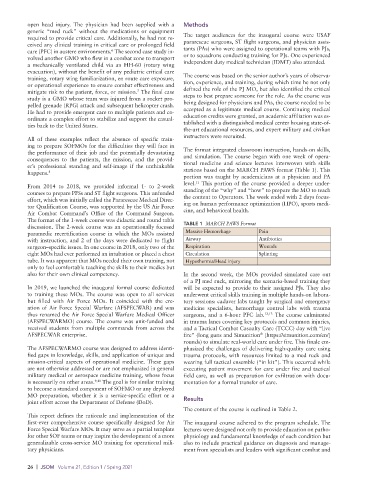
          happens. 8                                         stations based on the MARCH PAWS format (Table 1). This
                                                             portion was taught by academicians at a physician and PA
                                                                 11
          From 2014 to 2018, we provided informal 1- to 2-week   level.  This portion of the course provided a deeper under-
          courses to prepare PFSs and ST flight surgeons. This unfunded   standing of the “why” and “how” to prepare the MO to teach
          effort, which was initially called the Pararescue Medical Direc-  the content to Operators. The week ended with 2 days focus-
          tor Qualification Course, was supported by the US Air Force   ing on human performance optimization (HPO), sports medi-
          Air  Combat  Command’s Office  of  the  Command  Surgeon.   cine, and behavioral health.
          The format of the 1-week course was didactic and round table
          discussion. The 2-week course was an operationally focused   TABLE 1  MARCH PAWS Format
          paramedic  recertification course  in  which the  MOs assisted   Massive Hemorrhage  Pain
          with instruction, and 2 of the days were dedicated to flight   Airway       Antibiotics
          surgeon–specific issues. In one course in 2018, only two of the   Respiration  Wounds
          eight MOs had ever performed an intubation or placed a chest   Circulation  Splinting
          tube. It was apparent that MOs needed their own training, not   Hypothermia/Head injury
          only to feel comfortable teaching the skills to their medics but
          also for their own clinical competency.            In the second week, the MOs provided simulated care out
                                                             of a PJ med ruck, mirroring the scenario-based training they
          In 2019, we launched the inaugural formal course dedicated   will be expected to provide to their assigned PJs. They also
          to training these MOs. The course was open to all services   underwent critical skills training in multiple hands-on labora-
          but filled with Air Force MOs. It coincided with the cre-  tory sessions: cadaver labs taught by surgical and emergency
          ation of Air Force Special Warfare (AFSPECWAR) and was   medicine specialists, hemorrhage control labs with trauma
          thus renamed the Air Force Special Warfare Medical Officer   surgeons, and a 6-hour PFC lab. 12,13  The course culminated
          (AFSPECWARMO) course. The course was unit-funded and   in trauma lanes covering key protocols and common injuries,
          received students from multiple commands from across the   and a Tactical Combat Casualty Care (TCCC) day with “live
          AFSPECWAR enterprise.                              fire” (long guns and Simunition  [https://simunition.com/en/]
                                                                                      ®
                                                             rounds) to simulate real-world care under fire. This finale em-
          The AFSPECWARMO course was designed to address identi-  phasized the challenges of delivering high-quality care using
          fied gaps in knowledge, skills, and application of unique and   trauma protocols, with resources limited to a med ruck and
          mission-critical aspects of operational medicine. These gaps   wearing full tactical ensemble (“in kit”). This occurred while
          are not otherwise addressed or are not emphasized in general   executing patient movement for care under fire and tactical
          military medical or aerospace medicine training, whose focus   field care, as well as preparation for exfiltration with docu-
          is necessarily on other areas. 9,10  The goal is for similar training   mentation for a formal transfer of care.
          to become a standard component of SOFMO or any deployed
          MO  preparation,  whether  it is  a service-specific  effort  or  a
          joint effort across the Department of Defense (DoD).  Results
                                                             The content of the course is outlined in Table 2.
          This report defines the rationale and implementation of the
          first-ever comprehensive course specifically designed for Air   The inaugural course adhered to the program schedule. The
          Force Special Warfare MOs. It may serve as a partial template   lectures were designed not only to provide education on patho-
          for other SOF teams or may inspire the development of a more   physiology and fundamental knowledge of each condition but
          generalizable cross-service MO training for operational mili-  also to include practical guidance on diagnosis and manage-
          tary physicians.                                   ment from specialists and leaders with significant combat and


          26  |  JSOM   Volume 21, Edition 1 / Spring 2021

