


Page 29 - JSOM Spring 2021
P. 29
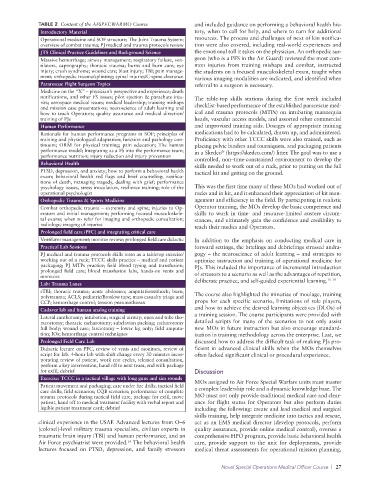
TABLE 2  Content of the AFSPECWARMO Course         and included guidance on performing a behavioral health his-
              Introductory Material                              tory, when to call for help, and where to turn for additional
              Operational medicine and SOF structure; The Joint Trauma System;   resources. The process and challenges of next of kin notifica-
              overview of combat trauma; PJ medical and trauma protocols review  tion were also covered, including real-world experiences and
              JTS Clinical Practice Guidelines and Background Science  the emotional toll it takes on the physician. An orthopedic sur-
              Massive hemorrhage; airway management; respiratory failure, ven-  geon (who is a PFS in the Air Guard) reviewed the most com-
              tilators, capnography; thoracic trauma; burns and burn care; eye   mon injuries from training mishaps and combat, instructed
              injury; crush syndrome; wound care; blast injury; TBI; pain manage-  the students on a focused musculoskeletal exam, taught when
              ment; orthopedic trauma/splinting; spinal injuries/C-spine clearance  various imaging modalities are indicated, and identified when
              Pararescue Flight Surgeon Topics                   referral to a surgeon is necessary.
              Medicine on the “X” – physician’s perspective and experience; death
              notifications, and other FS issues; pilot ejection & parachute inju-  The table-top skills stations during the first week included
              ries; aerospace medical issues; medical leadership; training mishaps   checklist-based performance of the established pararescue med-
              and mission case presentations; neuroscience of adult learning and
              how to teach Operators; quality assurance and medical direction/  ical and trauma protocols (MTPs) on intubating mannequin
              training of PJs                                    heads, vascular access models, and assorted other commercial
              Human Performance                                  and improvised training aids. Dosages of appropriate training
              Rationale for human performance programs in SOF; principles of   medications had to be calculated, drawn up, and administered.
              training and physiological adaptation; function and pathology con-  Proficiency with other TCCC skills were also trained, such as
              tinuum; ORM for physical training; pain education; The human   placing pelvic binders and tourniquets, and packaging patients
              performance model; Integrating as a FS into the performance team;   in a Skedco  (https://skedco.com/) litter. The goal was to use a
                                                                         ®
              performance nutrition; injury reduction and injury prevention  controlled, non–time-constrained environment to develop the
              Behavioral Health                                  skills needed to work out of a ruck, prior to putting on the full
              PTSD, depression, and anxiety; how to perform a behavioral health   tactical kit and getting on the ground.
              exam; behavioral health red flags and brief counseling; notifica-
              tions of death, managing tragedy, dealing with grief; performance
              psychology issues, stress inoculation, resilience training; role of the   This was the first time many of these MOs had worked out of
              operational psychologist                           rucks and in kit, and it enhanced their appreciation of kit man-
              Orthopedic Trauma & Sports Medicine                agement and efficiency in the field. By participating in realistic
              Combat orthopedic trauma – extremity and spine; injuries to Op-  Operator training, the MOs develop the basic competence and
              erators and initial management; performing focused musculoskele-  skills to work in time- and resource-limited austere circum-
              tal exams; when to refer for imaging and orthopedic consultation;   stances, and ultimately gain the confidence and credibility to
                radiologic imaging of injuries                   teach their medics and Operators.
              Prolonged field care (PFC) and integrating critical care
              Ventilator management; monitor review; prolonged field care  didactic  In addition to the emphasis on conducting medical care in
              Practical Lab Sessions                             forward settings, the briefings and debriefings stressed andra-
              PJ medical and trauma protocols skills intro as a tabletop exercise/  gogy – the neuroscience of adult learning – and strategies to
              working out of a ruck; TCCC skills practice – medical and patient   optimize instruction and training of operational medicine for
              packaging; PJ MTPs practice; field blood typing and transfusion;   PJs. This included the importance of incremental introduction
              prolonged field care; blood transfusion labs, hands-on vents and   of stressors to a scenario as well as the advantages of repetition,
              monitors                                           deliberate practice, and self-guided experiential learning. 15–19
              Lab: Trauma Lanes
              sTBI; thoracic trauma; acute abdomen; amputations/shock; burn;   The course also highlighted the minutiae of moulage, training
              polytrauma; ACLS; pediatric/Broslow tape; mass casualty triage and
              CCP; hemorrhage control; tension pneumothorax      props for each specific scenario, limitations of role players,
              Cadaver lab and human analog training              and how to achieve the desired learning objectives (DLOs) of
              Lateral canthotomy; intubation; surgical airway; open and tube tho-  a training session. The course participants were provided with
              racostomy; thoracic escharotomy; subclavian packing; escharotomy   detailed scripts for many of the scenarios to not only assist
              full body; wound care; fasciotomy – lower leg only; field amputa-  new MOs in future instruction but also encourage standard-
              tion; IOs; hemorrhage control techniques           ization in training methodology across the enterprise. Last, we
              Prolonged Field Care Lab                           discussed how to address the difficult task of making PJs pro-
              Didactic lecture on PFC, review of vents and monitors, review of   ficient in advanced clinical skills when the MOs themselves
              script for lab. 4-hour lab with shift change every 30 minutes incor-  often lacked significant clinical or procedural experience.
              porating review of patient, work rest cycles, telemed consultation,
              perform a key intervention, hand off to next team, end with package
              for exfil; debrief                                 Discussion
              Exercise: TCCC in a tactical village with long guns and sim rounds  MOs assigned to Air Force Special Warfare units must master
              Patient movement and packaging; care under fire drills; tactical field   a complex leadership role and a dynamic knowledge base. The
              care drills; field scenarios; CQB scenarios; performance of complete
              trauma protocols during tactical field care, package for exfil, move   MO must not only provide traditional medical care and clear-
              patient, hand off to medical treatment facility with verbal report and   ance for flight status for Operators but also perform duties
              legible patient treatment card; debrief            including the following: create and lead medical and surgical
                                                                 skills training, help integrate medicine into tactics and rescue,
              clinical experience in the USAF. Advanced lectures from O–6   act as an EMS medical director (develop protocols, perform
              (colonel)-level military trauma specialists, civilian experts in   quality assurance, provide online medical control), oversee a
              traumatic brain injury (TBI) and human performance, and an   comprehensive HPO program, provide basic behavioral health
              Air Force psychiatrist were provided.  The behavioral health   care, provide support to the unit for deployments, provide
                                           14
              lectures focused on PTSD, depression, and family stressors   medical threat assessments for operational mission planning,
                                                                         Novel Special Operations Medical Officer Course  |  27

