


Page 89 - JSOM Winter 2019
P. 89
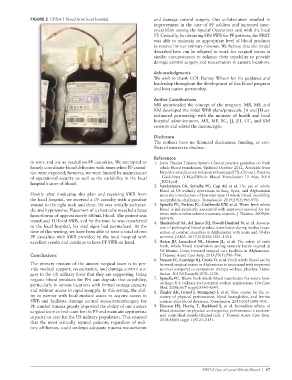
FIGURE 2  CPDA-1 blood from local hospital.        and damage control surgery. Our collaboration resulted in
                                                                 improvement in the care of PF soldiers and increased inter-
                                                                 operability among the Special Operations unit with the local
                                                                 PF. Critically, by obtaining HN SWB for PF patients, the ERST
                                                                 was able to maintain an appropriate level of blood products
                                                                 in reserve for our primary mission. We believe that the model
                                                                 described here can be adapted to work for surgical teams in
                                                                 similar circumstances to enhance their capability to provide
                                                                 damage control surgery and resuscitation in austere locations.

                                                                 Acknowledgments
                                                                 We wish to thank COL Ramey Wilson for his guidance and
                                                                 leadership throughout the development of this blood program
                                                                 and host nation partnership.

                                                                 Author Contributions
                                                                 MB spearheaded the concept of the program. MB, MF, and
                                                                 KM developed the initial WBB plans/protocols. JA and JH co-
                                                                 ordinated partnership with the minister of health and local
                                                                 hospital administrators. MB, MF, BC, JJ, JH, CC, and KM
                                                                 cowrote and edited the manuscripts.

                                                                 Disclosure
                                                                 The authors have no financial disclosures, funding, or con-
                                                                 flicts of interest to disclose.

                                                                 References
              to store and use as needed on PF casualties. We attempted to   1.  Joint Theater Trauma System Clinical practice guideline on fresh
              loosely coordinate blood deliveries with times when PF casual-  whole blood transfusion. Updated October 2012. Available from
              ties were expected; however, we were limited by maintenance   http://jts.amedd.army.mil/assets/docs/cpgs/JTS_Clinical_Practice
              of operational security as well as the variability in the local   _Guidelines_(CPGs)/Whole_Blood_Transfusion_15_May_2018
              hospital’s store of blood.                           _ID21.pdf
                                                                 2.  Vanderspurt CK, Spinella PC, Cap AP, et al. The use of whole
                                                                   blood in US military operations in Iraq, Syria, and Afghanistan
              Shortly after instituting this plan and receiving SWB from   since the introduction of low-titer type O whole blood: feasibility,
              the local hospital, we received a PF casualty with a gunshot   acceptability, challenges. Transfusion. 2019;59(3):965-970.
              wound to the right neck and chest. He was initially tachycar-  3.  Spinella PC, Perkins JG, Grathwohl KW, et al. Warm fresh whole
              dic and hypotensive. Placement of a chest tube revealed a large   blood is independently associated with improved survival for pa-
              hemothorax of approximately 600mL blood. The patient was   tients with combat-related traumatic injuries. J Trauma. 2009;66:
                                                                   S69-S76.
              transfused 1U local SWB, and by the time he was transferred   4.  Shackelford SA, del Junco DJ, Powell-Dunford N, et al. Associa-
              to the local hospital, his vital signs had normalized. At the   tion of prehospital blood product transfusion during medical evac-
              time of this writing, we have been able to treat a total of two   uation of combat casualties in Afghanistan with acute and 30-day
              PF casualties with SWB provided by the local hospital with   survival. JAMA. 2017;318(16):1581–1591.
              excellent results and continue to have PF SWB on hand.  5.  Auten JD, Lunceford NL, Horton JL, et al. The safety of early
                                                                   fresh, whole blood transfusion among severely battle injured at
                                                                   US Marine Corps forward surgical care facilities in Afghanistan.
              Conclusions                                          J Trauma Acute Care Surg. 2015;79(5):790–796.
                                                                 6.  Nessen SC, Eastridge BJ, Cronk D, et al. Fresh whole blood use by
              The primary mission of the austere surgical team is to pro-  forward surgical teams in Afghanistan is associated with improved
              vide medical support, resuscitation, and damage control sur-  survival compared to component therapy without platelets. Trans-
              gery to the US military force that they are supporting. Using   fusion. 2013;53(suppl):107S–113S.
              organic blood products for PFs can degrade that capability,   7.  Spinella PC. Warm fresh whole blood transfusion for severe hem-
              particularly in remote locations with limited storage capacity   orrhage: U.S. military and potential civilian applications. Crit Care
                                                                   Med. 2008;36(7 suppl):S340–S345.
              and without access to rapid resupply. In this setting, the abil-  8.  Ziegler AK, Grand J, Strangerup I, et al. Time course for the re-
              ity to partner with local medical assets to acquire access to   covery of physical performance, blood hemoglobin, and ferritin
              SWB and facilitate damage control resuscitation/surgery for   content after blood donation. Transfusion. 2015;55(4):898–905.
              PF combat trauma greatly improved the ability of our austere   9.  Eliassen HS, Hervig T, Backlund S, et al. Immediate effects of
              surgical team to both care for the PF and maintain appropriate   blood donation on physical and cognitive performance: a random-
              capacity to care for the US military population. This ensured   ized controlled double-blinded trial. J Trauma Acute Care Surg.
              that the most critically injured patients, regardless of mili-  2018;84(6S suppl 1):S125–S131.
              tary affiliation, could undergo adequate trauma resuscitation


                                                                                     ERST-5 Use of Local Whole Blood  |  87

