


Page 86 - JSOM Summer 2019
P. 86
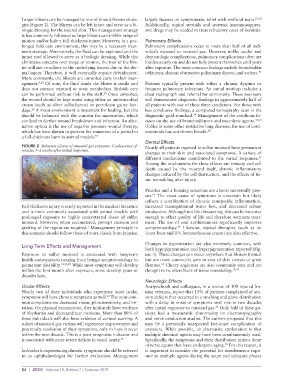
Larger blisters can be managed by one of three different strate-  largely focuses on symptomatic relief with artificial tears. 19,30
          gies (Figure 2). The blisters can be left intact and serve as a bi-  Additionally, topical steroids and systemic immunosuppres-
          ologic dressing for the injured skin. This management strategy   sive drugs may be needed to treat refractory cases of keratitis.
          is less commonly followed as large blisters can inhibit range of
          motion and/or hide a full-thickness injury. However, in a pro-  Pulmonary Effects
          longed field care environment, this may be a necessary treat-  Pulmonary complications occur in more than half of all indi-
          ment strategy. Alternatively, the fluid can be aspirated and the   viduals exposed to mustard gas. However, unlike ocular and
          intact roof allowed to serve as a biologic dressing. While this   dermatologic complications, pulmonary complications often are
          eliminates concerns over range of motion, the roof of the blis-  insidious early on and do not fully present themselves until years
          ter will not re-adhere to the underlying tissues due to the der-  after exposure. The most common findings include bronchiolitis
          mal injury. Therefore, it will eventually require debridement.   obliterans, chronic obstructive pulmonary disease, and asthma. 31
          More commonly, the blisters are unroofed early in their man-
          agement. 9,20  Of note, the fluid inside the blister is sterile and   Patients typically present with either a chronic dyspnea or
          does not contain mustard or toxic metabolites. Bedside care   frequent pulmonary infections. An initial workup includes a
          can be performed without risk to the staff.  Once unroofed,   chest radiograph and referral for spirometry. These two tests
                                            20
          the wound should be kept moist using either an antimicrobial   will demonstrate diagnostic findings in approximately half of
          cream (such as silver sulfadiazine) or petroleum gauze ban-  all patients with one of these three conditions. For those with
          dage.  A moist environment is important for healing, but this   less conclusive findings, a computed tomography scan is the
              20
          should be balanced with the concern for maceration, which   diagnostic gold standard.  Management of the condition fo-
                                                                                 24
          can lead to further wound breakdown and infection. An alter-  cuses on the use of bronchodilators and mucolytic agents. 32,33
          native option is the use of negative pressure wound therapy,   Unlike in some other restrictive lung diseases, the use of corti-
          which has been shown to prevent the transition of a partial to   costeroids has not shown benefit. 23
          a full-thickness burn in animal models. 29
                                                             Dermal Effects
          FIGURE 2  Subacute effects of mustard gas exposure. Coalescence of   Nearly all patients exposed to sulfur mustard have permanent
          vesicles 1–2 weeks after initial exposure.
                                                             changes to their skin and associated symptoms. A variety of
                                                             different  mechanisms  contributed  to  the  varied  responses.
                                                                                                            27
                                                             Among the mechanisms for these effects are toxicity and cell
                                                             death caused by the mustard itself, chronic inflammatory
                                                             changes induced by the cell destruction, and the effects of tis-
                                                             sue remodeling after injury.
                                                             Pruritus and a burning sensation are almost universally pres-
                                                             ent.  The exact cause of symptoms is uncertain but likely
                                                                14
                                                             reflects a combination of chronic nonspecific inflammation,
          Full-thickness injury is rarely reported in the medical literature   increased transepidermal water loss, and decreased sebum
          and is more commonly associated with animal models with   production. Although not life threatening, this can be intrusive
          prolonged exposure to highly concentrated doses of sulfur   enough to effect quality of life and therefore warrants treat-
          mustard. However, when encountered, prompt excision and   ment.  The  use of  oral antihistamines  significantly  improves
          grafting of the region are required.  Management principle in   symptomatology.  Likewise, topical therapies (such as an
                                     5
                                                                          34
          this scenario should follow those of more classic burn injuries.  Unna boot and 1% betamethasone cream) are also effective.
                                                             Changes in pigmentation are also extremely common, with
          Long-Term Effects and Management
                                                             both hypopigmentation and hyperpigmentation reported (Fig-
          Exposure to sulfur mustard is associated with long-term   ure 3). These changes can occur anywhere that blisters formed
          health consequences ranging from benign symptomatology to   but are more commonly seen in area of skin creases or great
          permanent disability. 14,23,29  While most symptoms will develop   flexures.  Cherry angiomas are also commonly seen and are
                                                                    14
          within the first month after exposure, some develop years or   thought to be aftereffects of tissue remodeling. 14,27
          decades later.
                                                             Neurologic Effects
          Ocular Effects                                     Azarpazhooh and colleagues, in a review of 100 injured Ira-
          Nearly two of three individuals who experience acute ocular   nian veterans, report that 13% of patients complained of sen-
          symptoms will have chronic symptoms as well.  The most com-  sory deficits that occurred in a stocking and glove distribution
                                             30
          mon complaints are decreased vision, photosensitivity, and irri-  with a delay in onset of symptoms until one to two decades
          tation. On physical examination, they uniformly have evidence   after initial exposure to mustard gas.  Only half of these pa-
                                                                                          35
          of blepharitis and decreased tear meniscus. More than 80% of   tients had a measurable abnormality on electromyography
          these individuals will also have evidence of corneal scarring. A   and nerve conduction studies. The authors proposed that this
          subset of mustard gas victims will experience improvement and   may be a previously unreported late-onset complication of
          potentially resolution of their symptoms, only to have it recur   exposure. While possible, an alternative explanation is that
          within the next decade. This is a poor prognostic indicator and   multiple chemical agents may have been simultaneously used.
          is associated with more severe deficits in visual acuity. 30  Specifically, the symptoms and their distribution mirror those
                                                             of nerve agents that have undergone aging.  For this reason, it
                                                                                              20
          Individuals experiencing chronic symptoms should be referred   is important to consider the potential for simultaneous expo-
          to  an  ophthalmologist  for  further  evaluation.  Management   sure to multiple agents during the acute and subacute phases


          84  |  JSOM   Volume 19, Edition 2 / Summer 2019

