


Page 81 - JSOM Summer 2019
P. 81
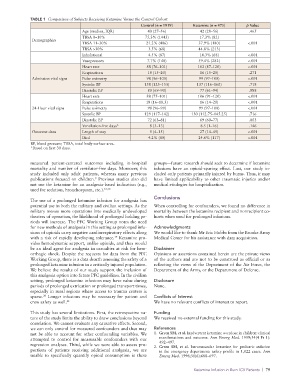
TABLE 1  Comparison of Subjects Receiving Ketamine Versus the Control Cohort
                                                           Control (n = 1919)    Ketamine (n = 475)    p Value
                                   Age (median, IQR)          40 (27–56)            42 (28–56)          .465
                                   TBSA 0–10%                75.3% (1445)          17.3% (82)
              Demographics
                                   TBSA 11–30%               21.2% (406)           37.9% (180)         <.001
                                   TBSA >30%                  3.5% (68)            44.8% (213)
                                   Inhalational               4.5% (87)            14.3% (68)          <.001
                                   Vasopressors               7.7% (148)           59.4% (282)         <.001
                                   Heart rate                 88 (76–101)          102 (87–120)        <.001
                                   Respirations               18 (15–20)            16 (15–20)          .271
              Admission vital signs  Pulse oximetry           98 (96–100)          99 (97–100)         <.001
                                   Systolic BP               138 (123–153)        137 (116–160)         .718
                                   Diastolic BP               80 (69–90)            77 (61–94)          .088
                                   Heart rate                 88 (75–101)          106 (91–120)        <.001
                                   Respirations              18 (16–18.5)           16 (14–20)         <.001
              24-Hour vital signs  Pulse oximetry             98 (96–99)           99 (97–100)         <.001
                                   Systolic BP               129 (117–142)      130 (112.75–145.25)     .716
                                   Diastolic BP               72 (63–81)            69 (60–77)          .003
                                   Ventilation-free days*      8 (3–13)             8.5 (1–16)          .146
              Outcome data         Length of stay              9 (4–15)             27 (14–49)         <.001
                                   Died                       4.2% (80)            24.6% (117)         <.001
              BP, blood pressure; TBSA, total body surface area.
              *Based on first 30 days.

              measured patient-centered outcomes including in-hospital   groups—future research should seek to determine if ketamine
              mortality and number of ventilator-free days. Moreover, this   infusions have an opioid-sparing effect.  Last, our study in-
              study  included only  adult patients,  whereas  many  previous   cluded only patients primarily injured by burns. Thus, it may
              publications  focused  on  children.   Previous  studies  also  did   have limited applicability to other traumatic injuries and/or
                                        9
              not use the ketamine for an analgesia-based indication (e.g.,   medical etiologies for hospitalization.
              used for sedation, bronchospasm, etc.). 16,18
                                                                 Conclusions
              The use of a prolonged ketamine infusion for analgesia has
              potential use in both the military and civilian settings. As the   When controlling for confounders, we found no difference in
              military moves more operations into medically undeveloped   mortality between the ketamine recipient and nonrecipient co-
              theaters of operation, the likelihood of prolonged holding pe-  horts when used for prolonged infusions.
              riods will increase. The PFC Working Group notes the need
              for new methods of analgesia in this setting as prolonged infu-  Acknowledgments
              sions of opioids carry negative cardiorespiratory effects along   We would like to thank Mr Eric Hobbs from the Brooke Army
              with a risk of rapidly developing tolerance.  Ketamine pro-  Medical Center for his assistance with data acquisition.
                                                19
              vides hemodynamic support, unlike opioids, and thus would
              be an ideal agent for analgesia in casualties at risk for hem-  Disclaimer
              orrhagic shock. Despite the requests for data from the PFC   Opinions or assertions contained herein are the private views
              Working Group, there is a data dearth assessing the safety of a   of the authors and are not to be construed as official or as
              prolonged ketamine infusion in a critically injured population.   reflecting the views of the Department of the Air Force, the
              We believe the results of our study support the inclusion of   Department of the Army, or the Department of Defense.
              this analgesia option into future PFC guidelines. In the civilian
              setting, prolonged ketamine infusions may have value during   Disclosure
              periods of prolonged extrication or prolonged transport times,   None.
              especially in rural regions where access to trauma centers is
              sparse.  Longer infusions may be necessary for patient and   Conflicts of Interest
                   20
              crew safety as well. 21                            We have no relevant conflicts of interest to report.
              This study has several limitations. First, the retrospective na-  Funding
              ture of the study limits the ability to draw conclusions beyond   We received no external funding for this study.
              correlation. We cannot evaluate any causative effects. Second,
              we can only control for measured confounders and thus may   References
              not be able to account for other confounding variables. We   1.  Green SM, et al. Inadvertent ketamine overdose in children: clinical
              attempted to control for measurable confounders with our   manifestations and outcome. Ann Emerg Med. 1999;34(4 Pt 1):
                                                                   492–497.
              regression analyses. Third, while we were able to assess pro-  2.  Green SM, et al.  Intramuscular ketamine for pediatric sedation
              portions of patients receiving additional analgesia, we are   in the emergency department: safety profile in 1,022 cases. Ann
              unable to specifically quantify opioid consumption in these   Emerg Med. 1998;31(6):688–697.

                                                                                 Ketamine Infusion in Burn ICU Patients  |  79

