


Page 137 - JSOM Summer 2019
P. 137
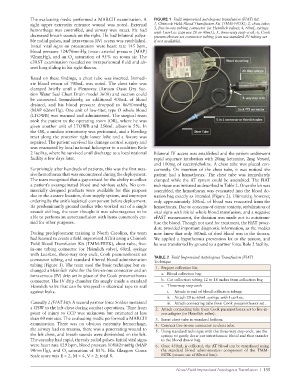
The evaluating medic performed a MARCH examination. A   FIGURE 1  Field improvised autologous transfusion (FIAT) kit.
              right upper extremity entrance wound was noted. External   1, Chinook Field Blood Transfusion Kit (TMM-FBTK); 2, chest tube;
              hemorrhage was controlled, and airway was intact. He had   3, five-in-one tubing connector (or Heimlich valve); 4, 60mL syringe
              decreased breath sounds on the right. He had bilateral palpa-  with LuerLoc (can use 20 or 40mL); 5, three-way stop-cock; 6, Cook
                                                                 pneumothorax set connector tubing (can use standard IV tubing set
              ble radial pulses, and intravenous (IV) access was established.   if not available).
              Initial vital signs on presentation were heart rate 145 bpm,
              blood pressure 124/76mmHg (mean arterial pressure [MAP]
              92mmHg), and an O  saturation of 95% on room air. The
                               2
              eFAST examination revealed no intraperitoneal fluid and ab-
              sent lung sliding in his right thorax.
              Based on these findings, a chest tube was inserted. Immedi-
              ate blood return of 700mL was noted. The chest tube was
              clamped briefly until a Pleurovac (Atrium Oasis Dry Suc-
              tion Water Seal Chest Drain model 3600) and suction could
              be connected. Immediately, an additional 400mL of blood
              drained, and his blood pressure dropped to 86/50mmHg
              (MAP 62mmHg). One unit of low-titer, type O whole blood
              (LTOWB) was warmed and administered. The surgical team
              took the patient to the operating room (OR), where he was
              given another unit of LTOWB and 250mL albumin 5%. In
              the OR, a median sternotomy was performed, and a bleeding
              tract along the posterior right lower lobe and a fissure was
              repaired. The patient survived his damage control surgery and
              was evacuated by local national helicopter to a coalition Role
              2 facility, where he survived until discharge to a local national   Bilateral IV access was established and the patient underwent
              facility a few days later.                         rapid sequence intubation with 20mg ketamine, 2mg Versed,
                                                                 and 100mg of succinylcholine. A chest tube was placed con-
              Surprisingly after hundreds of patients, this was the first mas-  currently. On insertion of the chest tube, it was noticed the
              sive hemothorax that was encountered during the deployment.   patient had a hemothorax. The chest tube was immediately
              The team recognized that a gap existed for the ability to collect   clamped while the AT system could be assembled. The FIAT
              a patient’s exsanguinated blood and reinfuse safely. No com-  technique was initiated as described in Table 2. Once the kit was
              mercially designed products were available for this purpose   assembled, the hemothorax was evacuated into the blood do-
              due to the austere location, slow supply system, and improper   nation bag exactly as intended (Figure 2). Ultimately, however,
              ordering by the unit’s logistical component before deployment.   only approximately 300mL of blood was evacuated from the
              As predominantly ground medics who worked out of a single   hemothorax. Due to concerns of citrate toxicity, stabilization of
              assault aid bag, the team thought it was advantageous to be   vital signs with initial whole blood transfusion, and a negative
              able to perform an autotransfusion with items commonly car-  eFAST reassessment, the decision was made not to autotrans-
              ried for other purposes.                           fuse the blood. Though not used for treatment, the FIAT proce-
                                                                 dure provided important diagnostic information, as the medics
              During predeployment training in North Carolina, the team   now knew that only 300mL of shed blood was in the thorax.
              had learned to create a field improvised ATkit using a Chinook   We applied a hypothermia prevention kit to the patient, and
              Field Blood Transfusion Kit (TMM-FBTK), chest tube, five-  he was transferred by ground to a partner force Role 2 facility.
              in-one tubing connector (or Heimlich valve), 60mL syringe
              with LuerLoc, three-way stop cock, Cook pneumothorax set
              connector tubing, and standard filtered blood administration   TABLE 2  Field Improvised Autologous Transfusion (FIAT)
                                                                 Technique
              tubing (Figure 1). The team used the basic technique but ex-
              changed a Heimlich valve for the five-in-one connector and an   1.  Prepare collection kit.
              intravenous (IV) drip set in place of the Cook pneumothorax   a.  Blood collection bag
              connector. The IV drip chamber fits snugly inside a standard   b.  Cut collection tubing 12 to 18 inches from collection bag
              Heimlich valve that can be wrapped in electrical tape to seal   c.  Three-way stop-cock
              against leaks.                                          i.   Attach to end of blood collection tubing.
                                                                      ii.  Attach 20 to 60mL syringe with LuerLoc.
              Casualty 2 (FIAT kit): A second partner force Soldier sustained   iii.  Attach connecting tube from Cook pneumothorax set .
              a GSW to the left chest during combat operations. Time from   2.  Attach connecting tube from Cook pneumothorax set to five-in-
              point  of  injury  to  CCP  was  unknown  but  estimated  at  less   one adapter (or Heimlich valve).
              than 60 minutes. The evaluating medic performed a MARCH   3.  Insert chest tube in standard fashion.
              examination. There was no obvious extremity hemorrhage,   4.  Connect five-in-one connector to chest tube.
              the airway had no trauma, there was a penetrating wound to
              the left chest, and breath sounds were diminished on the left.   5.  Using standard technique with the three-way stop-cock, use the
                                                                    syringe to gently draw out intrathoracic blood and then transfer
              The casualty had rapid, thready radial pulses. Initial vital signs   to the blood donor bag.
              were heart rate 129 bpm, blood pressure 108/82mmHg (MAP   6.  Once 450mL is collected, the AT blood can be transfused using
              90mmHg), and O saturation of 85%. His Glasgow Coma    the  standard  blood  administration  component  of  the   TMM-
                            2
              Scale score was E = 2, M = 4, V = 2; total 8.         FBTK (ensure use of filtered line).
                                                                          Novel Field Improvised Autologous Transfusion  |  135

