


Page 134 - JSOM Summer 2019
P. 134
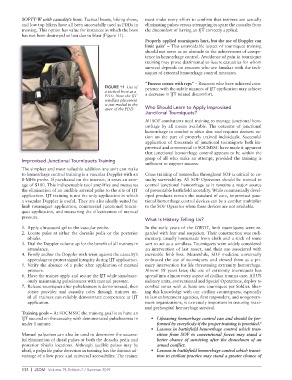
SOFTT-W with casualty’s boot. Tactical boots, hiking shoes,   must make every effort to confirm that trainees are actually
          and low top hikers have all been successfully used as PDDs in   eliminating pulses versus attempting to spare the casualty from
          training. This option has value for instances in which the boot   the discomfort of having an IJT correctly applied.
          has not been destroyed or lost due to blast (Figure 11).
                                                             Properly applied tourniquets hurt, but the use of Doppler can
                                                             limit pain  – This unavoidable aspect of tourniquet training
                                                                     7
                                                             should not serve as an obstacle to the achievement of compe-
                                                             tence in hemorrhage control. Avoidance of pain in tourniquet
                                                             training may prove detrimental to future casualties for whom
                                                             survival depends on rescuers who are familiar with the tech-
                                                             niques of external hemorrhage control measures.

                                                             “Finesse comes with reps” – Rescuers who have achieved com-
                                            FIGURE 11  Use of   petence with the subtle nuances of IJT application may achieve
                                            a tactical boot as a   a decrease in IJT related discomfort.
                                            PDD. Note the IJT
                                            windlass placement
                                            is just medial to the   Who Should Learn to Apply Improvised
                                            apex of the PDD.
                                                             Junctional Tourniquets?
                                                             All SOF combatants need training to manage junctional hem-
                                                             orrhage by all means available. The outcome of junctional
                                                             hemorrhage in combat is often dire and requires decisive ac-
                                                             tion  on  the  part  of  properly  trained  individuals.  Successful
                                                             application of thousands of junctional tourniquets both im-
                                                             provised and commercial in SOCMSSC have made it apparent
                                                             that junctional hemorrhage control appears to be within the
                                                             grasp of all who make an attempt, provided the training is
          Improvised Junctional Tourniquets Training
                                                             sufficient to support success.
          The simplest and most valuable addition any unit can make
          to hemorrhage control training is a vascular Doppler with an   Cross training of nonmedics throughout SOF is critical to ca-
          8-MHz probe. If purchased on the internet, it costs an aver-  sualty survivability. All SOF Operators should be trained to
          age of $100. This indispensable tool amplifies and measures   control junctional hemorrhage as it remains a major source
          the elimination of an audible arterial pulse to the site of IJT   of preventable battlefield mortality. While commercially devel-
          application. IJT training is not the only application in which   oped products remain the standard of care, improvised junc-
          a vascular Doppler is useful. They are also ideally suited for   tional hemorrhage control devices can be a combat multiplier
          limb tourniquet application, commercial junctional tourni-  to the SOF Operator when these devices are not available.
          quet application, and measuring the effectiveness of manual
          pressure.
                                                             What Is History Telling Us?
          1.  Apply ultrasound gel to the vascular probe.    In the early years  of the  GWOT, limb tourniquets  were  re-
          2.  Locate pulse at either the dorsalis pedis or the posterior   garded with fear and suspicion. Their construction was rudi-
            tibialis.                                        mentary, usually homemade from cloth and a stick of some
          3.  Dial the Doppler volume up for the benefit of all trainees in   sort to act as a windlass. Tourniquets were widely considered
            attendance.                                      an intervention of last resort, and their use associated with
          4.  Firmly anchor the Doppler with wrist against the casualty’s   inevitable limb loss. Meanwhile, SOF medicine universally
            appendage to protect signal integrity during IJT application.  embraced the use of tourniquets and viewed them as a pri-
          5.  Verify the absence of a pulse after application of manual   mary intervention for life threatening extremity hemorrhage.
            pressure.                                        Almost 18 years later, the use of extremity  tourniquets has
          6.  Have the trainee apply and secure the IJT while simultane-  spread into almost every aspect of civilian trauma care. All US
            ously maintaining pulselessness with manual pressure.  military units, conventional and Special Operations, deploy to
          7.  Release tourniquet after pulselessness is demonstrated, then   combat zones with at least one tourniquet per Soldier. Shar-
            rotate provider and casualty roles through trainees un-  ing this knowledge with our civilian counterparts, especially
            til all trainees can reliably demonstrate competence at IJT   to law enforcement agencies, first responders, and nongovern-
            application.                                     ment organizations, is extremely important in ensuring maxi-
                                                             mal prehospital hemorrhage survival.
          Training goals – At SOCMSSC the training goal is to have an
          IJT secured on the casualty with demonstrated pulselessness in   •  Lifesaving hemorrhage control can and should be per-
          under 1 minute.                                         formed by everybody if the proper training is provided. 8
                                                               •  Lessons in battlefield hemorrhage control which tran-
          Manual palpation can also be used to determine the success-  sition from SOF to conventional forces may stand a
          ful elimination of distal pulses at both the dorsalis pedis and   better chance of surviving after the drawdown of an
          posterior tibialis locations. Although audible pulses may be   armed conflict.
          ideal, a palpable pulse detection in training has the distinct ad-  •  Lessons in battlefield hemorrhage control which transi-
          vantage of a low price and universal accessibility. The trainer   tion to civilian practice may stand a greater chance of


          132  |  JSOM   Volume 19, Edition 2 / Summer 2019

