


Page 136 - JSOM Summer 2019
P. 136
Case Presentation

                             Creation and Utilization of a Novel Field Improvised
                            Autologous Transfusion System in a Combat Casualty


                    Tyler Scarborough, HMC ; Michael Turconi, NSOCM ; David Callaway, MD, MPA *
                                                                                                  3
                                                                      2
                                            1


          ABSTRACT
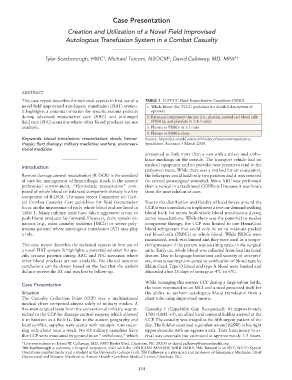
          This case report describes the technical aspects in first use of a   TABLE 1  CoTCCC Fluid Resuscitation Guidelines 180801
          novel field improvised autologous transfusion (FIAT) system.   1. Whole blood (See TCCC guidelines for detailed description of
          It highlights a potential solution for specific trauma patients   options)
          during advanced resuscitative care (ARC) and prolonged   2. Balanced component therapy (i.e., plasma, packed red blood cells
          field care (PFC) scenarios where other blood products are not   (PRBCs), and platelets in 1:1:1 ratio)
          available.                                          3. Plasma or PRBCs in 1:1 ratio
                                                              4. Plasma or PRBCs alone
          Keywords: blood transfusion; resuscitation; shock, hemor-  Source: https://jts.amedd.army.mil/index.cfm/committees/cotccc
          rhagic; fluid therapy; military medicine; warfare; unconven-  /guidelines. Accessed 5 March 2019.
          tional medicine
                                                             amounted to little more than a van with a driver and ambu-
                                                             lance markings on the outside. The transport vehicle had no
                                                             medical equipment and no provider was present to tend to the
          Introduction
                                                             patient en route. While there was a method for air evacuation,
          Remote damage control resuscitation (R-DCR) is the standard   the helicopter could hold only two patients and it was reserved
          of care for management of hemorrhagic shock in the austere   for critical postsurgical wounded. More ARC was performed
          prehospital environment. “Hemostatic resuscitation” com-  than is typical in a traditional CCP/Role I because it was hours
          posed of whole blood or balanced component therapy is a key   from the next echelon of care.
          component of R-DCR. The most recent Committee on Tacti-
          cal Combat Casualty Care guidelines for fluid resuscitation   Due to the distribution and fluidity of local forces around the
          focus on the importance of early whole blood and are listed in    CCP, it was unrealistic to implement a true on-demand walking
          Table 1. Many military units have taken aggressive action to   blood bank for warm fresh whole blood transfusions during
          push blood products far forward. However, there remain sit-  active resuscitations. While there was the potential to receive
          uations (e.g., mass casualty incidents [MCIs] or severe poly-  component therapy. the CCP was limited to one HemaCool
          trauma patient) where autologous transfusion (AT) may play   blood refrigerator that could only be set to maintain packed
          a role.                                            red blood cells (PRBCs) or whole blood. While PRBCs were
                                                             maintained, stock was limited and they were used as a tempo-
          This case report describes the technical aspects in first use of   rizing measure if the patient was awaiting space in the surgical
          a novel FIAT system. It highlights a potential solution for spe-  suite. Early on, whole blood was collected from local national
          cific trauma patients during ARC and PFC scenarios where   donors. Due to language limitations and scarcity of interpret-
          other blood products are not available. No clinical outcome   ers, most screenings amounted to verification of blood type by
          conclusions can be drawn based on the fact that the patient   Eldon Card. Type O blood and type A blood were banked and
          did not receive the AT and was lost to follow-up.  discarded after 21 days of storage at 4°C to 6°C.

                                                             While managing this austere CCP during a large urban battle,
          Case Presentation
                                                             the team responded to an MCI and a need presented itself for
          Situation                                          the ability to perform autologous blood transfusion from a
          The Casualty Collection Point (CCP) was a multinational   chest tube using improvised means.
          medical effort composed almost solely of military medics. A
          five-man surgical team from the conventional military was at-  Casualty 1 (Capability Gap Recognized): At approximately
          tached to the CCP for damage control surgery, which allowed   1700 (GMT +3), an allied local national Soldier arrived at the
          it to function as a Role I+. Due to the austere geography and   CCP. The casualty was triaged as the fifth urgent patient of the
          local conflict, supplies were scarce with resupply runs occur-  day. The Soldier sustained a gunshot wound (GSW) in his right
          ring only about once a week. No US military casualties from   upper shoulder with no apparent exit. Time from injury to ar-
          this CCP were evacuated by ground in an “ambulance,” which   rival was uncertain but estimated at approximately 1.5 hours.
          *Correspondence to David W. Callaway, MD, 1000 Blythe Blvd, Charlotte, NC 28203 or david.callaway@atriumhealth.org
                                                                                  2
          1 Mr Scarborough is currently a hospital corpsmen, chief with the USSOCOM MARSOC MRR 2MRB.  Mr Turconi is an ISTC NATO Special
          Operations combat medic and a student at the University College Cork.  Dr Callaway is a physician and professor of Emergency Medicine, Chief
                                                           3
          Operational and Disaster Medicine at Atrium Health–Carolinas Medical Center, Charlotte, NC.
                                                          134

