


Page 114 - JSOM Summer 2019
P. 114
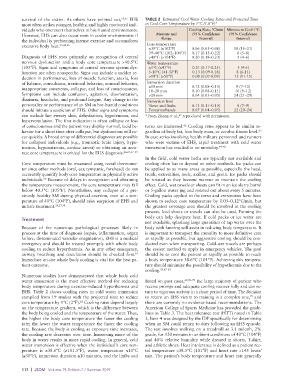
survival of  the victim.  As others have  pointed out, 54,55  EHS   TABLE 2  Estimated Cool Water Cooling Rates and Projected Time
          most often strikes younger, healthy, and highly motivated indi-  to Cool Core Temperature by 1°C (1.8°F)*
          viduals who overexert themselves in hot-humid environments.          Cooling Rate, °C/min   Minutes to Cool 1°C
          However, EHS can also occur even in cooler environments if   Measure and    (95% Confidence   (95% Confidence
          the individual is performing intense exercise and accumulates   Range    Interval)       Interval)
          excessive body heat. 23,48,56                       Core temperature
                                                              ≤39°C (≤102°F)    0.06 (0.05–0.06)  18 (16–21)
                                                              39–40°C (102–104°F)  0.17 (0.13–0.22)  6 (5–8)
          Diagnosis of EHS rests primarily on recognition of central   >40°C (>104°F)  0.20 (0.18–0.23)  5 (4–6)
          nervous dysfunction and a body core temperature >40.5°C   Water temperature
          (105°F). Signs and symptoms of central nervous system dys-  ≤5°C (≤41°F)  0.21 (0.17-0.25)  5 (4-6)
          function are often nonspecific. Signs can include a sudden re-  5-10°C (41-50°F)  0.13 (0.09-0.18)  8 (6-11)
          duction in performance, loss of muscle function, ataxia, loss   >10°C (>50°F)  0.08 (0.07-0.09)  13 (11-15)
          of balance, convulsions, irrational behavior, unusual behavior,   Immersion duration
                                                                                                   9 (7–12)
          inappropriate comments, collapse, and loss of consciousness.   ≤10 min  0.12 (0.08–0.15)  10 (9–12)
                                                              10–20 min
                                                                                0.10 (0.08–0.11)
          Symptoms  can include  confusion,  agitation, disorientation,   >20 min  0.04 (0.03–0.05)  24 (21–29)
          dizziness, headache, and profound fatigue. Any change in the   Immersion level
          personality or performance of an SM in hot-humid conditions   Torso and limbs  0.13 (0.11–0.15)  8 (7–9)
          should initiate a suspicion of EHS. Other signs and symptoms   Forearms/hands  0.05 (0.04–0.05)  22 (20–24)
          can include hot sweaty skin, dehydration, hypotension, and   *From Zhang et al.,  reproduced with permission.
                                                                           62
          hyperventilation. The first indication is often collapse or loss
          of consciousness and the patient may display normal, lucid be-  torso are immersed.  Cooling rates appear to be similar re-
                                                                             62
          havior for a short time after collapse, but dysfunction will oc-  gardless of body fat, lean body mass, or aerobic fitness level.
                                                                                                            63
          cur quickly. A broad array of differential diagnoses are possible   In case series involving health military personnel and runners
          for collapsed individuals (e.g., traumatic brain injury, hypo-  who were victims of EHS, rapid treatment with cold water
          tension, hyponatremia, cardiac arrest) so obtaining an accu-  immersion has resulted in no mortality. 64–66
          rate core temperature is critical for the EHS diagnosis. 26,27,57–59
                                                             In the field, cold water baths are typically not available and
          Core temperature must be measured using rectal thermome-  cooling often has to depend on other methods. Ice packs can
          ter since other methods (oral, ear, tympanic, forehead) do not   be applied to as many areas as possible, especially the head,
          accurately quantify body core temperature in physically active   trunk, extremities, neck, axillae, and groin. Ice packs should
          individuals.  Because of delays in recognition and obtaining   be rotated as they become warmer to maintain the cooling
                   60
          the temperature measurement, the core temperature may fall   effect. Cold, wet towels or sheets can fit in an ice slurry barrel
          below 40.5°C (105°F). Nonetheless, any collapse of a pre-  or 5-gallon water jug and rotated out about every 5 minutes.
          viously healthy SM during physical exertion, even at a tem-  Cooling packs applied to the torso and extremities have been
          perature of 40°C (104°F), should raise suspicion of EHS and   shown to reduce core temperature by 0.03–0.12°C/min, but
          initiate treatment. 26,27,58                       the greatest coverage area should be involved in the cooling
                                                             process. Iced sheets or towels can also be used. Fanning the
                                                             body can help dissipate heat. If cold packs or ice water are
          Treatment
                                                             not available, splashing large quantities of tap water over the
          Because of the numerous pathological processes likely in   body with fanning will assist in reducing body temperature. It
          process at the time of diagnosis (sepsis, inflammation, organ   is important to transport the causality to more definitive care
          failure, disseminated vascular coagulation), EHS is a medical   as rapidly as possible, but aggressive cooling should be con-
          emergency and should be treated promptly with whole body   ducted even when transporting. Cold-wet towels are perhaps
          cooling to reduce hyperthermia. As in any other emergency,   the easiest method to apply in emergency vehicles. The goal
          airway,  breathing  and  circulation  should  be  checked  first.    should be to cool the patient as rapidly as possible to reach
                                                         61
          Immediate on-site whole body cooling is vital for the best pa-  a body temperature 38.6°C (101°F). Achieving this tempera-
          tient outcome.                                     ture should minimize the possibility of hypothermia due to the
                                                             cooling. 59,67–69
          Numerous studies have demonstrated that whole body cold
          water immersion is the most effective method for reducing   Based on past cases, 49,70–72  the large majority of patient who
          body temperature during exercise-induced hyperthermia and   receive prompt and adequate cooling recover fully and can re-
          EHS. Table 2 shows cooling rates in cold water immersion   turn to vigorous activity in a short period of time. The decision
          compiled from 19 studies with the projected time to reduce   to return an EHS victim to training is a complex one,  and
                                                                                                        73
          core temperature by 1°C (2°F).  Cooling rates depend largely   there are currently no evidence-based recommendations. The
                                  62
          on the temperature gradient, which is the difference between   American College of Sports Medicine has provided the guide-
          the body being cooled and the temperature of the water. Thus,   lines in Table 3. The heat tolerance test (HTT) noted in Table
          the higher the body core temperature the faster the cooling   3, Item 4 was designed by the IDF specifically for determining
          rate; the lower the water temperature the faster the cooling   when an SM could return to duty following an EHS episode.
          rate. Because the body is cooling as exposure time increases,   The test involves walking on a treadmill at 3.1 miles/h, 2%
          the cooling rate decreases over time. Immersing more of the   grade, for 120 minutes in ambient conditions of 40°C (104°F)
          body in water results in more rapid cooling. In general, cold   and 40% relative humidity while dressed in shorts, T-shirt,
          water immersion is effective when the individual’s core tem-  and athletic shoes. Heat intolerance is defined as a patient rec-
          perature is  ≥38.6°C (≥101.5°F), water temperature  ≤10°C   tal temperature <38.5°C (101°F) and heart rate >145 beats/
          (≤50°F), immersion duration ≤10 minutes, and the limbs and   min. The patient’s body temperature and heart rate generally


          112  |  JSOM   Volume 19, Edition 2 / Summer 2019

