


Page 112 - JSOM Summer 2019
P. 112
harmless. Under normal exercise conditions, a small amount   FIGURE 1  Incidence of heat stroke in the United States military,
          of endotoxins leak into the portal circulation and the liver de-  1998 to 2017.
          grades them. However, with excessive body heat the leakage of
          endotoxins overwhelms the capacity of the liver and they enter
          the sterile environment of the central circulation causing endo-
          toxemia. Endotoxemia triggers an inflammatory response re-
          sulting in activation of leukocytes and inflammatory cytokines
          (e.g., interlukin-1, interlukin-6, tumor necrosis factor-α). The
          onset of heat stroke also corresponds with the appearance of
          markers of coagulation (e.g., thrombin, prothrombin, fibrin)
          and a DIC. Besides these factors, there are direct effects of
          high heat that can damage cellular proteins and result in cell
          death. The combined inflammatory, coagulation, and direct
          cytotoxic heat effects cause injury to the vascular endothelium
          and microthrombosis throughout the circulation resulting in
          multiorgan failure and vascular collapse. 5,10,16–20

          Incidence of EHS
          The civilian literature on the incidence of EHS comes from ob-
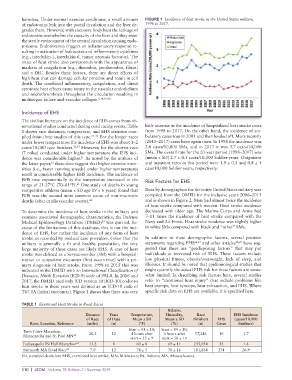
          servational studies conducted during road racing events. Table   little increase in the incidence of hospitalized heat stroke cases
          1 shows race distances, temperature, and EHS statistics com-  from 1998 to 2017. On the other hand, the incidence of am-
          piled from three studies of this type. 21–23  For the longer races   bulatory cases rose in 2001 and then leveled off. More recently
          under lower temperatures the incidence of EHS was about 1–2   (2015–2017) cases have again risen. In 1998 the incidence was
          cases/10,000 race finishers. 22,23  However, for the shorter race   2.0 cases/10,000 SMs, and in 2017 it was 3.7 cases/10,000
          (7 miles) conducted under higher temperature the EHS inci-  SMs. The overall rate for the 20-year period (1998–2017) was
          dence was considerable higher.  As noted by the authors of   (mean ± SD) 2.7 ± 0.5 cases/10,000 Soldier-years. Outpatient
                                  21
          the latter paper,  these data suggest that higher exercise inten-  and inpatient rates in this period were 1.9 ± 0.5 and 0.8 ± 1
                      21
          sities (i.e., faster running speeds) under higher temperatures   case/10,000 Soldier-years, respectively.
          result in considerable higher EHS incidence. The incidence of
          EHS  rose  exponentially  as  the  temperature  increased  in  the   Risk Factors for EHS
          range of 21-27°C (70–81°F).  One study of deaths in young
                                 21
          competitive athletes (mean ± SD age 19 ± 6 years) found that   Data by demographics for the entire United States military was
          EHS was the second most common cause of non-traumatic   compiled from the DMED for the inclusive years 2006–2015
          deaths (after cardiovascular events). 24           and is shown in Figure 2. Men had almost twice the incidence
                                                             of heat stroke compared with women. Heat stroke incidence
          To determine the incidence of heat stroke in the military and   decreased with older age. The Marine Corps and Army had
          examine associated demographic characteristics, the Defense   7–11 times the incidence of heat stroke compared with the
          Medical Epidemiology Database (DMED)  was queried. Be-  Navy and Air Force. Heat stroke incidence was slightly higher
                                           25
          cause of the limitations of this database, this is not the inci-  in white SMs compared with black and “other” SMs.
          dence of EHS, but rather the incidence of any form of heat
          stroke as recorded by medical care providers. Given that the   In addition to these demographic factors, several position
          military is generally a fit and healthy population, the very   statements regarding EHS 26,27  and other articles 28,29  have sug-
          large majority of these cases are likely EHS. A case of heat   gested that there are “predisposing factors” that may put
          stroke was defined as a Servicemember (SM) with a hospital-  individuals at increased risk of EHS. These factors include
          ization or outpatient encounter (first occurrence) with a pri-  low physical fitness, obesity/overweight, lack of sleep, and
          mary diagnosis of heat stroke. From 1998 to 2015 this was   illnesses. It should be noted that epidemiological studies that
          indicated in the DMED with an International Classification of   might quantify the actual EHS risk for these factors are some-
          Diseases, Ninth Revision (ICD-9) code of 992.0. In 2016 and   what limited. In describing risk factors here, several studies
          2017, the DMED used only ICD version 10 (ICD-10) codes so   refer to “exertional heat injury” that include problems like
          heat stroke in these years was defined as an ICD-10 code of   heat cramps, heat syncope, heat exhaustion, and EHS. Where
          T67.0A (initial encounter). Figure 1 shows that there was very   specific risk data on EHS are available, it is specified here.


          TABLE 1  Exertional Heat Stroke in Road Races
                                                                      Relative
                                    Distance    Years    Temperature,  Humidity,  Race            EHS Incidence
                                     of Race  of Data   Mean ± SD    Mean ± SD   Finishers    EHS   (cases/10,000
             Race, Location, Reference  (miles)  (n)      (°F)          (%)        (n)    Cases    finishers)
                                                      Start = 41 ± 10;  Start = 84 ± 10;
           Twin Cities Marathon,
           Minneapolis and St. Paul MN 23  26.2  12    4 hours after    4 hours after   57,246  10   1.7
                                                       start = 53 ± 9  start = 58 ± 19
           Indianapolis IN Half Marathon 22  13.2  8     60 ± 8       69 ± 11    235,054    32       1.4
           Falmouth MA Road Race 21   7.0      12        74 ± 5       70 ± 16    101,864   274       26.9
          SD, standard deviation; EHS, exertional heat stroke; MN, Minnesota; IN, Indiana; MA, Massachusetts.


          110  |  JSOM   Volume 19, Edition 2 / Summer 2019

