


Page 23 - JSOM Winter 2018
P. 23
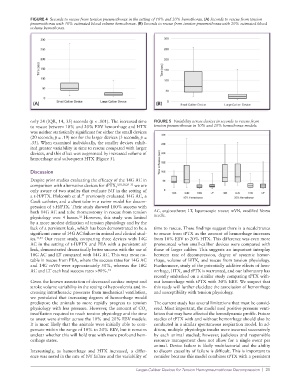
FIGURE 4  Seconds to rescue from tension pneumothorax in the setting of 10% and 20% hemothorax. (A) Seconds to rescue from tension
              pneumothorax with 10% estimated blood volume hemothorax. (B) Seconds to rescue from tension pneumothorax with 20% estimated blood
              volume hemothorax.


               (A)                                               (B)


              only 24 (IQR, 14, 35) seconds (p < .001). The increased time   FIGURE 5  Variability across devices in seconds to rescue from
              to rescue between 10% and 20% EBV hemorrhage and HTX   tension pneumothorax in 10% and 20% hemothorax models.
              was neither statistically significant for either the small devices
              (20 seconds; p = .19) nor for the larger devices (3 seconds; p =
              .33). When examined individually, the smaller devices exhib-
              ited greater variability in time to rescue compared with larger
              devices, and this effect was augmented by increased volume of
              hemorrhage and subsequent HTX (Figure 5).


              Discussion
              Despite prior studies evaluating the efficacy of the 14G AC in
              comparison with alternative devices for tPTX, 9,10,18,29–31  we are
              only aware of two studies that evaluate NT in the setting of
              a t-H/PTX. Holcomb et al.  previously evaluated 14G AC, a
                                   32
              Cook catheter, and a chest tube in a swine model for decom-
              pression of t-H/PTX. Their study showed 100% success with
              both 14G AC and tube thoracostomy in rescue from tension   AC, angiocatheter; LT, laparoscopic trocar; mVN, modified Veress
              physiology over 4 hours.  However, this study was limited   needle.
                                  32
              by a more modest definition of tension physiology and by the
              lack of a persistent leak, which has been demonstrated to be a   time to rescue. These findings suggest there is a recalcitrance
              significant cause of 14G AC failure in animal and clinical stud-  to rescue from tPTX as the amount of hemorrhage increases
              ies. 11,25  Our recent study, comparing three devices with 14G   from 10% EBV to 20% HTX. This difference was even more
              AC in the setting of t-H/PTX and PEA with a persistent air   pronounced when small-caliber devices were compared with
              leak, demonstrated dramatically better success with the use of   those of larger caliber. This suggests an important interplay
              10G AC and LT compared with 14G AC. This was most no-  between  rate  of decompression, degree  of  systemic  hemor-
              table in rescue from PEA, where the success rates for 14G AC   rhage, volume of HTX, and rescue from tension physiology.
              and 14G mVN were approximately 50%, whereas the 10G   Furthermore, study of the potentially additive effects of hem-
              AC and LT each had success rates >90%. 14          orrhage, HTX, and tPTX is warranted, and our laboratory has
                                                                 recently embarked on a similar study comparing tPTX with-
              Given the known association of decreased cardiac output and   out hemorrhage with tPTX with 30% EBV. We suspect that
              stroke volume variability in the setting of hypovolemia and in-  this study will further elucidate the association of hemorrhage
              creasing intrathoracic pressures from mechanical ventilation,   and susceptibility with tension physiology.
              we postulated that increasing degrees of hemorrhage would
              predispose the animals to more rapidly progress to tension   The current study has several limitations that must be consid-
              physiology with less pressure. However, the amount of CO    ered. Most important, the model used positive-pressure venti-
                                                             2
              insufflation required to reach tension physiology and the time   lation that may have affected the hemodynamic profile. Future
              to onset were similar across the 10% and 20% EBV models.   studies of tPTX with and without hemorrhage should also be
              It is most likely that the animals were initially able to com-  conducted in a similar spontaneous respiration model. In ad-
              pensate within the range of 10% to 20% EBV, but it remains   dition, multiple physiologic insults were incurred successively
              unclear whether this will hold true with more profound hem-  by  each  animal studied;  however,  judicious  and  responsible
              orrhage states.                                    resource management does not allow for a single event per
                                                                 animal. Device failure is likely multifactorial and the ability
              Interestingly, as hemorrhage and HTX increased, a differ-  to discern causality of failure is difficult. This is important to
              ence was noted in the rate of NT failure and the variability of   consider because this model combines tPTX with a persistent

                                                         Larger-Caliber Devices for Tension Hemopneumothorax Decompression  |  21

