


Page 28 - JSOM Winter 2018
P. 28
the Department of the Army, US Air Force Office of the Sur-  5.  Hsu HH, Tzao C, Chang WC, et al. Zinc chloride (smoke bomb)
          geon General, the Department of the Air Force, the Depart-  inhalation lung injury: clinical presentations, high-resolution CT
          ment of Defense, or the US Government.                findings, and pulmonary function test results. Chest. 2005;127
                                                                (6):2064–2071.
                                                              6.  Zerahn B, Kofoed-Enevoldsen A, Jensen BV, et al. Pulmonary
          Author Contributions                                  damage  after  modest  exposure  to  zinc  chloride  smoke.  Respir
          All authors contributed to the writing of this manuscript and   Med. 1999;93(12):885–890.
          approved the final version.                         7.  Superior Signal Company. Materials Safety Data Sheet: Superior
                                                                Smoke. 2008. http://www.nerwa.org/msds.pdf. Accessed 7 Octo-
          References                                            ber 2018.
          1.  US Army. Grenades and pyrotechnic signals. Vol FM 3-23.30.   8.  Matarese SL, Matthews JI. Zinc chloride (smoke bomb) inhala-
            Washington, DC: Government Printing Office; 2000:1–7, 1–8.  tional lung injury. Chest. 1986;89(2):308–309.
          2.  Macaulay MB, Mant AK. Smoke-bomb poisoning. A fatal case   9.  Marrs TC, Colgrave HF, Edginton JA, et al. The repeated dose
            following the inhalation of zinc chloride smoke. J R Army Med   toxicity of a zinc oxide/hexachloroethane smoke. Arch Toxicol.
            Corps. 1964;110:27–32.                              1988;62(2-3):123–132.
          3.  Chian C-F, Wu C-P, Chen C-W, et al. Acute respiratory distress syn-  10.  Loh CH, Chang YW, Liou SH, et al. Case report: hexachlo-
            drome after zinc chloride inhalation: survival after extracorporeal   roethane smoke inhalation: a rare cause of severe hepatic injuries.
            life support and corticosteroid treatment. Am J Crit Care. 2010;   Environ Health Perspect. 2006;114(5):763–765.
            19(1):86–90.
          4.  Gil F, Pla A, Hernández AF, et al. A fatal case following exposure
            to zinc chloride and hexachloroethane from a smoke bomb in a fire
            simulation at a school. Clin Toxicol. 2008;46(6):563–565.


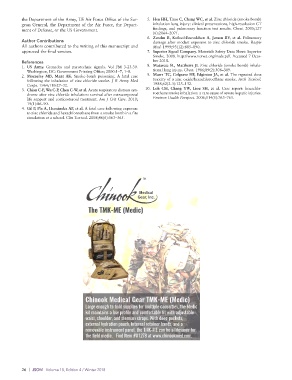
                                      The TMK-ME (Medic)


                                    Chinook Medical Gear TMK-ME (Medic)
                                    Large enough to hold supplies for multiple casualties, the Medic
                                    kit maintains a low profile and comfortable fit with adjustable
                                    waist, shoulder, and sternum straps. With deep pockets,
                                    external hydration pouch, internal retainer bands, and a
                                    removable instrument panel, the TMK-ME can be a lifesaver for
                                    the field medic.   Find Item #01278 at www.chinookmed.com.


          26  |  JSOM   Volume 18, Edition 4 / Winter 2018

