


Page 27 - JSOM Winter 2018
P. 27
Vital signs at that time were heart rate, 140/min; blood pres-  Zinc chloride readily combines with water in the atmosphere
              sure,  100/60mmHg; respiratory  rate, 40/min; temperature,   and in the respiratory tract to create hydrochloric acid and
              103.6°F (39.8°C), and pulse oximetry, 55% on room air. He   zinc oxychloride. Because of the small particle size, it can pen-
              was awake and alert, visibly in severe respiratory distress, with   etrate deep into the respiratory tract and cause severe irrita-
              crepitus over the anterior chest and neck. Cardiac examina-  tion and pulmonary epithelial necrosis within the alveoli.  For
                                                                                                             8
              tion revealed tachycardia without murmurs, rubs, or gallops.   zinc chloride, the threshold limit value and immediately dan-
              Pulmonary auscultation demonstrated coarse breath sounds   gerous to life and health value are 1mg/mm  and 50mg/mm ,
                                                                                                   3
                                                                                                                3
              with loud bilateral crackles. The remainder of his physical ex-  respectively, and animal studies have demonstrated pulmonary
              amination was without abnormal findings.           edema,  alveolar hemorrhage,  localized  bulbous emphysema,
                                                                 and alveolar cell carcinoma with exposure. 9
              The patient was intubated for respiratory failure. His chest
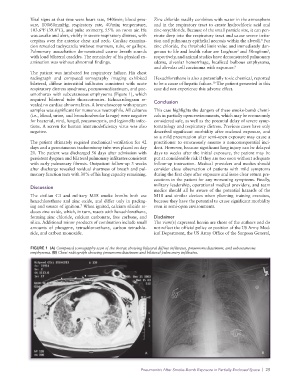
              radiograph and computed tomography imaging exhibited   Hexachlorethane is also a potentially toxic chemical, reported
              bilateral, diffuse interstitial infiltrates consistent with acute   to be a cause of hepatic failure.  The patient presented in this
                                                                                         10
              respiratory distress syndrome, pneumomediastinum, and pne-  case did not experience this adverse effect.
              umothorax with subcutaneous emphysema (Figure 1), which
              required bilateral tube thoracotomies. Echocardiogram re-  Conclusion
              vealed no cardiac abnormalities. A bronchoscopy with sputum
              samples was significant for numerous neutrophils. All cultures   This case highlights the dangers of these smoke-bomb chemi-
              (i.e., blood, urine, and bronchoalveolar lavage) were negative   cals in partially open environments, which may be erroneously
              for bacterial, viral, fungal, pneumocystis, and legionella infec-  considered safe, as well as the potential delay of severe symp-
              tions. A screen for human immunodeficiency virus was also   tomatology and respiratory distress. Previous cases have only
              negative.                                          described significant morbidity after enclosed exposure, and
                                                                 so a mild presentation after semi-open exposure may cause a
              The patient ultimately required mechanical ventilation for 42   practitioner to erroneously assume a nonconsequential inci-
              days and a percutaneous tracheostomy tube was placed on day   dent. However, because significant lung injury can be delayed
              21. The patient was discharged 56 days after admission with   days to weeks after the initial exposure, the patient may be
              persistent dyspnea and bilateral pulmonary infiltrates consistent   put at considerable risk if they are too soon without adequate
              with early pulmonary fibrosis. Outpatient follow-up 3 weeks     follow-up instruction. Medical providers and medics should
              after discharge revealed residual shortness of breath and pul-  consider close observation of patients with mild symptoms
              monary function tests with 30% of his lung capacity remaining.  during the first days after exposure and issue clear return pre-
                                                                 cautions to the patient for any worsening symptoms. Finally,
                                                                 military leadership, operational medical providers, and team
              Discussion
                                                                 medics should all be aware of the potential hazards of the
              The civilian C3 and military M18 smoke bombs both use   M18 and  similar  devices when  planning  training exercises,
              hexachlorethane and zinc oxide, and differ only in packag-  because they have the potential to cause significant morbidity
              ing and source of ignition.  When ignited, calcium silicide re-  even in semi-open environments.
                                  7
              duces zinc oxide, which, in turn, reacts with hexachlorethane,
              forming zinc chloride, calcium carbonate, free carbons, and   Disclaimer
              silica. Additional minor products of combustion include small   The view(s) expressed herein are those of the authors and do
              amounts of phosgene, tetrachloroethane, carbon tetrachlo-  not reflect the official policy or position of the US Army Med-
              ride, and carbon monoxide.                         ical Department, the US Army Office of the Surgeon General,


              FIGURE 1  (A) Computed tomography scan of the thorax showing bilateral diffuse infiltrates, pneumomediastinum, and subcutaneous
              emphysema. (B) Chest radiograph showing pneumomediastinum and bilateral pulmonary infiltrates.


                                                           Pneumonitis After Smoke-Bomb Exposure in Partially Enclosed Space  |  25

