


Page 79 - JSOM Fall 2018
P. 79
the tourniquet, return of arterial flow was assessed by leaving TABLE 3 Tourniquet Results: Median Scores for Pain and
the probe in situ and monitoring Doppler waveform. Application Time
Variable C-A-T TMT
End Point Pain score, median (IQR) 5 (4–7) 6 (3–8)
a
The application was considered successful if (1) ultrasound Application time, median
showed total occlusion of the popliteal artery; (2) the wind (IQR), seconds 37.5 (27–52) 35 (29–42)
lass mechanism was locked into the plastic gate; (3) the study CAT, Combat Application Tourniquet; IQR, interquartile range;
participant deemed discomfort to be tolerable; and (4) arterial TMT, Tactical Mechanical Tourniquet.
flow resumed at tourniquet release. a Pain was scored according to a numeric pain rating scale.
TABLE 4 2 × 2 Contingency Table of Tourniquet Success or Failure
Data Collection
Pain Not
Demographic data on age and sex were collected. The time Tourniquet Pain Tolerated Tolerated Total
taken to successfully apply each tourniquet (from first receiv
ing the tourniquet to arterial occlusion) and maximum pain CAT 22 2 24
scores on a 0 to 10 verbal numeric pain rating scale (0 = no TMT 17 7 24
pain, 10 = worst pain ever experienced) were also collected. Total 39 9 48
An answer (either CAT or TMT or same) was requested CAT, Combat Application Tourniquet; TMT, Tactical Mechanical
to two questions: “Which tourniquet is easiest to use?” and Tourniquet.
“Which tourniquet is the most painful?”
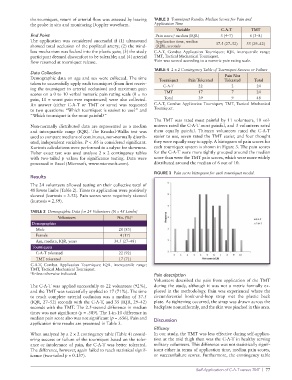
The TMT was rated most painful by 11 volunteers, 10 vol
Nonnormally distributed data are represented as a median unteers rated the CAT most painful, and 3 volunteers rated
and interquartile range (IQR). The KruskalWallis test was them equally painful. Thirteen volunteers rated the CAT
used to compare medians of continuous, nonnormally distrib easier to use, seven rated the TMT easier, and four thought
uted, independent variables. P < .05 is considered significant. they were equally easy to apply. A histogram of pain scores for
Kurtosis calculations were performed to analyze for skewness. each tourniquet system is shown in Figure 3. The pain scores
Fisher exact test was used analyze 2 × 2 contingency tables for the CAT were more tightly grouped around the median
with twotailed p values for significance testing. Data were score than were the TMT pain scores, which were more widely
processed in Excel (Microsoft, www.microsoft.com). distributed around the median of 6 out of 10.
FIGURE 3 Pain score histogram for each tourniquet model.
Results
The 24 volunteers allowed testing on their collective total of
48 lower limbs (Table 2). Times to application were positively
skewed (kurtosis = 3.52). Pain scores were negatively skewed
(kurtosis = 2.59).
TABLE 2 Demographic Data for 24 Volunteers (N = 48 Limbs)
Volunteers No. (%) a
Demographics
Male 20 (83)
Female 4 (17)
Age, median, IQR, years 34.5 (27–48)
Tourniquets
CAT tolerated 22 (92)
TMT tolerated 17 (71)
CAT, Combat Application Tourniquet; IQR, interquartile range;
TMT, Tactical Mechanical Tourniquet.
a Unless otherwise indicated. Pain description
Volunteers described the pain from application of the TMT
The CAT was applied successfully to 22 volunteers (92%), during the study, although it was not a metric formally ex
and the TMT was successfully applied to 17 (71%). The time plored in the methodology. Pain was experienced where the
to reach complete arterial occlusion was a median of 37.5 circumferential hookandloop strap met the plastic back
(IQR, 27–52) seconds with the CAT, and 35 (IQR, 29–42) plate. As tightening occurred, the strap was drawn across the
seconds with the TMT. The 2.5second difference in median backplate nonuniformly, and the skin was pinched in this area.
times was not significant (p = .589). The 1in10 difference in
median pain score also was not significant (p = .656). Pain and Discussion
application time results are presented in Table 3.
Efficacy
When analyzed by a 2 × 2 contingency table (Table 4) consid In our study, the TMT was less effective during selfapplica
ering success or failure of the tourniquet based on the toler tion at the mid thigh than was the CAT in healthy serving
ance or intolerance of pain, the CAT was better tolerated. military volunteers. This difference was not statistically signif
The difference, however, again failed to reach statistical signif icant either in terms of application time, median pain scores,
icance (twotailed p = 0.137). or success/failure scores. Furthermore, the contingency table
Self-Application of C-A-T versus TMT | 77

