


Page 78 - JSOM Fall 2018
P. 78
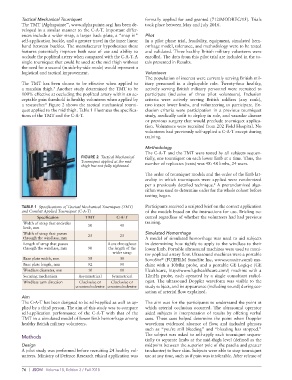
Tactical Mechanical Tourniquet formally applied for and granted (712/MODREC/15). Trials
The TMT (Alphapointe , www.alphapointe.org) has been de took place between May and July 2016.
™
veloped in a similar manner to the CAT. Important differ
ences include a wider strap, a larger back plate, a “snap in” Pilot
selfapplication buckle, and a greater travel in the inner linear In a pilot phase trial, feasibility, equipment, simulated hem
band between buckles. The manufacturer hypothesizes these orrhage model, tolerance, and methodology were to be tested
features potentially improve both ease of use and ability to and validated. Three healthy British military volunteers were
occlude the popliteal artery when compared with the CAT. A enrolled. The data from this pilot trial are included in the to
single tourniquet that could be used at the mid thigh without tals presented in Results.
the need for a second (in sidebyside mode) would represent a
logistical and tactical improvement. Volunteers
The population of interest were currently serving British mil
The TMT has been shown to be effective when applied to itary personnel in a deployable role. Twentyfour healthy,
a manikin thigh. Another study determined the TMT to be actively serving British military personnel were recruited to
7
100% effective at occluding the popliteal artery within an ac participate (inclusive of three pilot volunteers). Inclusion
ceptable pain threshold in healthy volunteers when applied by criteria were actively serving British soldiers (any rank),
a researcher. Figure 2 shows the tactical mechanical tourni two intact lower limbs, and volunteering to participate. Ex
8
quet applied to the mid thigh. Table 1 illustrates the specifica clusion criteria were participation in a previous tourniquet
tions of the TMT and the CAT. study, medically unfit to deploy in role, and vascular disease
or previous surgery that would preclude tourniquet applica
tion. Volunteers were recruited from 202 Field Hospital. No
volunteers had previously selfapplied a CAT except during
training.
Methodology
The CAT and the TMT were tested by all subjects sequen
FIGURE 2 Tactical Mechanical tially, one tourniquet on each lower limb at a time. Thus, the
Tourniquet applied at the mid number of replicates (tests) was 48: 48 limbs, 24 users.
thigh but not fully tightened.
The order of tourniquet models and the order of the limb lat
erality in which tourniquets were applied were randomized
per a previously detailed technique. A prerandomized algo
8
rithm was used to determine order for the whole cohort before
testing began.
TABLE 1 Specifications of Tactical Mechanical Tourniquet (TMT) Participants received a scripted brief on the correct application
and Combat Applied Tourniquet (C-A-T) of the models based on the instructions for use. Briefing oc
Specification TMT C-A-T curred regardless of whether the volunteers had had previous
Width of strap that encircles 50 40 training.
limb, mm
Width of strap that passes Simulated Hemorrhage
through the windlass, mm 25 25 A model of simulated hemorrhage was used to aid subjects
Length of strap that passes Runs throughout in determining how tightly to apply to the windlass to their
through the windlass, mm 90 the length of the lower limb. Portable ultrasound machines were used to moni
wider strap tor popliteal artery flow. Ultrasound machines were a portable
Base plate width, mm 58 38 SonoSite (FUJIFILM SonoSite Inc, www.sonosite.com/) ma
®
Base plate length, mm 92 90 chine with a 10Mhz probe, and a portable GE Logiqe (GE
Windlass diameter, mm 10 10 Healthcare, http://www3.gehealthcare.com/) machine with a
Securing mechanism Asymmetrical Symmetrical 12mHz probe, each operated by a single consultant radiol
Windlass turn direction Clockwise or Clockwise or ogist. The ultrasound Doppler waveform was visible to the
counterclockwise counterclockwise study subject, and its appearance (including sound) during ces
sation of arterial flow explained.
Aim
The CAT has been designed to be selfapplied as well as ap The aim was for the participants to understand the point at
plied by a third person. The aim of this study was to compare which arterial occlusion occurred. The ultrasound operator
selfapplication performance of the CAT with that of the aided subjects in interpretation of results by offering verbal
TMT in a simulated model of lower limb hemorrhage among cues. These cues helped determine the point when Doppler
healthy British military volunteers. waveform evidenced absence of flow, and included phrases
such as “you’re still bleeding” and “bleeding has stopped.”
The subject was asked to selfapply each tourniquet sequen
Methods
tially to separate limbs at the midthigh level (defined as the
Design midpoint between the superior pole of the patella and greater
A pilot study was performed before recruiting 24 healthy vol trochanter) to bare skin. Subjects were able to stop tourniquet
unteers. Ministry of Defence Research ethical application was use at any time, such as if pain was intolerable. After release of
76 | JSOM Volume 18, Edition 3 / Fall 2018

