


Page 77 - JSOM Fall 2018
P. 77
The Combat Application Tourniquet
Versus the Tactical Mechanical Tourniquet
Comparison of Performance in
Self-Application by Healthy Military Volunteers
1
1
A. Beaven, MBChB, MRCS ; M. Ballard, FRCR ; E. Sellon, MBBS, MRCS, MSc(SEM), FRCR ;
1,2
1
R. Briard, FRCR ; P.J. Parker, MB BCh, BAO, DipIMC, FRCSEd, FRCSOrth, FIMC 1
ABSTRACT
Background: Exsanguination from limb injury is an import Combat Application Tourniquet
ant battlefield consideration that is mitigated with the use of The CAT has saved many lives, particularly in the Ameri
emergency tourniquets. The Combat Application Tourniquet can and British military campaigns. Studies have found that
(CAT ) is the current British military standard tourniquet. a single selfapplied CAT may not always be sufficient to
®
Methods: We tested the selfapplication of a newer tourniquet arrest bleeding when applied to the mid thigh. American and
1,2
system, the Tactical Mechanical Tourniquet (TMT), against British military doctrine advocates the use of two CATs side
3,4
selfapplication of the CAT. A total of 24 healthy British mil by side if bleeding is uncontrolled with one tourniquet. In
itary volunteers selfapplied the CAT and the TMT to their fact, a realworld study reported the percentage failure of a
mid thigh in a randomized, sequential manner. Popliteal artery singly applied CAT to be 18%, with the thigh being the least
flow was monitored with a portable ultrasound machine, and successful body region. The CAT has benefitted from spiral
5
time until arterial occlusion was measured. Pain scores were development: a continual improvement cycle refining model
also recorded. Results The volunteers allowed testing on their design in response to battlefield feedback. The seventh gener
lower limbs (n = 48 legs). The CAT was applied success ation CAT has been manufactured and is being distributed
fully to 22 volunteers (92%), and the TMT was successfully for use. Improvements to the generation 6 model are intended
applied to 17 (71%). Median time to reach complete arterial to accommodate common user mistakes and include a single
occlusion was 37.5 (interquartile range [IQR], 27–52) seconds routing buckle, windlass rod of increased diameter, beveled
with the CAT, and 35 (IQR, 29–42) seconds with the TMT. windlass clip, reinforced strap, and beveled stabilization plate.
The 2.5second difference in median times was not significant Manufacturer CAT Resources postulates that these improve
(p = .589). The 1in10 difference in median pain score was ments increase application speed, simplify training, increase
also not significant (p = .656). The success or failure of self strength, and improve comfort. Initial manikin testing showed
application between the two tourniquet models as assessed by that the generation 7 outperformed the generation 6 in hem
contingency table was not significant (p= .137). Conclusion: orrhage control, ease of use, and user preference. Figure 1
6
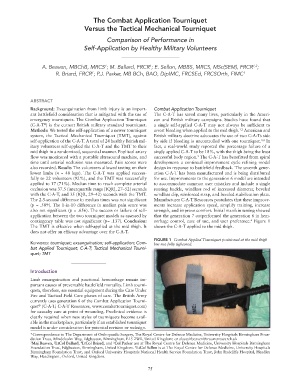
The TMT is effective when selfapplied at the mid thigh. It shows the CAT applied to the mid thigh.
does not offer an efficacy advantage over the CAT.
FIGURE 1 Combat Applied Tourniquet positioned at the mid thigh
Keywords: tourniquet; exsanguination; self-application; Com- but not fully tightened.
bat Applied Tourniquet; C-A-T; Tactical Mechanical Tourni-
quet; TMT
Introduction
Limb exsanguination and junctional hemorrhage remain im
portant causes of preventable battlefield mortality. Limb tourni
quets, therefore, are essential equipment during the Care Under
Fire and Tactical Field Care phases of care. The British Army
currently uses generation 6 of the Combat Application Tourni
quet (CAT; CAT Resources, www.combattourniquet.com)
®
for casualty care at point of wounding. Preclinical evidence is
clearly required when new styles of tourniquets become avail
able in the marketplace, particularly if an established tourniquet
model is under consideration for potential revision or redesign.
*Correspondence to The Department of Orthopaedic Surgery, The Royal Centre for Defence Medicine, University Hospitals Birmingham Foun
dation Trust, Mindelsohn Way, Edgbaston, Birmingham, B15 2WB, United Kingdom; or alastairbeaven@traumaresearch.uk
5
1 Maj Beaven, LtCol Ballard, LtCol Briard, and Col Parker are at The Royal Centre for Defence Medicine, University Hospitals Birmingham
2
4
Foundation Trust, Edgbaston, Birmingham, United Kingdom. LtCol Sellon is at The Royal Centre for Defence Medicine, University Hospitals
3
Birmingham Foundation Trust, and Oxford University Hospitals National Health Service Foundation Trust, John Radcliffe Hospital, Headley
Way, Headington, Oxford, United Kingdom.
75

