


Page 48 - JSOM Fall 2018
P. 48
The ship’s crew and the boarding element were not from the Materials and Methods
same unit. They were integrated by bringing the entire crew to
gether under the same commanding officer. The vessel’s small Respondents were recruited by the first author after contact
size had a positive effect on the integration because it allowed with the boarding element’s captain. He agreed to partici
a large group of people with mutual and few tasks to coexist pate in the study with his crew while serving onboard HMS
onboard (O. Stark, personal communication). Carlskrona during a 4month assignment. The commander of
the ship also gave his consent for the study to be carried out
The chief psychologist of the Swedish Armed Forces has during Operation Ocean Shield. The respondents consisted
emphasized the importance of lessons learned from previ of 11 men aged 23 to 39 years (mean age, 26 years). They
ous international operations. For example, it is desirable were an accessible and homogeneous group, healthy, and well
17
to plan and implement effective training that can mentally trained, with a high probability of completing the study. Ac
26
prepare individuals to take part in international operations. cording to Patton, homogeneous sampling reduces variation
Pollack also pointed out the importance of psychological and simplifies the analysis.
17
care of individuals. In a systematic review of peacekeeping
deployments, Sareen et al concluded that most peace keep The respondents wrote individual notes of events over 1 week
18
ers do not develop high levels of distress. Positive appraisal on three different occasions: at the beginning, in the middle,
or sense of meaningfulness of a mission was associated with and at the end of their duty overseas. All notes were stored in a
lower levels of distress. Soldiers assigned to international safety locker by the medical director onboard when each writ
duty need to be prepared for all possible events that the duty ing period ended. When all three test periods were completed,
may involve. 19 the notes were checked by the security officer to ensure that
no classified information was divulged. All the notes passed
Eriksson developed a model for producing readiness, using the security check without deletions, and nothing in the texts
20
the taxonomy of Blooms (cognitive area) and Kratwohls (af was left out.
fect area) and adding a professional axis, whereby people are
forced to take a stand on important questions for particular
professions and then develop a system of values of their own,
which result in a higher level of readiness. Eriksson implies
20
that the cognitive area is the “drill,” which involves doing
different kinds of exercises and training over and over again,
and the affect area is “how you can create new knowledge.”
Together, this creates an apprehension of the environment that
presents a truthful picture of the world and increases one’s
readiness. Knowledge is created by going through new things
one has not been in contact with before.
Schraagen and Post found that a team’s level of readiness
21
depends on experience. Compared with less experienced naval
teams, more experienced naval teams are characterized by a
larger proportion of information shared, increased team par
ticipation, and the team coordinator playing a more central
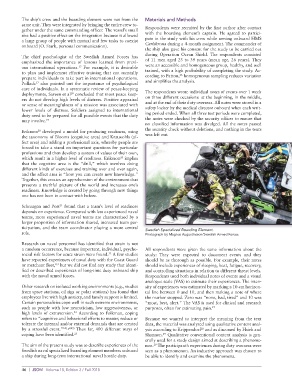
role. Swedish Specialized Boarding Element.
Photograph by Magnus Augustinsson/Swedish Armed Forces.
Research on naval personnel has identified that strain is not
a random occurrence, because important, individual, psycho All respondents were given the same information about the
social risk factors for acute strain were found. A few studies study: They were expected to document events and they
22
have reported experiences of naval duty with the Coast Guard should be as thorough as possible. For example, their notes
or merchant fleet, but we did not find any study that identi should include experiences of sleeping, heat, fatigue, recovery,
2,3
fied or described experiences of longtime duty onboard ship and controlling situations in relation to different threat levels.
with the naval armed forces. Respondents used both individual notes of events and a visual
analogue scale (VAS) to estimate their experiences. The inten
Other research on isolated working environments (e.g., studies sity of experiences was estimated by marking a 10cm horizon
from space stations, oil rigs or polar stations) has found that tal line between 0 and 10, and then making a note of where
employees live with high anxiety, and family support is limited. the marker stopped. Zero was “none, bad, tired” and 10 was
Certain personalities cope well in such extreme environments, “most, best, alert.” The VAS is used for clinical and research
such as people with low neuroticism, low aggressiveness, or purposes, often for estimating pain. 27
high levels of extraversion. According to Folkman, coping
23
refers to “cognitive and behavioral efforts to master, reduce or Because we wanted to interpret the meaning from the text
tolerate the internal and/or external demands that are created data, the material was analyzed using qualitative content anal
by a stressful event.” 24( p843) Thus far, 400 different ways of ysis according to Krippendorf and as discussed by Hsieh and
28
coping have been identified. 25 Shannon. Qualitative conventional content analysis is gen
29
erally used for a study design aimed at describing a phenome
The aim of the present study was to describe experiences of the non. The participant’s experiences during duty overseas were
29
Swedish naval specialized boarding element members onboard seen as a phenomenon. An inductive approach was chosen to
a ship during longterm international naval hostile duty. be able to identify and examine the phenomena.
46 | JSOM Volume 18, Edition 3 / Fall 2018

