


Page 43 - JSOM Fall 2018
P. 43
Results
From April 2013 to October 2016, 245 evaluable applications
of the iTClamp were reported. Male patients accounted for
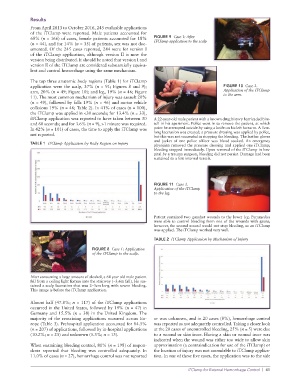
68% (n = 166) of cases, female patients accounted for 18% FIGURE 9 Case 1: After
(n = 44), and for 14% (n = 35) of patients, sex was not doc iTClamp application to the scalp
umented. Of the 245 cases reported, 244 were for version I
of the iTClamp application, although version II is now the
version being distributed. It should be noted that version I and
version II of the iTClamp are considered substantially equiva
lent and control hemorrhage using the same mechanism.
The top three anatomic body regions (Table 1) for iTClamp
application were the scalp, 37% (n = 91; Figures 8 and 9); FIGURE 10 Case 2.
arm, 20% (n = 49; Figure 10); and leg, 19% (n = 46; Figure Application of the iTClamp
11). The most common mechanism of injury was assault 20% to the arm.
(n = 49), followed by falls 19% (n = 46) and motor vehicle
collisions 19% (n = 46; Table 2). In 41% of cases (n = 100),
the iTClamp was applied in <30 seconds; for 13.4% (n = 33),
iTClamp application was reported to have taken between 30 A 22yearold male patient with a known drug history barricaded him
and 60 seconds; and for 3.6% (n = 9), >1 minute was required. self in his apartment. Police went in to remove the patient, at which
In 42% (n = 101) of cases, the time to apply the iTClamp was point he attempted suicide by using a knife on his left forearm. A 5cm
not reported. long laceration was created; a pressure dressing was applied by police,
but this was not successful in stopping the bleeding. The leather gloves
and jacket of one police officer was blood soaked. An emergency
TABLE 1 iTClamp Application by Body Region on Injury physician removed the pressure dressing and applied one iTClamp;
bleeding stopped immediately. Upon removal of the iTClamp in hos
pital by a trauma surgeon, bleeding did not persist. Damage had been
sustained to a few internal vessels.
FIGURE 11 Case 3.
Application of the iTClamp
to the leg.
Patient sustained two gunshot wounds to the lower leg. Paramedics
were able to control bleeding from one of the wounds with gauze;
however, the second wound would not stop bleeding, so an iTClamp
was applied. The iTClamp worked very well.
TABLE 2 iTClamp Application by Mechanism of Injury
FIGURE 8 Case 1: Application
of the iTClamp to the scalp.
After consuming a large amount of alcohol, a 64 year old male patient
fell from a ceiling light fixture into the stairway (~3.6m fall). He sus
tained a scalp laceration that was 2–3cm long with severe bleeding.
This image is before the iTClamp application.
Almost half (47.8%; n = 117) of the iTClamp applications
occurred in the United States, followed by 19% (n = 47) in
Germany and 15.5% (n = 38) in the United Kingdom. The
majority of the remaining applications occurred across Eu or was unknown, and in 20 cases (8%), hemorrhage control
rope (Table 3). Prehospital application accounted for 84.5% was reported as not adequately controlled. Taking a closer look
(n = 207) of applications, followed by inhospital applications at the 20 cases of uncontrolled bleeding, 25% (n = 5) were due
(10.2%; n = 25) and unknown (5.3%; n = 13). to a wound or skin issue. Having a skin or wound issue was
indicated when the wound was either too wide to allow skin
When examining bleeding control, 81% (n = 198) of respon approximation (a contraindication for use of the iTClamp) or
dents reported that bleeding was controlled adequately. In the location of injury was not amendable to iTClamp applica
11.0% of cases (n = 27), hemorrhage control was not reported tion. In one of these five cases, the application was to the side
iTClamp for External Hemorrhage Control | 41

