


Page 106 - JSOM Fall 2018
P. 106
member of the ISTC team. The ISTC delivers the highest qual changes that are required for the NSOCM student to be suc
ity education and training via three separate training branches cessful during the NSOCM course, especially because most are
(Tactical, Planning, and Medical) in advanced and specialized learning these new lifesaving skills in their second or third
closequarter combat, sniper training, SOF planning, conduct language (i.e., English). Therefore, based the author’s opinion
after capture, and Special Operations medicine. The ISTC on the special characteristics of the ISTCNSOCM student, a
medical branch provides four different courses, starting with new acronym is necessary: PAID.
the Advanced Medical First Responders (AMFR) course and
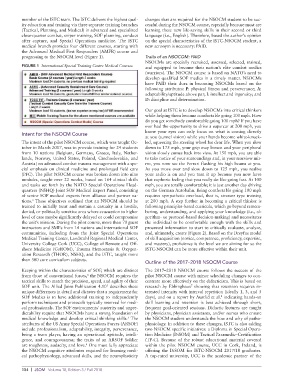
progressing to the NSOCM level (Figure 1). Traits of an NSOCOM: PAID
NSOCMs are specially recruited, assessed, selected, trained,
FIGURE 1 International Special Training Centre Medical Courses. and equipped to become their nation’s elite combat medics
(warriors). The NSOCM course is based on NATO’s need to
develop qualified SOF medics in a timely matter. NSOCMs
have PAID their dues in becoming NSOCMs based on the
following attributes: P: physical fitness and perseverance; A:
adaptability/aptitude above par; I: intellect and ingenuity; and
D: discipline and determination.
Our goal at ISTC is to develop NSOCMs into critical thinkers
while helping them become comfortable going 100 mph. How
do you get somebody comfortable going 100 mph? If you have
ever had the opportunity to drive a supercar at 200 mph, you
know your eyes can only focus on what is coming directly
Intent for the NSOCM Course
at you (tunnel vision) while your hands become whiteknuck
The intent of the pilot NSOCM course, which was taught Oc led, squeezing the steering wheel for dear life. When you slow
tober to March 2017, was to provide training for 24 students down to 175 mph, your grip may loosen and your peripheral
from 10 nations (Belgium, Germany, Greece, Italy, Nether vision slowly comes back into view. At 150 mph, you are able
lands, Norway, United States, Poland, Czechoslovakia, and to take notice of your surroundings and, in your rearview mir
Austria) on advanced combat trauma management with a spe ror, you now see the Ferrari flashing his high beams at you.
cial emphasis on clinical medicine and prolonged field care As you move over and slow down to 125 mph, you realize
(PFC). The pilot NSOCM course was broken down into nine your radio is on and you turn it up because you now have
modules, taught over 22 weeks, based on 164 clinical skills that euphoric feeling that you really do like going fast. At 100
and tasks set forth by the NATO Special Operations Head mph, you are totally comfortable; it is just another day driving
quarters (NSHQ) Joint SOF Medical Expert Panel, consisting on the German Autobahn. Being comfortable going 100 mph
of senior SOF medical experts from alliance and partner na requires sympathetic overload, that is, stressor type training
tions. These objectives outlined that an NSOCM should be at 200 mph. A step further in becoming a critical thinker is
3
trained to initially treat and sustain a casualty in a hostile, following principlesbased curricula, which go beyond remem
denied, or politically sensitive area where evacuation to higher bering, understanding, and applying your knowledge (i.e., al
level of care maybe significantly delayed or could compromise gorithm or protocolbased decisionmaking) and necessitates
the unit’s mission. During the pilot course, more than 70 guest the individual to be comfortable enough with the skills and
instructors and SMEs from 14 nations and international SOF processed information to start to critically evaluate, analyze,
communities, including from the Joint Special Operations and, ultimately, create (Figure 2). Based on the Dreyfus model
Medical Training Center, Landstuhl Regional Medical Center, of skill acquisition (novice, competence, proficiency, expertise,
University College Cork (UCC), College of Remote and Off and mastery), proficiency is the level we are aiming for so the
shore Medicine (CoROM), Trauma Hemostasis & Oxygen ISTCNSOCM can be more effective within their unit.
ation Research (THOR), NSHQ, and the ISTC, taught more
than 300 core curriculum subjects.
Outline of the 2017–2018 NSOCM Course
Keeping within the characteristics of SOF, which are distinct The 2017–2018 NSOCM course follows the success of the
from those of conventional forces, the NSOCM requires the pilot NSOCM course with minor scheduling changes to con
4
tactical skills to match the precision, speed, and agility of their centrate more effectively on the didacticism. This is based on
SOF unit. The Allied Joint Publication 4.10 describes these research by Ebbinghaus showing that retention requires in
5
7
unique differences in detail and dictates that a requirement for terested intensity with interval repetition (ideally 1, 3, and 5
SOF Medics is to have additional training to independently days), and on a report by Austlid et al. indicating handson
8
perform techniques and protocols typically reserved for medi skill learning and retention is best achieved through short,
cal professionals. The SOF environments’ austerity and unpre frequent goaloriented sessions. Didactic lectures are taught
dictability require that NSOCMs have a strong foundation of by physicians, physician assistants, and/or nurses who ensure
medical knowledge and develop critical thinking skills. The the NSOCM student understands the how and why of patho
5
attributes of the US Army Special Operations Forces (ARSOF) physiology. In addition to these changes, ISTC is also adding
include professionalism, adaptability, integrity, perseverance, two NSOCM specific initiatives: a Diploma in Special Opera
being a team player, having an operational aptitude, intelli tion Medicine (DiSOM) and Tactical Paramedic–Certification
gence, and courageousness; the traits of an ARSOF Soldier (TPC). Because of the robust educational material covered
are toughness, audacity, and love. One must fully appreciate within the pilot NSOCM course, UCC in Cork, Ireland, is
6
the NSOCM cognitive attributes required for learning medi offering the DiSOM for ISTCNSOCM 2017/18 graduates.
cal pathophysiology, advanced skills, and the neuroplasticity A toprated university, UCC is the academic partner of the
104 | JSOM Volume 18, Edition 3 / Fall 2018

