


Page 108 - JSOM Fall 2018
P. 108
practice the military decisionmaking process, outlined in the THOR and the Norwegian Naval Special Operations Com
NSHQ Special Operations Medical Leaders Handbook, with mand. NSOCM students receive additional training in chem
9
a full mission analyses and briefback to the ISTC Commander ical, biological, radiological, nuclear, and explosive (CBRNE)
and staff members as their final exercise. measures, military working canines, environmental (i.e., alti
tude, dive, flight medicine), and human performance. In the
Module 4: Rescue Techniques final week, NSOCMs attend the CoROM Tropical, Travel,
Rescue Techniques focuses on combat rescue techniques and and Expedition Medical Skills course to prepare them to work
is taught by SMEs from DNKPeak Safety, Air Zermatt, and in austere environments using basic laboratory analysis and
US Air Force Pararescue members. Students learn proper tech portable ultrasound (Figure 4).
niques on how to conduct high and lowangle rescue, con
fined space rescue, and vehicle extraction. FIGURE 4 Components of module 6: Clinical Medicine.
Module 5: TCCC
TCCC continues where Trauma Fundamentals leaves off, with
individual trauma scenarios that focus on individual and lit
ter carries and emphasize the three phases of TCCC: care un
der fire, tactical field care, and tactical evacuation care. The
second and third weeks include teambased scenarios during
which students must react to numerous realworld situations
using skills taught within the TCCC protocols (Defense Health
Agency, deployedmedicine.com). All NSOCM staff instructors
are also certified as National Association of Emergency Medi
cal Technicians–TCCC instructors.
Module 6: Clinical Medicine
Clinical Medicine, the longest module (5 weeks), covers the
importance of preventive and environmental medicine, history ACLS, advanced cardiovascular life support; HEENT, head, eyes,
taking, clinical examinations, and writing a SOAP (subjec ears, nose, throat.
tive, objective, assessment, plan) note based on body systems.
Disease and nonbattle injury account for significantly more Module 7: Prolonged Field Care
medical evacuations than do combat injuries. Accordingly, PFC is a continuum of care based on TCCC guidelines for sit
10
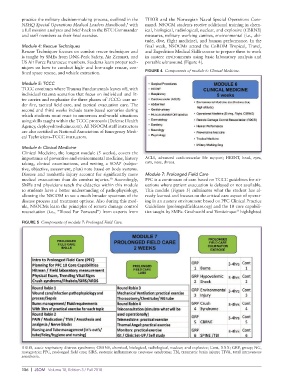
SMEs and physicians teach the didactics within this module uations where patient evacuation is delayed or not available.
so students have a better understanding of pathophysiology, This module (Figure 5) culminates what the student has al
allowing the NSCOM to see a much broader spectrum of the ready learned and focuses on the critical care aspect of operat
disease process and treatment options. Also during this mod ing in an austere environment based on PFC Clinical Practice
ule, NSOCMs learn the principles of remote damage control Guidelines (prolongedfieldcare.org) and the 10 core capabili
resuscitation (i.e., “Blood Far Forward”) from experts from ties taught by SMEs. Grathwohl and Venticinque highlighted
11
FIGURE 5 Components of module 7: Prolonged Field Care.
ARDS, acute respiratory distress syndrome; CBRNE, chemical, biological, radiological, nuclear, and explosive; Cont, XXX; GRP, group; NG,
nasogastric; PFC, prolonged field care; SIRS, systemic inflammatory response syndrome; TBI, traumatic brain injury; TIVA, total intravenous
anesthesia.
106 | JSOM Volume 18, Edition 3 / Fall 2018

