


Page 109 - JSOM Fall 2018
P. 109
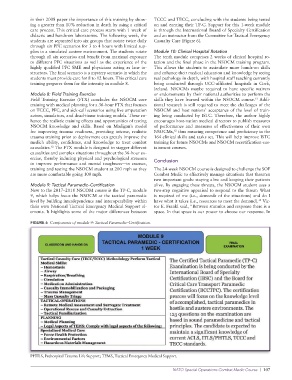
in their 2008 paper the importance of this training by show TCCC and TECC, concluding with the students being tested
ing a greater than 10% reduction in death by using a critical on and earning their TPC. Support for this 1week module
care process. This critical care process starts with 1 week of is through the International Board of Specialty Certification
didactic and handson laboratories. The following week, the and an instructor from the Committee for Tactical Emergency
students are separated into six groups that rotate twice daily Casualty Care (Figure 6).
through six PFC scenarios for 3 to 4 hours with limited sup
plies in a simulated austere environment. The students rotate Module 10: Clinical Hospital Rotation
through all six scenarios and benefit from maximal exposure The tenth module comprises 2 weeks of clinical hospital ro
to different PFC situations as well as the experience of the tation and the final phase in the NSOCM training program.
highly qualified PFC SME and physicians acting as lane in This allows the students to assimilate more handson skills
structors. The final scenario is a mystery scenario in which the and enhance their medical education and knowledge by seeing
students must provide care for 8 to 12 hours. This critical care real pathology in depth, with hospital staff teaching currently
training prepares them for the intensity in module 8. being conducted through UCCaffiliated hospitals in Cork,
Ireland. NSOCMs maybe required to have specific waivers
Module 8: Field Training Exercise or endorsements by their national authorities to perform the
Field Training Exercise (FTX) concludes the NSOCM core skills they have learned within the NSOCM course. Addi
13
training with medical planning for a 36hour FTX that focuses tional research is still required to meet the challenges of the
on TCCC, PFC, and sickcall scenarios using live amputation NSOCM and host nations’ acceptance of the level of train
actors, simulators, and deadtissue training models. These en ing being conducted by ISTC. Therefore, the author highly
hance the realistic training effects and opportunities of testing encourages hostnation medical directors to publish measures
NSOCM knowledge and skills. Based on Madigan’s model of performance and measures of effectiveness of their own
for improving trauma readiness, providing intense, realistic NSOCMs, thus ensuring competence and proficiency in the
12
trauma training prior to deployment can greatly improve the 164 clinical skills and tasks set. This will help improve ISTC
medic’s ability, confidence, and knowledge to treat combat training for future NSOCMs and NSOCM recertificationsus
causalities. The FTX module is designed to stagger different tainment courses.
12
causalities and complex situations throughout the 36hour ex
ercise, thereby inducing physical and psychological stressors Conclusion
to improve performance and mental toughness—in essence,
training and testing the NSOCM student at 200 mph so they The 24week NSOCM course is designed to challenge the SOF
are more comfortable going 100 mph. Combat Medic to effectively manage situations that threaten
two important goals: staying alive and keeping their patients
Module 9: Tactical Paramedic–Certification alive. By engaging these threats, the NSOCM student uses a
New to the 2017–2018 NSCOM course is the TPC, module twostep cognitive appraisal to respond to the threat: What
9, which helps focus the NSOCM at the tactical paramedic is required of me (i.e., demands of the situations) and do I
level by building interdependence and interoperability within have what it takes (i.e., resources to meet the demand). Vic
15
their own National Tactical Emergency Medical Support el tor E. Frankl said, “Between stimulus and response there is a
ements. It highlights some of the major differences between space. In that space is our power to choose our response. In
FIGURE 6 Components of module 9: Tactical Paramedic–Certification.
PHTLS, Prehospital Trauma Life Support; TEMS, Tactical Emergency Medical Support.
NATO Special Operations Combat Medic Course | 107

