


Page 57 - JSOM Summer 2018
P. 57
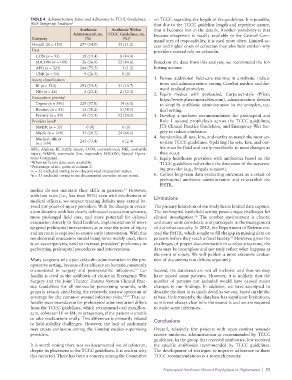
TABLE 4  Administration Rates and Adherence to TCCC Guidelines,   on TCCC regarding the length of the guidelines. It is possible,
              With Subgroup Analyses a                           that due to the TCCC guideline length and repetitive nature,
                                  Antibiotic   Antibiotic Within   that it becomes lost in the details. Another possibility is that
                               Administered, no.  TCCC Guidelines, no.   because ertapenem is readily available in the Central Com-
              Category              (%)             (%) b        mand area of responsibility, it is used more often. Limited ac-
              Overall (N = 550)   297 (54.0)      33 (11.1)      cess and higher costs of cefotetan may also help explain why
              Unit                                               providers instead rely on cefazolin.
                CON (n = 93)       18 (19.4)       8 (44.4)
                 SOCOM (n = 100)   26 (26.0)      22 (84.6)      Based on the data from this analysis, we recommend the fol-
                AFG (n = 323)     244 (75.5)       3 (1.2)       lowing actions:
                UNK (n = 34)        9 (26.5)       0 (0)
              Injury classification                              1.  Pursue additional field-care training in antibiotic indica-
                                                                   tions and administration among Combat medics and for-
                BI (n = 524)      291 (55.5)      31 (10.7)        ward medical providers.
                NBI (n = 26)        6 (23.1)       2 (33.3)      2.  Equip medics with preloaded, Carpuject-style (Pfizer,
              Evacuation priority c                                https://www.pfizerinjectables.com), administration devices
                Urgent (n = 396)  229 (57.8)       14 (6.1)        to simplify antibiotic administration in the complex, tac-
                Routine (n = 43)   13 (30.2)       5 (38.5)        tical setting.
                Priority (n = 89)  49 (55.1)      12 (24.5)      3.  Develop a uniform recommendation for prehospital and
              Provider level d                                     Role  1  wound  prophylaxis  across  the  TCCC  guidelines,
                NMFR (n = 35)        0 (0)         0 (0)           JTS Clinical Practice Guidelines, and Emergency War Sur-
                Medic (n = 169)    35 (20.7)      24 (68.6)        gery to reduce confusion.
                 Medical officer                                 4.  Standardize all sets, kits, and outfits to match the most up-
                (n = 334)         245 (73.4)       6 (2.4)         to-date TCCC guidelines. Updating the sets, kits, and out-
              AFG, Afghan; BI, battle injury; CON, conventional; NBI, nonbattle   fits must be fluid and easily modifiable to meet changes as
              injury; NMFR, nonmedic first responder; SOCOM, Special Opera-  they occur.
              tions Command.                                     5.  Equip healthcare providers with antibiotics based on the
              a When sufficient data were available.               TCCC guidelines rather than the discretion of the supervis-
              b Percentage of no. given in column 2.
              c n = 22 excluded owing to no documented evacuation status.  ing provider (e.g., brigade surgeon).
              d n = 35 excluded owing to no documented provider at any point.  6.  Collect long-term data evaluating outcomes as a result of
                                                                   prehospital antibiotic administration and re-establish the
                                                                   PHTR.
              medics do not maintain their skills in garrison.  However,
                                                    13
              with low rates (i.e., less than 80%) even with involvement of   Limitations
              medical officers, we suspect training deficits may extend be-
              yond just point-of-injury providers. With the change in evacu-  The primary limitation of our study lies in limited data capture.
              ation doctrine with less clearly delineated evacuation schemes,   The prehospital battlefield setting poses unique challenges for
              more prolonged field care, and more potential for delayed   clinical investigation.  The combat environment is chaotic
                                                                                 16
              evacuation directly to fixed facilities, implementation of more   and many units coordinate and participate in the management
              targeted prehospital interventions at or near the point of injury   of a combat casualty. In 2012, the Department of Defense cre-
              and en route is required to ensure early intervention. With this   ated the PHTR, which sought to fill the gap in missing data on
              nondoctrinal evacuation model being more widely used, there   patients before they reach a fixed facility.  However, given the
                                                                                                15
              is an accompanying need to increase providers’ proficiency in   challenges of proper documentation in combat situations, the
              performing prehospital procedures and interventions.  data may be incomplete and not truly reflect what happens at
                                                                 the point of injury. We will publish a more extensive evalua-
              Many surgeons rely upon cefazolin administration in the pre-  tion of documentation deficits separately.
              operative setting, because of its efficacy on bacteria commonly
              encountered in surgery and postoperative infections.  Ce-  Second, the databases are not all inclusive and thus we may
                                                         14
              fazolin is cited as the antibiotic of choice in Emergency War   have missed some patients. However, it is unlikely that the
              Surgery and the Joint Theater Trauma System Clinical Prac-  number of patients not included would have caused major
              tice Guidelines for all nonocular penetrating wounds, with   changes in our findings. In addition, we have attempted to
              primary reason cited being the relatively narrow spectrum of   describe the data in as much detail as we can, based on the da-
              coverage for the common wound infection risks. 14,15  That ce-  tabase. Unfortunately, the database has significant limitations,
              fazolin recommendation for prehospital administration differs   so it is not always clear who the source is and we are required
              from the TCCC guidelines, which recommend oral moxiflox-  to make some inferences.
              acin, cefotetan IV or IM, or ertapenem, if the patient is unable
              to take medications orally. This difference is primarily related   Conclusions
              to field-stability challenges. However, the lack of uniformity
              may create confusion among the Combat medics supervising   Overall, relatively few patients with open combat wounds
              providers.                                         receive antibiotic administration as recommended by TCCC
                                                                 guidelines. In the group that received antibiotics, few received
              It is worth noting there was no documented use of cefotetan,   the specific antibiotics recommended by TCCC guidelines.
              despite its placement in the TCCC guidelines. It is unclear why   The development of strategies to improve adherence to these
              this occurred. There has been a concern among the Committee   TCCC recommendations is a research priority.

                                                                    Prehospital Antibiotic Wound Prophylaxis in Afghanistan  |  55

