


Page 56 - JSOM Summer 2018
P. 56
of moxifloxacin orally for all patients with penetrating eye   on arrival, and three were enemy prisoners of war; data from
          trauma or other open combat wounds who are able to take oral   these casualties were excluded. Of the remaining 705 casual-
          medications. For patients with penetrating eye trauma or open   ties with available records, 643 (91.2%) had battle injuries,
          combat wounds unable to take oral medication (owing to, for   and there were 550 with a documented open wound, including
          example, shock, unresponsive, or abdominal injury), TCCC   penetrating eye injury, other penetrating trauma, amputation,
          guidelines recommend ertapenem 1g IV or IM once daily. 10,11  laceration, degloving, or gunshot wound (Table 1). Within the
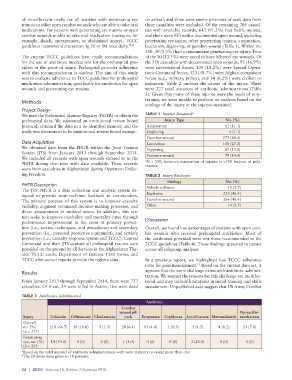
                                                             550, 30 (5.5%) had a concomitant penetrating eye injury. Four
          The current TCCC guidelines have made recommendations   of the 30 (13.3%) were noted to have bilateral eye wounds. Of
          for the use of antibiotic medications for the prehospital pro-  the 550 casualties with documented open wounds, 93 (16.9%)
          viders at the point of injury. Prehospital provider adherence   were conventional forces, 100 (18.2%) were Special Opera-
          with this recommendation is unclear. The aim of this study   tions Command forces, 323 (58.7%) were Afghan-component
          was to evaluate adherence to TCCC guidelines for prehospital   forces (e.g., military, policy), and 34 (6.2%) were civilian or
          medication administration, specifically for antibiotics for open   unknown. Table 2 outlines the causes of the injury. There
          wounds and penetrating eye trauma.                 were 327 total instances of antibiotic administration (Table
                                                             3). Given that many of these injuries were the result of poly-
                                                             trauma, we were unable to perform an analysis based on the
          Methods
                                                             etiology of the injury or the injuries sustained.
          Project Design
          We used the Prehospital Trauma Registry (PHTR) to obtain the   TABLE 1  Injuries Sustained a
          prehospital data. We submitted an institutional review board   Injury Type          No. (%)
          protocol; obtained the data in a de-identified manner; and the   Amputation         61 (11.1)
          study was determined to be institutional review board exempt.  Degloving              6 (1.1)
                                                              Gunshot wound                  273 (49.6)
          Data Acquisition                                    Laceration                     150 (27.3)
          We obtained data from the PHTR within the Joint Trauma   Peppering                  87 (15.8)
          System (JTS) from January 2013 through September 2014.
          We included all records with open wounds entered in to the   Puncture wound         79 (14.4)
          PHTR during that time with data available. These records   a N = 550; however, summation of injuries is >550 because of poly-
          were from casualties in Afghanistan during Operation Endur-  trauma.
          ing Freedom.                                       TABLE 2  Injury Etiologies
                                                                      Etiology                No. (%)
          PHTR Description                                    Vehicle collision                15 (2.7)
          The JTS PHTR is a data collection and analytic system de-
          signed to provide near–real-time feedback to commanders.   Explosive               255 (46.4)
          The primary purpose of this system is to improve casualty   Gunshot wound          266 (48.4)
          visibility, augment command decision-making processes, and   Other                   14 (2.5)
          direct procurement of medical assets. In addition, this sys-
          tem seeks to improve morbidity and mortality rates through
          performance  improvement  in  the areas  of primary  preven-  Discussion
          tion (i.e., tactics, techniques, and procedures) and secondary   Overall, we found low percentages of patients with open com-
          prevention (i.e., personal protective equipment), and tertiary   bat wounds who received prehospital antibiotics. Most of
          prevention (i.e., casualty response system and TCCC). Central   the antibiotics provided were not those recommended in the
          Command and their JTS capture all prehospital trauma care   TCCC guidelines (Table 4). These findings appeared to persist
          provided on the ground by all Services in the Afghanistan The-  across all subgroup analyses.
          ater. TCCC cards, Department of Defense 1380 forms, and
          TCCC after-action reports provide the registry data.  In a previous report, we highlighted low TCCC adherence
                                                             rates for pain management.  Based on the current data set, it
                                                                                  12
          Results                                            appears that the same challenge exists with antibiotic adminis-
                                                             tration. We suspect the reasons for this challenge are multifac-
          From January 2013 through September 2014, there were 737   torial and may include limitations in initial training and skills
          casualties. Of these, 24 were killed in Action, five were dead   sustainment. Unpublished data suggest that US Army Combat

          TABLE 3  Antibiotics Administered
                                                             Antibiotic
                                                   Combat
                                                  wound pill                                        Piperacillin-
           Injury     Cefazolin  Ceftriaxone Clindamycin  pack  Ertapenem  Cephlexan  Levofloxacin Metronidazole tazobactam
           Overall,
           no. (%)    218 (66.7)  38 (11.6)  5 (1.5)  20 (6.1)  13 (4.0)  1 (0.3)  5 (1.5)  4 (1.2)  23 (7.0)
           (n = 327)
           Penetrating
           eye, no. (%)    14 (70.0)  0 (0)  0 (0)  1 (5.0)   0 (0)    0 (0)    5 (25.0)    0 (0)     0 (0)
           (n = 20) b
          a Based on the total number of antibiotic administrations with some patients receiving more than one.
          b The 20 doses were given to 18 patients.


          54  |  JSOM   Volume 18, Edition 2/Summer 2018

