


Page 52 - JSOM Summer 2018
P. 52
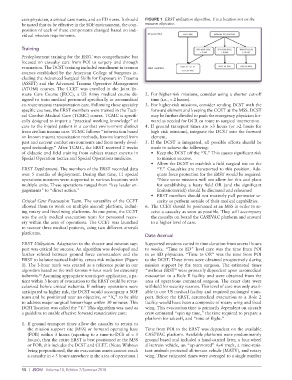
care physician, a critical care nurse, and an ED nurse. It should   FIGURE 1  ERST utilization algorithm. Y is a location not on the
          be noted that to be effective in the SOF environment, the com-  mission objective.
          position of each of these components changed based on indi-
          vidual mission requirements.


          Training
          Predeployment training for the ERST was comprehensive but
          focused  on  casualty  care  from  POI to  surgery  and  through
          evacuation. The DCST training included enrollment in trauma
          courses established by the American College of Surgeons in-
          cluding the Advanced Surgical Skills for Exposure in Trauma
          (ASSET) and the Advanced Trauma Operative Management
          (ATOM) courses. The CCET was enrolled in the Joint En-
          route Care Course (JECC), a US Army medical course de-  2.  For higher-risk missions, consider using a shorter cut-off
          signed to train medical personnel specifically in aeromedical   time (i.e., < 2 hours).
          en-route trauma transportation care. Following these specialty   3.  For higher-risk missions, consider sending DCST with the
          specific courses, the ERST members were trained in the Tacti-  forward element and keeping the CCET at the MSS. DCST
          cal Combat Medical Care (TCMC) course. TCMC is specifi-  may be further divided to push the emergency physician for-
          cally designed to impart a “practical working knowledge” of   ward as needed for DCR en route to surgical intervention.
          care to the injured patient in a combat environment distinct   4.  If ground transport times are >3 hours (or >2 hours for
          from civilian trauma care. TCMC follows “information based   high risk missions), integrate the DCST into the forward
          on known trauma resuscitation methods, lessons learned from   element.
          past and current combat environments and from newly devel-  5.  If the DCST is integrated, all possible efforts should be
          oped technology.” After TCMC, the ERST received 2 weeks   made to achieve the following:
          of didactic and field training from subject matter experts in   •  Keep the DCST off the “X.” This causes significant risk
          Special Operation tactics and Special Operations medicine.  to mission success.
                                                               •  Allow the DCST to establish a field surgical site on the
          ERST Deployment. The members of the ERST recorded data   “Y.” Casualties are transported to this position. Ade-
          over 5 months of deployment. During that time, 11 special   quate force protection for the ERST would be required.
          operations missions were supported in various locations with   *Note some missions will not allow for this and plans
          multiple units. These operations ranged from “key leader en-  for establishing a hasty field OR (and the significant
          gagements” to “direct action.”                          limitations/risk) should be discussed and rehearsed
                                                               •  ERST members should not routinely pull perimeter se-
          Critical Care Evacuation Team. The versatility of the CCET   curity or perform outside of their medical capabilities.
          allowed them to work on multiple aircraft platform, includ-  6.  The CCET should be positioned at an MSS in order to re-
          ing rotary and fixed wing platforms. At one point, the CCET   ceive a casualty as soon as possible. They will accompany
          was the only medical evacuation  team for personnel recov-  the casualty on board the CASEVAC platform and onward
          ery within the area of operations. The CCET was launched   to a higher level of care.
          to recover three medical patients, using two different aircraft
          platforms.
                                                             Data Accrual
          ERST Utilization. Adaptation to the theater and mission sup-  Supported missions varied in time duration from several hours
          port was critical for success. An algorithm was developed and   to weeks. “Time to ED” level care was the time from POI
          further refined between ground force commanders and the   to an ED physician. “Time to OR” was the time from POI
          ERST to balance tactical liability versus risk reduction (Figure   to the DCST. These times were obtained prospectively during
          1). The 3-hour mark was created as a reference point in our   mission support by the team surgeon. The estimated  times
          algorithm based on the well-known 4-hour mark for extremity   “without ERST” were primarily dependent upon aeromedical
          ischemia.  Assuming appropriate tourniquet application, a pa-  evacuation to a Role II facility and were obtained from the
                 10
          tient within 3 hours of evacuation to the ERST could be revas-  area of operations command  surgeon. The exact  data were
          cularized before critical ischemia. If military operations were   withheld for security reasons. This level of care was only avail-
          anticipated as higher risk, the DCST would accompany a SOF   able in one US medical facility and required prolonged trans-
          team and be positioned near an objective, or “X,” to be able   port. Before the ERST, aeromedical evacuation to a Role 2
          to address major surgical hemorrhage within 30 minutes. This   facility would have been a composite of rotary wing and fixed
          DCST location was called the “Y.” This algorithm was used as   wing. This evacuation time is primarily dependent on aircraft
          a guideline to enable effective forward resuscitative care:  crew estimated “spin up time,” the time required to prepare a
                                                             platform for takeoff, and “time of flight.”
          1.  If ground transport times allow the casualty to return to
            the mission support site (MSS) or forward operating base   Time from POI to the ERST was dependent on the available
            (FOB) within 3 hours (equating to a time-to-DCS of < 3   CASEVAC platform. Available platforms were predominantly
            hours), then the entire ERST is best positioned at the MSS   ground based and included a hand-carried litter, a four-wheel
            or FOB; this includes the DCST and CCET. (Note: Without   all-terrain vehicle, an “up-armored” 4×4 truck, a mine-resis-
            being prepositioned, the air evacuation assets cannot reach   tant ambush protected all- terrain vehicle (MATV), and rotary
            a casualty in < 3 hours anywhere in the area of operations.)  wing. These estimated times were averaged to a single number


          50  |  JSOM   Volume 18, Edition 2/Summer 2018

