


Page 53 - JSOM Summer 2018
P. 53
over mission length. Average estimates were required given that   Discussion
              variables such as length of mission, DCST location, CASEVAC
              asset and location of POI could not realistically be controlled in   In this study, the ERST significantly improves time to DCR
              a combat environment over the length of the mission.  and DCS in an environment without robust aeromedical evac-
                                                                 uation following surgical stabilization. With the ability to re-
              Prospective “Time to ED” and “Time to OR” were averaged   duce prehospital time in penetrating trauma, the ERST can
              and were compared with retrospective averaged times “With-  reduce  time  to surgical  hemorrhage  control, thereby  poten-
              out ERST.” Data were entered into Microsoft Excel and an-  tially enabling a reduction in trauma mortality.
              alyzed by paired t-test and one-way ANOVA for significant
              difference.                                        The ERST resulted from the discrepancy between elevated
                                                                 risk of SOF missions and medical evacuation within US Af-
                                                                 rica Command (AFRICOM). The development of a suitable
              Results                                            medical  response  to  the  discrepancy  of  trauma  coverage  in
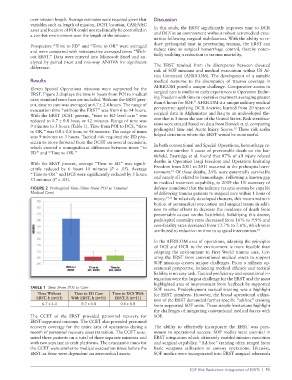
              Eleven Special Operations missions were supported by the   AFRICOM posed a unique challenge. Comparative access to
              ERST. Figure 2 displays the time in hours from POI to medical   surgical care is similar to early experiences in Operation Endur-
              care; standard error bars are included. Without the ERST pres-  ing Freedom with time to operative treatment averaging greater
                                                                                 11
              ent, time to care was averaged at 6.7 ± 2.4 hours. The range of   than 6 hours for SOF.  AFRICOM is a unique military medical
              evacuation time “without the ERST” was from 6 to 14 hours.   perspective: applying DCR doctrine learned from 20 years of
              With the ERST DCST present, “time to ED level care” was   surgical data in Afghanistan and Iraq to an undeveloped the-
              reduced to 0.7 ± 0.8 hour, or 42 minutes. Range of time was   ater that is 3 times the size of the United States. Risk stratifica-
              9 minutes to 3 hours (Table 1). Time from POI to DCS, “time   tions were created based on data from Remick et al. comparing
                                                                                                  12
              to OR,” was 0.8 ± 0.8 hour, or 48 minutes. The range of times   prehospital time and Acute Injury Scores.  These risk scales
              was 9 minutes to 3 hours. Tactical risk required the ED phy-  helped determine where the ERST would be most useful.
              sician to move forward from the DCST on several occasions,
              which created a nonsignificant difference between times “to   In both conventional and Special Operations, hemorrhage re-
              ED” and “Time to OR.”                              mains the number 1 cause of preventable death on the bat-
                                                                 tlefield. Eastridge et al. found that 87% of all injury related
              With the ERST present, average “Time to ED” was signifi-  deaths in Operation Iraqi Freedom and Operation Enduring
              cantly reduced by 6 hours 10 minutes (P < .05). Average   Freedom from 2001 to 2011 occurred in the prehospital envi-
                                                                        13
              “Time to OR” and DCS were significantly reduced by 5 hours   ronment.  Of these deaths, 24% were potentially survivable
              53 minutes (P < .05).                              and nearly all related to hemorrhage. Following a known gap
                                                                 in medical treatment capability, in 2009 the US secretary of
              FIGURE 2  Prehospital Time (Time From POI to Trauma/   defense mandated that the military trauma system be capable
              Medical Care)                                      of delivering trauma patients to surgical care within 1 hour of
                                                                 injury. 14,15  In relatively developed theaters, this meant redistri-
                                                                 bution of aeromedical evacuation and surgical teams in addi-
                                                                 tion to other efforts to decrease the incidence of death from
                                                                 preventable causes on the battlefield. Solidifying this decree,
                                                                 prehospital mortality rates decreased from 16% to 9.9% and
                                                                 case-fatality rates decreased from 13.7% to 7.6%, which were
                                                                 attributed to reduction in time to surgical intervention. 16

                                                                 In the AFRICOM area of operations, adapting the principles
                                                                 of DCS and DCR to the environment is more feasible than
                                                                 adapting the environment to First World trauma care. Cre-
                                                                 ating the ERST from conventional medical assets to support
                                                                 SOF missions creates unique challenges. From a military op-
                                                                 erational perspective, balancing medical efficacy and tactical
                                                                 liability is no easy task. Tactical proficiency and operational in-
                                                                 tegration were the largest challenge for the ERST and the most
                                                                 highlighted area of improvement from feedback by supported
              TABLE 1  Time From POI to Care                     SOF teams. Predeployment tactical training was a highlight
                 Time Without   Time to ED Care   Time to DCS With   for ERST members. However, the broad operational utiliza-
                ERST, h (n=11)  With ERST, h (n=11)  ERST, h (n=11)  tion of the ERST demanded further specific “ad-hoc” training
                  6.7 ± 2.4        0.7 ± 0.8       0.8 ± 0.8     from supported SOF units. These simple limitations highlight
                                                                 the challenges of integrating conventional medical forces with
              The  CCET  of  the  ERST  provided  personnel  recovery  for   SOF.
              ERST-supported missions. The CCET also provided personnel
              recovery coverage for the entire area of operations during a   The ability to effectively incorporate the ERST was para-
              month of personnel recovery asset transition. The CCET evac-  mount to operational success. SOF medics were essential in
              uated three patients on a total of three separate missions and   ERST integration which ultimately enabled mission execution
              with two separate aircraft platforms. The evacuation times for   and surgical capability. “Ad-hoc” training often ranged from
              the CCET were similar to medical evacuation times before the   basic weapons utilization to convoy operations. Likewise,
              ERST as these were dependent on aeromedical assets.  SOF medics were incorporated into ERST surgical rehearsals


                                                                               SOF Risk Reduction: Integration of ESRTs  |  51

