


Page 56 - JSOM Spring 2018
P. 56
clinically. However, a benefit of the present setup is that it   reflecting the views of the Department of Defense or United
          allowed direct comparison with a body of literature  and   States Government. The authors are employees of the US gov-
                                                     7–9
          offered insights into reducing flow to an easily controlled   ernment. This work was prepared as part of their official du-
          level—an important aim of bleeding control. An third limita-  ties and, as such, there is no copyright to be transferred.
          tion is that upstream flow was steady and laminar but not
          pulsatile. Also, water is a Newtonian fluid (e.g., follows New-  Disclosure
          ton’s law of viscosity), while blood is more complex by being   The authors declare no conflicts of interest.
          non-Newtonian (e.g., does not follow the law). The viscosity
          of water is very low (practically inviscid), and temperature ef-  Author Contributions
          fects are negligible.                              LVG,  JFK,  and  MAD  conceived  the  study;  LVG  and  JFK
                                                             designed the study; LVG and JFK resourced, managed, and
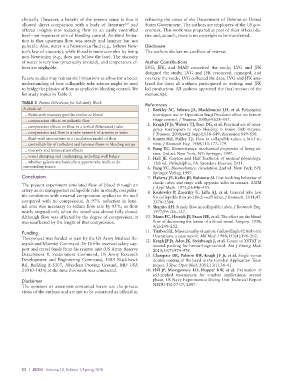
          Future studies may redress the limitations to allow for a better   oversaw the study; LVG collected the data; LVG and JFK ana-
          understanding of how collapsible tube science might be used   lyzed the data; all authors participated in writing; and JFK
          to bridge the physics of flow as applied to bleeding control. We   led production. All authors approved the final version of the
          list study topics in Table 3.                      manuscript.
          TABLE 3  Future Directions for Scholarly Work      References
           A check of                                          1.  Beekley AC, Sebesta JA, Blackbourne LH, et al. Prehospital
           … fluids with viscosity profiles similar to blood    tourniquet use in Operation Iraqi Freedom: effect on hemor-
           … compression effects on pulsatile flow              rhage control. J Trauma. 2008;64:S28–S37.
           … compression effects on flow in a forked (bifurcated) tube    2.  Kragh JF Jr, Walters TJ, Baer DG, et al. Practical use of emer-
                                                                gency tourniquets to stop bleeding in major limb trauma.
           … compression and flow in a tube network of arteries or veins  J Trauma. 2008;64(2 Suppl):S38–S49; discussion S49–S50.
           … fluid–wall interactions in a circulation model of flow    3.  Kamm RD, Pedley TJ. Flow in collapsible tubes: a brief re-
           … controllability of turbulent and laminar flows in bleeding setups  view. J Biomech Eng. 1989;111:177–179.
           … viscosity and temperature effects                 4.  Fung YC. Biomechanics: mechanical properties of living tis-
                                                                sues. 2nd ed. New York, NY: Springer; 1997.
           … vessel clamping and unclamping, including wall bulges    5.  Hall JE. Guyton and Hall Textbook of medical physiology.
           … whether gelatin mechanically supports tube walls as do   12th ed. Philadelphia, PA: Saunders Elsevier; 2011.
           surrounding tissues                                 6.  Fung YC. Biomechanics: circulation. 2nd ed. New York, NY:
                                                                Springer Verlag; 1997.
          Conclusion                                           7.  Flaherty JE, Keller JB, Rubinow SI. Post buckling behavior of
          The present experiment simulated flow of blood through an   elastic tubes and rings with opposite sides in contact. SAIM
                                                                J Appl Math. 1972;23:446–455.
          artery as an unsupported collapsible tube in steady, nonpulsa-    8.  Kozlovsky P, Zaretsky U, Jaffa AJ, et al. General tube law
          tile conditions with external compression applied to the wall   for collapsible thin and thick-wall tubes. J Biomech. 2014;47:
          compared with no compression. A 97% reduction in lumi-  2378–2384.
          nal area was necessary to reduce flow rate by 95%, as flow     9.  Shapiro AH. Steady flow in collapsible tubes. J Biomech Eng.
          nearly stopped only when the vessel was almost fully closed.   1977;99:126–147.
          Although flow was affected by the degree of compression, it   10.  Mann FC, Herrick JF, Essex HE, et al. The effect on the blood
          was unaffected by the length of that compression.     flow of decreasing the lumen of a blood vessel. Surgery. 1938;
                                                                4(2):249–252.
          Funding                                            11.  Timboe HL. Mass casualty situation: Gallant Eagle 82 Airborne
          This project was funded in part by the US Army Medical Re-  Operations: a case report. Mil Med. 1988;153(4):198–202.
          search and Materiel Command. Dr Griffin received salary sup-  12.  Kragh JF Jr, Aden JK, Steinbaugh J, et al. Gauze vs XSTAT in
                                                                wound packing for hemorrhage control. Am J Emerg Med.
          port and travel funds from his reserve unit (US Army Reserve   2015;33(7):974–976.
          Detachment 8, Sustainment Command, US Army Research   13.  Clumpner BR, Polston RW, Kragh JF Jr, et al. Single versus
          Development and Engineering Command, 5183 Blackhawk   double routing of the band in the Combat Application Tour-
          Rd,  Building  E-5307, Aberdeen  Proving Ground,  MD  USA   niquet. J Spec Oper Med. 2013;13(1):34–41.
          21010-5424) at the time this work was conducted.   14.  Hill JP, Montgomery LD, Hopper KW, et al. Evaluation of
                                                                self-applied tourniquets for combat applications, second
          Disclaimer                                            phase. US Navy Experimental Diving Unit Technical Report
          The opinions or assertions contained herein are the private   NEDU-TR-07-07, 2007.
          views of the authors and are not to be construed as official or


          52  |  JSOM   Volume 18, Edition 1/Spring 2018

