


Page 55 - JSOM Spring 2018
P. 55
similar results. Their study experimentation with a collapsible   indicate whether they thought of either speed or volume for
              tube was set up vertically to check the effects of area reduction   flow, as there may be an opportunity for improved clarity by
              on flow rate; they subsequently checked their measurements   surveying opinions and by later refining instruction of the skill
              with the use of mathematical equations, and they confirmed   of bleeding assessment. In a 2007 study of tourniquet use as
              the effect of arterial luminal reduction on blood flow in dogs.   assessed with the use of plethysmography, investigators puz-
              Mann and coauthors found similar results by reducing luminal   zled why tourniquets may increase blood flow velocity when
              area in two ways: external compression and internal blockage.   occlusion was not attained, and the present study results,
              They found that flow was affected little until area reduction   collapsible tube science, and the Venturi effect can plausibly
              was severe, like the key finding of our study. Mann and co-  explain why it was so.  If caregivers or investigators do not
                                                                                   14
              authors found that: “The area of the lumen may be reduced   understand well the metric of performance (velocity of flow
              50 per cent without any change in blood flow, and it can be   or volume of flow) that they use in assessment, then their as-
              reduced as much as 90 per cent before a 50 per cent reduction   sessment may be incomplete or biased, resulting in suboptimal
              in blood flow occurs.”  Results of the present study and of   care to the patient.
                                10
              Mann and coauthors’ study are coherent in their applicability
              to inorganic tubes and living mammals. In other words, the   In the 20th century, collapsible tube science was used in at-
              phenomena described are not specific to blood flow or even to   tempts to develop bleeding control interventions. It was funded
              biology, as fluid mechanics applies generally.     by the US government. Funds were granted to several institu-
                                                                 tions whose investigators developed knowledge and interven-
              Collapsible tube science can aid in the selection of bleeding   tions (Table 2). Few such interventions were eventually tried
              control interventions for further preclinical study such as with   in care, but the funding eventually stopped and evidently did
              manikins, cadavers, or animals or by down-selection of un-  not flow again. During the decade we have been involved in
              promising candidate interventions. Such studies may improve   the management of bleeding control research, potential fund-
              our capacity to reduce the number of animals required for   ing for such development has not come up in discussion until
              later studies  of bleeding control by abandoning poorly per-  late 2016, when we reported to managers the results of the
              forming candidate interventions or refining power analyses   present study. Current costs of such research are mostly in the
              through better understanding of treatment effect sizes. Mann   man-hours of skilled investigators because the materials are
              and coauthors used animals, and knowledge generated from   relatively inexpensive. The lines of potential work in applying
              this study of tubes could reduce the number needed for future   collapsible tube science to first aid control of bleeding appear
              studies. 10                                        to be legitimate scientific topics and appear to be a frugal out-
                                                                 lay offering a good return on investment. Organizations that
              Mann and coauthors also pointed out that the clinicians they   may conduct such work include civilian programs of biome-
              spoke with thought that the bleeding was most reliably as-  chanical engineering involving professors/instructors and their
              sociated with the artery’s external wall diameter, its internal   students at the level of a master’s or doctoral degree. The US
              (lumen) diameter, or its cross-sectional area of the lumen,   government may reconsider its funding of such programs.
              and clinicians were unsure about which area was most reli-
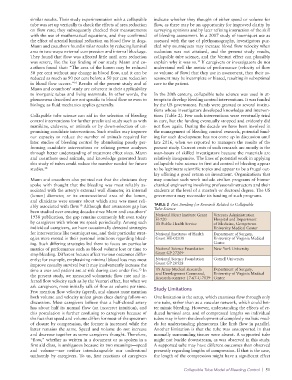
              ably associated with flow.  Although that awareness gap has   TABLE 2  Past Funding for Research Related to Collapsible
                                  10
              been studied over ensuing decades since Mann and coauthors’   Tube Science
              1938 publication, the gap remains commonly felt even today   National Heart Institute Grant   Veterans Administration
              by caregivers with whom we speak periodically. Among such   H-720          Hospital and Department
                                                                                         of Medicine, Georgetown
                                                                 US Public Health Service
              individual caregivers, we have occasionally detected strategies            University Medical Center
              for interventions like tourniquet use, and their particular strat-  National Institutes of Health   Department of Surgery,
              egies were rooted in their personal intuitions regarding bleed-  Grant HE-02038  University of Virginia Medical
              ing. Such differing strategies led them to focus on particular             Center
              metrics of performance such as blood volume lost or time to   National Science Foundation   New York University
              stop bleeding. Different focuses affect various outcomes differ-  Grant GP 27209
              ently; for example, emphasizing minimal blood loss may most   National Science Foundation   Cornell University
              improve casualty survival but it may inadvertently increase the   Grant GP 20528
              time a user and patient are at risk during care under fire.  In   US Army Medical Research   Department of Surgery,
                                                          13
              the present study, we measured volumetric flow rate and in-  and Development Command,   University of Virginia Medical
              ferred flow velocity such as by the Venturi effect, but when we   Research contract 17-67-C-7039 Center
              ask caregivers, most initially talk of flow as volume per time.   Study Limitations
              Few mention flow velocity (speed), and almost none mention
              both volume and velocity unless given clues during follow-on   One limitation is the setup, which examines flow through only
              discussion. Most caregivers believe that a half-closed artery   one tube, rather than as a vascular network, which could bet-
              has about half its normal flow (an incorrect intuition), and   ter mimic bleeding. However, understanding the effects of re-
              this postulation is further confusing to caregivers because of   duced luminal area and of compressed lengths on individual
              the fact that speed and volume differ: for most of the spectrum   tubes may inform the development of complexly realistic mod-
              of closure by compression, the former is increased while the   els for understanding phenomena like limb flow in parallel.
              latter  remains  the  same. Speed  and  volume do  not increase   Another limitation is that the tube was unsupported in that
              and decrease together as some caregivers thought. Therefore,   normally surrounding tissues were absent. A supported tube
              “flow,” whether as written in a document or as spoken in a   might not buckle downstream, as was observed in this study.
              first aid class, is ambiguous because its two meanings—speed   A supported tube may have different outcomes than observed
              and volume—are neither interchangeable nor understood   presently regarding lengths of compression. If that is the case,
              uniformly by caregivers. To us, first reactions of caregivers   the length of the compression might have a significant effect

                                                                             Collapsible Tube Model of Bleeding Control  |  51

