


Page 54 - JSOM Spring 2018
P. 54
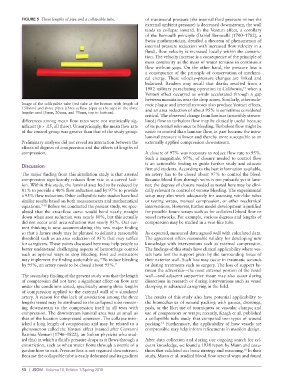
FIGURE 5  Three lengths of pipe and a collapsible tube.  of transmural pressure (the internal fluid pressure minus the
                                                             external ambient pressure) is decreased downstream, the wall
                                                             tends to collapse inward. In the Venturi effect, a corollary
                                                             of the Bernoulli principle (Daniel Bernoulli [1700–1782], a
                                                             Swiss mathematician, detailed a theorem of phenomenon of
                                                             internal pressure reduction with increased flow velocity in a
                                                             fluid), flow velocity is increased locally within the constric-
                                                             tion. The velocity increase is a consequence of the principle of
                                                             mass continuity as the mass of water remains in continuous
                                                             flow without gaps. On the other hand, the pressure loss is
                                                             a consequence of the principle of conservation of mechani-
                                                             cal energy. These velocity–pressure changes are linked and
                                                             balanced.  Readers  may  recall  that  deaths  resulted  from  a
                                                             1982 military parachuting operation in California,  when a
                                                                                                     11
                                                             Venturi effect occurred as winds accelerated through a gap
                                                             between mountains near the drop zones. Similarly, atheroscle-
          Image of the collapsible tube (red tube at the bottom with length of   rotic plaque and arterial stenoses also produce Venturi effects,
          150mm) and three pipes (three yellow pipes at the top) in the three   and an area reduction of about 95% is sometimes considered
          lengths used (5mm, 20mm, and 70mm, top to bottom).
                                                             critical. The observed change from laminar (smoothly stream-
          differences among mean flow rates were not statistically sig-  lined) flow to turbulent flow may be clinically useful because
          nificant (p > .05, all three). Unsurprisingly, the mean flow rate   of its potential relevance to bleeding. Turbulent flow might be
          of the control group was greater than that of the study group.  easier to control than laminar flow, in part because the intra-
                                                             luminal pressure is lower and thereby more susceptible to an
          Preliminary analyses did not reveal an interaction between the   externally applied compression downstream.
          effects of degrees of compression and the effects of lengths of
          compression.                                       A closure of 97% was necessary to reduce flow rate to 95%.
                                                             Such a magnitude, 97%, of closure needed to control flow
                                                             is an actionable finding to guide further study and educate
          Discussion
                                                             first aid students. According to the best information available,
          The major finding from this simulation study is that arterial   an artery has to be closed about 97% to control the bleed.
          compression significantly reduces flow rate in a curved fash-  Because blood flow through veins is not pulsatile yet is lami-
          ion. Within this study, the luminal area had to be reduced by   nar, the degrees of closure needed as tested here may be clini-
          81% to provide a 40% flow reduction and by 97% to provide   cally relevant to control of venous bleeding. The experimental
          a 95% flow reduction. Other collapsible tube studies have had   setup may also work adequately for assessing vein-like tubes
          similar results based on both measurements and mathematical   or testing wraps, manual compression, or other mechanical
          equations. 7–10  Before we conducted the present study, we spec-  interventions. However, further model development is justified
          ulated that the area–flow curve would bend nearly straight   for possible future setups such as for collateral blood flow or
          down when area reduction was nearly 80%, but this actually   vessel networks. For example, various degrees and lengths of
          did not occur until area reduction was nearly 95%. Our cur-  compression may be studied in a vein-like tube.
          rent thinking is now accommodating this new major finding
          so that a future study may be planned to delimit a reasonable   As expected, measured data agreed well with calculated data.
          threshold such as an area reduction of 95% that may suffice   The agreement offers reasonable validity for developing new
          for caregivers. These points discussed here may help people to   knowledge with interventions such as external compression.
          better understand challenging aspects of hemorrhage control   The findings of this study have clinical applicability where ves-
          such as optimal ways to stop bleeding. First aid instructors   sels have lost the support given by the surrounding tissue of
          may implement the finding actionable as, “To reduce bleeding   their exterior wall. Such loss may occur in traumatic wounds
          by 95%, an artery needs to be closed about 95%.”   or during treatments such as surgery. The loss of support be-
                                                             tween the adventitia—the most external portion of the vessel
          The secondary finding of the present study was that the length   wall—and adjacent supportive tissue may also occur during
          of compression did not have a significant effect on flow rate   dissections in research or during interventions such as vessel
          under the conditions tested, specifically among three lengths   clamping in advanced caregiving in the field.
          of compression applied to the external wall of a simulated
          artery. A reason for this lack of association among the three   The results of this study also have potential applicability to
          lengths tested may be attributed to the collapsed tube remain-  the biomechanics of wound packing with gauzes, dressings,
          ing downstream to the compression itself in all tests with   pads, or the like; use of tourniquets or vascular clamps; and
          compression. The downstream luminal area was as small as   use of compressors or wraps; recently, Kragh et al. published
          that of the location compressed upstream. The collapse mim-  a collapsible tube study that compared two types of wound
          icked a long length of compression and may be related to a   packing.  Furthermore,  the applicability of how vessels are
                                                                    12
          phenomenon called the Venturi effect (named after Giovanni   compressible may help inform refinements in manikin design.
          Battista Venturi [1746–1822], an Italian physicist who stud-
          ied this) in which a fluid’s pressure drops as it flows through a   After data collection and during our ongoing search for rel-
          constriction, such as when water flows through a nozzle of a   evant knowledge, we found a 1938 report by Mann and coau-
          garden hose to exit. Pressure loss is not regained downstream.   thors that validated our basic strategy and reasoning.  In their
                                                                                                      10
          Because the collapsible tube is easily deformed and its gradient   study, Mann et al. studied blood flow several ways and found

          50  |  JSOM   Volume 18, Edition 1/Spring 2018

