


Page 60 - JSOM Spring 2018
P. 60
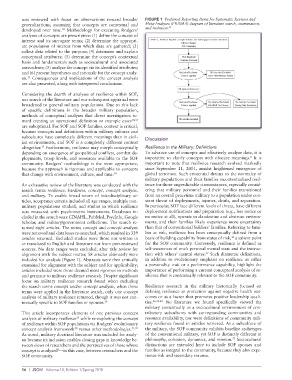
was reviewed with focus on observations toward broader   FIGURE 1  Preferred Reporting Items for Systematic Reviews and
          generalizations, assuming that concepts are contextual and   Meta-Analyses (PRISMA) diagram of literature search, examination,
          developed over time.  Methodology for executing Rodgers’   and inclusion. 35
                           30
          analyses of concepts are prescriptive: (1) define the concept of
          interest and its surrogate terms; (2) determine the appropri-
          ate population of interest from which data are gathered; (3)
          collect data related to the purpose; (4) determine and explain
          conceptual attributes; (5) determine the concept’s contextual
          basis and fundamentals such as sociocultural and associated
          antecedents; (5) analyze the concept via its identified attributes;
          and (6) present hypotheses and rationale for the concept analy-
          sis.  Consequences and implications of the concept analysis
            31
          are also presented, along with interpreted conclusions.

          Considering the dearth of analyses of resilience within SOF,
          our search of the literature and our subsequent appraisal were
          broadened to general military populations. Due to this lack
          of specific definitions in the broader military population,
          methods  of conceptual  analyses  that direct  investigators  to-
          ward creating an operational definition or example cases 30,32
          are suboptimal. For SOF and SOF families, context is critical,
          because concepts and definitions within military cultures and
          subcultures have completely different meanings than in civil-  Discussion
          ian environments, and SOF is a completely different context
          altogether.  Furthermore, resilience may morph conceptually   Resilience in the Military: Definitions
                  33
          depending on emergence of geopolitical conflicts, combat de-  To advance use of concepts and effectively analyze data, it is
                                                                                                        8
          ployments, troop levels, and resources available to the SOF   imperative to clarify concepts with obscure meanings.  It is
          community. Rodgers’ methodology is the most appropriate,   important to note that resilience research evolved markedly
          because the approach is rigorous and applicable to concepts   since September 11, 2001, amidst heightened emergence of
          that change with environment, culture, and time. 34  global terrorism. Such existential threats to the normalcy of
                                                             military populations and their families recontextualized resil-
          An exhaustive review of the literature was conducted with the   ience for those unpredictable circumstances, especially consid-
          search terms  resilience, hardiness, concept, concept analysis,   ering that military personnel and their families transitioned
          and  military. To enable broad return of interdisciplinary ar-  from an overall peacetime military to a population under con-
          ticles, acceptance criteria included all age ranges, multiple non-  stant threat of deployments, injuries, death, and separation.
          military populations studied, and studies in which resilience   In particular, SOF face different levels of threat, have different
          was measured with psychometric instruments. Databases in-  deployment notifications and preparation (e.g., less notice or
          cluded in the search were CINAHL, PubMed, PsycInfo, Google   no notice at all), operate in clandestine and abstruse environ-
          Scholar, and military/government collections. The search re-  ments, and their families likely experience more uncertainty
          turned eight articles. The terms concept and concept analysis   than that of conventional Soldiers’ families. Referring to fami-
          were removed and databases re-searched, which resulted in 339   lies at risk, resilience has been conceptually defined from a
          articles returned. Excluded studies were those not written in   basis of building capability from states of risk,  a salient point
                                                                                                 36
          or translated to English and literature not from peer-reviewed   for the SOF community. Conversely, resilience is defined as
          sources. No date ranges were excluded; after title review for   self-awareness of one’s personal mental state and the interac-
          alignment with the subject matter, 58 articles ultimately were   tion with others’ mental states.  Such diametric definitions,
                                                                                      37
          included for analysis (Figure 1). Abstracts were then critically   in addition to evolutionary emphasis on resilience as either
          examined for alignment with the subject and for applicability;   a personality trait or a performance capability, highlight the
          articles included were those deemed most rigorous in methods   importance of performing a current conceptual analysis of re-
          and germane to military resilience research. Despite significant   silience that is contextually relevant to the SOF community.
          focus on  military  resilience research found when  excluding
          the search terms concept and/or concept analysis, when those   Resilience research in the military historically focused on
          terms were applied in the literature search, only one concept   defining resilience as protection against negative health out-
          analysis of military resilience returned, though it was not con-  comes or as a factor that promotes positive leadership quali-
          textually specific to SOF families or spouses. 19  ties. 26,38-44   No literature  we  found  specifically  viewed  the
                                                             military contextually as a sociocultural environment of con-
          This article incorporates elements of one previous concept   tributory subcultures with  corresponding  communities and
          analysis of military resilience  while re-exploring the concept   resource availability, nor were definitions of community mili-
                                 19
          of resilience within SOF populations via Rodgers’ evolutionary   tary resilience found in articles retrieved. As a subculture of
          concept analysis framework  versus other methodologies. 31,32   the military, the SOF community exhibits baseline archetypes
                                30
          As noted, military doctrinal literature was included for analy-  of the conventional military, yet SOF is distinctly different in
                                                                                                 27
          sis because its inclusion enables closing gaps in knowledge be-  philosophy, cohesion, dynamics, and mission.  Sociocultural
          tween views of researchers and the perspectives of those whose   distinctions  are  extended  here  to  include  SOF  spouses  and
          concept is analyzed —in this case, between researchers and the   families as integral to the community, because they also expe-
                         8
          SOF community.                                     rience risk and secondary trauma.

          56  |  JSOM   Volume 18, Edition 1/Spring 2018

