


Page 121 - JSOM Spring 2018
P. 121
discovered that 13 of 25 cases died within 60 minutes. Patients   TABLE III  Signs and Symptoms of Anaphylaxis 18
              taking beta blockers, angiotensin converting enzyme (ACE) in-  Signs and Symptoms       Percentage
              hibitors, or angiotensin receptor blocking medications as well   Cutaneous
              as those with co-existing medical conditions such as poorly   Urticaria and angioedema    62-90
              controlled asthma, chronic obstructive pulmonary disease and
              cardiovascular disease, were shown to have more severe reac-  Flushing                    45-55
              tions and a higher mortality. 7,8,9                Pruritus without rash                   2-5
                                                                 Respiratory
                                                                 Dyspnea, wheezing                      45-50
              Diagnosis of anaphylaxis
                                                                 Angioedema of upper airway             50-60
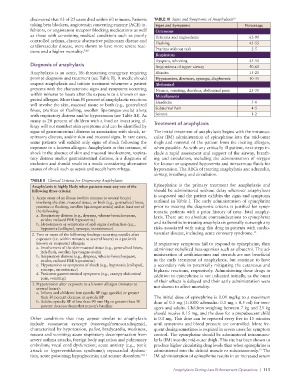
              Anaphylaxis is an acute, life-threatening emergency requiring   Rhinitis                  15-20
              prompt diagnosis and treatment (see Table II). A medic should   Hypotension, dizziness, syncope, diaphoresis  30-35
              suspect anaphylaxis and initiate treatment whenever a patient   Abdominal
              presents with the characteristic signs and symptoms occurring   Nausea, vomiting, diarrhea, abdominal pain  25-30
              within minutes to hours after the exposure to a known or sus-  Miscellaneous
              pected allergen. More than 80 percent of anaphylactic reactions
              will involve the skin, mucosal tissue or both (e.g., generalized   Headache                5-8
              hives, pruritus or flushing, swollen lips-tongue-uvula) along   Substernal Pain            4-5
              with respiratory distress and/or hypotension (see Table III). As   Seizure                 1-2
              many as 20 percent of children with a food or insect sting al-
              lergy will not manifest skin symptoms and can be identified by   Treatment of anaphylaxis
              signs of gastrointestinal distress in association with shock, re-  The initial treatment of anaphylaxis begins with the intramus-
              spiratory distress, and/or skin and mucosal signs. In rare cases,   cular (IM) administration of epinephrine into the mid-outer
              some patients will exhibit only signs of shock following the   thigh and removal of the patient from the inciting allergen,
              exposure to a known allergen. Anaphylaxis in this instance, of   when possible. As with any critically ill patient, next steps in-
              shock in the absence of skin and mucosal involvement, respira-  clude a rapid assessment and support of the airway, breath-
              tory distress and/or gastrointestinal distress, is a diagnosis of   ing  and circulation,  including  the administration  of  oxygen
              exclusion and should result in a medic considering alternative   for known or suspected hypoxemia and intravenous fluids for
              causes of shock such as sepsis and occult hemorrhage.  hypotension. The ABCs of treating anaphylaxis are: adrenalin,
                                                                 airway, breathing and circulation.
              TABLE II  Clinical Criteria for Diagnosing Anaphylaxis
              Anaphylaxis is highly likely when patients meet any one of the   Epinephrine is the primary treatment for anaphylaxis and
              following three criteria:                          should be administered without delay whenever anaphylaxis
                                                                 is suspected and the patient exhibits the signs and symptoms
              1. Acute onset of an illness (within minutes to several hours)
                involving the skin, mucosal tissue, or both (e.g., generalized hives,   outlined in Table I. The early administration of epinephrine
                pruritus or flushing, swollen lips-tongue-uvula) and at least one of   prior to meeting the diagnostic criteria is justified for symp-
                the following:                                   tomatic patients with a prior history of near- fatal anaphy-
                a. Respiratory distress (e.g., dyspnea, wheeze-bronchospasm,   laxis. There are no absolute contraindications to epinephrine
                  stridor, reduced PEF, hypoxemia)
                b. Hypotension or symptoms of end-organ dysfunction (e.g.,   and its benefits in treating anaphylaxis generally outweigh any
                  hypotonia [collapse], syncope, incontinence)   risks associated with using this drug in patients with cardio-
              2. Two or more of the following findings occurring rapidly after   vascular disease, including acute coronary syndrome. 12
                exposure (i.e. within minutes to several hours) to a patient’s
                known or suspected allergen:                     If respiratory symptoms fail to respond to epinephrine, then
                a. Involvement of the skin-mucosal tissue (e.g., generalized hives,   administer nebulized beta-agonists such as albuterol. The ad-
                  itch-flush, swollen lips-tongue-uvula)
                b. Respiratory distress (e.g., dyspnea, wheeze-bronchospasm,   ministration of antihistamines and steroids are not beneficial
                  stridor, reduced PEF, hypoxemia)               in the early treatment of anaphylaxis, but continue to have
                c. Hypotension or symptoms of shock (e.g., hypotonia [collapse],   a secondary role in potentially mitigating the cutaneous and
                  syncope, incontinence)                         biphasic reactions, respectively. Administering these drugs in
                d. Persistent gastrointestinal symptoms (e.g., crampy abdominal   addition to epinephrine is not indicated initially, as the onset
                  pain, vomiting)
              3. Hypotension after exposure to a known allergen (minutes to   of their effects is delayed and their early administration were
                several hours):                                  not shown to affect mortality.
                a. Infants and children: low systolic BP (age specific) or greater
                  than 30 percent decrease in systolic BP        The initial dose of epinephrine is 0.01 mg/kg to a maximum
                b. Adults: systolic BP of less than 90 mm Hg or greater than 30   dose of 0.5 mg (1:1000 adrenalin: 0.5 mg = 0.5 ml) for teen-
                  percent decrease from that person’s baseline   agers and adults. Children weighing between 7 kg and 25 kg
                                                                 should receive 0.15 mg, and the dose for a prepubescent child
              Other conditions that may appear similar to anaphylaxis   is 0.3 mg. This dose can be repeated every five to 15 minutes
              include vasomotor syncope (vasovagal/neurocardiogenic),   until symptoms and blood pressure are controlled. More fre-
              characterized by hypotension, pallor, bradycardia, weakness,   quent dosing sometimes is required in severe cases for symptom
              nausea and vomiting; acute respiratory decompensation from   control. The epinephrine should be administered intramuscu-
              severe asthma attacks, foreign body aspiration and pulmonary   larly (IM) into the mid-outer thigh. This site has been shown to
              embolism; vocal cord dysfunction; acute anxiety (e.g., panic   produce higher circulating drug levels than when epinephrine is
              attack or hyperventilation syndrome); myocardial dysfunc-  administered into the deltoid muscle or subcutaneously.  The
                                                                                                            13
              tion, acute poisoning; hypoglycemia; and seizure disorders. 10,11  IM administration of epinephrine results in an increased serum
                                                                        Anaphylaxis During Law Enforcement Operations  |  115

