


Page 119 - JSOM Spring 2018
P. 119
An Ongoing Series


                                     Diagnosis and Treatment of Anaphylaxis
                                       During Law Enforcement Operations


                                                         Kevin Gerold


              CASE REPORT
              Your team has been assigned a protective detail for visiting
              foreign dignitaries. During dinner, an officer assigned to one
              of  the  principals  requests  your  team  medic  to  assist  with  a
              possible medical emergency. The patient is a 64-year-old male,
              slightly overweight, complaining of difficulty breathing and
              being light headed. The onset of symptoms occurred shortly
              after eating the Thai salad. He is tachycardic and his skin is
              flushed.

              Questions to ask:
              1.  What is your initial differential diagnosis?
              2.  What additional questions are necessary to determine a
                working diagnosis and initial action plan?
              3.  What is your initial diagnosis and treatment plan?
              4.  What additional treatments would you provide, if any?
              5.  The patient responds well to initial treatment and symp-
                toms resolve rapidly. He is unwilling to leave the meeting
                for further medical care. What is the risk associated with
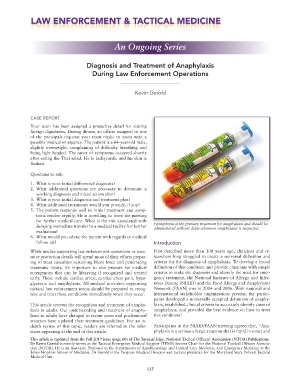
                delaying immediate transfer to a medical facility for further   Epinephrine is the primary treatment for anaphylaxis and should be
                                                                 administered without delay whenever anaphylaxis is suspected.
                evaluation?
              6.  What would you advise the patient with regards to medical
                follow up?                                       Introduction
              While medics supporting law enforcement operations or exec-  First described more than 100 years ago, clinicians and re-
              utive protection details will spend most of their efforts prepar-  searchers long struggled to create a universal definition and
              ing to treat casualties sustaining blunt force and penetrating   criteria for the diagnosis of anaphylaxis. To develop a broad
              traumatic injury, it’s important to also prepare for medical   definition of this condition and provide clinicians with simple
              emergencies that can be lifesaving if recognized and treated   criteria to make the diagnosis and identify the need for emer-
              early. These include cardiac arrest, cardiac chest pain, hypo-  gency treatment, the National Institute of Allergy and Infec-
              glycemia and anaphylaxis. All medical providers supporting   tious Disease (NIAID) and the Food Allergy and Anaphylaxis
              tactical law enforcement teams should be prepared to recog-  Network (FAAN) met in 2004 and 2006. With national and
              nize and treat these conditions immediately when they occur.  international stakeholder organizations present, the partici-
                                                                 pants developed a universally accepted definition of anaphy-
              This article reviews the recognition and treatment of anaphy-  laxis, established clinical criteria to accurately identify cases of
              laxis in adults. Our understanding and treatment of anaphy-  anaphylaxis, and provided the best evidence on how to treat
              laxis in adults have changed in recent years and professional   this condition. 1
              societies have updated their treatment guidelines. For an in-
              depth review of this topic, readers are referred to the refer-  Participants at the NIAID/FAAN meeting agreed that, “Ana-
              ences appearing at the end of this article.        phylaxis is a serious allergic reaction that is rapid in onset and
              This article is reprinted from the Fall 2017 issue (page 60) of The Tactical Edge, National Tactical Officers’ Association (NTOA) Publications.
              Dr Kevin Gerold currently serves as the Tactical Emergency Medical Support (TEMS) Section Chair for the National Tactical Officers Associa-
              tion (NTOA). He is an Associate Professor in the departments of Anesthesiology and Critical Care Medicine, and Emergency Medicine at the
              Johns Hopkins School of Medicine. Dr Gerold is the Program Medical Director and tactical physician for the Maryland State Police’s Tactical
              Medical Unit.

                                                              113

